Anthropic sues Defense Department over ban, OpenAI’s robotics leader resigns
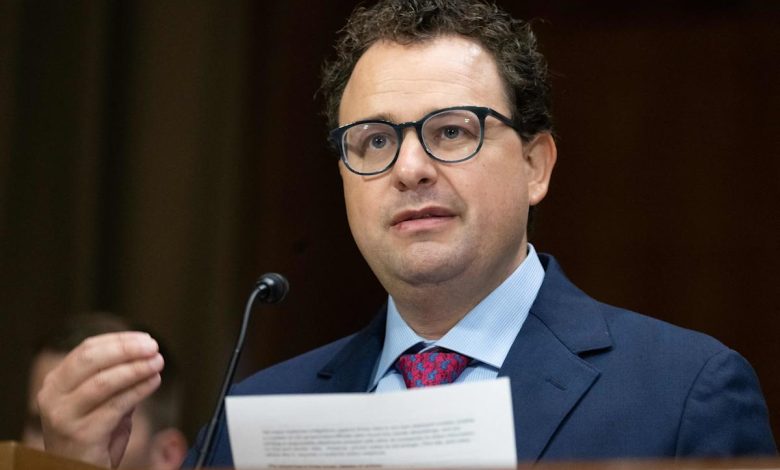
Anthropic (ANTH.PVT) sued the Department of Defense on Monday to block a ban on the company after the Pentagon labeled it a national security risk.
The lawsuit is the latest development in an ongoing clash between the artificial intelligence startup and the Defense Department, following the US government’s labeling of Anthropic as a “supply chain risk for national security.”
In a blog post, Anthropic CEO Dario Amodei vowed to fight the action, which is usually reserved for foreign adversaries, writing that Anthropic has “no choice but to challenge it in court.”
In the post, Amodei also said he resumed negotiations with the Defense Department to put a military contract back on the table. OpenAI (OPAI.PVT) reached a deal with the government last week, which elicited pushback from employees and users, including the lab’s hardware and robotics leader, Caitlin Kalinowski, who resigned over concerns about the deal with the Pentagon.
Anthropic and OpenAI were also in focus after Nvidia (NVDA) CEO Jensen Huang’s suggestion that the chipmaker’s multibillion-dollar investments in the startups could be the last of their kind for a while.
Nvidia has also reportedly halted production of China-bound H200 chips, the Financial Times reported, as regulatory efforts in Washington and Beijing have restricted imports to the Chinese market.
And earlier this week, tech watchers were also treated to a slew of product announcements from Apple (AAPL). The product release list included a new low-cost MacBook Neo computer, an entry-level iPhone 17e smartphone, two new iPad Airs, and new MacBook Air and MacBook Pro laptops with more powerful M5 chips.
Follow along for the latest updates on the tech sector.
LIVE 60 updates
-
Anthropic files lawsuit against Department of Defense
Anthropic (ANTH.PVT) on Monday filed a lawsuit against the Department of Defense and a host of other federal agencies a part of its ongoing battle with the Pentagon over the use of its AI models.
In its suit, filed in a California district court, Anthropic is seeking to overturn Defense Secretary Pete Hegseth’s decision to label the artificial intelligence company as a supply chain threat and President Trump’s move to ban the use of Anthropic’s software across the federal government.
“Seeking judicial review does not change our longstanding commitment to harnessing AI to protect our national security, but this is a necessary step to protect our business, our customers, and our partners. We will continue to pursue every path toward resolution, including dialogue with the government,” an Anthropic spokesperson said in a statement.
The blowup between the DOD and Anthropic comes after the company told the department that it wouldn’t allow the DOD to use its AI models for the mass surveillance of Americans or to develop fully autonomous weapons.
Anthropic already works with the DOD, and reports say the Pentagon used the company’s technology during its operation in Venezuela in January and in the current conflict with Iran.
But Trump and Hegseth’s announcements mean that the DOD has six months to transition to a different AI platform.
“I am directing EVERY Federal Agency in the United States Government to IMMEDIATELY CEASE all use of Anthropic’s technology. We don’t need it, we don’t want it, and will not do business with them again!” Trump wrote in a post on Truth Social on Feb. 27.
-
Amazon’s Zoox expands service as robotaxi competition heats up
Amazon’s (AMZN) Zoox unveiled new service areas to test its robotaxi offerings, the latest move in the race for robotaxi dominance.
Zoox announced on Monday morning that it is bringing its autonomous vehicle testing program to Dallas and Phoenix, expanding its footprint to 10 US markets. The move marks one of the company’s most geographically ambitious steps since Amazon acquired the startup for $1.3 billion in 2020.
Zoox crossed 1 million autonomous miles driven late last year and has served more than 300,000 riders across its San Francisco and Las Vegas operations. It currently offers free public rides in parts of both cities — around the Strip in Las Vegas and in select San Francisco neighborhoods — and plans to begin charging for rides in those markets in 2026.
Zoox’s latest move follows the industry’s trend of expanding operations across the US in a quest to see who can dominate the space.
-
Microsoft and Anthropic team up to bring Claude Cowork to Microsoft 365
Microsoft (MSFT) teamed up with Anthropic (ANTH.PVT) to bring the Claude Cowork service to its Microsoft 365 Copilot AI platform. My colleague Daniel Howley writes that the service, called Copilot Cowork, can perform tasks on behalf of enterprise users, such as building presentations, pulling data into Excel spreadsheets, and emailing co-workers to set up meetings.
Howley reports:
-
OpenAI hardware leader resigns after deal with Pentagon
Reuters reports:
-
Oracle and OpenAI end plans to expand flagship data center
Bloomberg reports:
-
Palantir faces challenge to remove Anthropic from Pentagon’s AI software
Reuters reports:
-
Anthropic ready for legal battle with Pentagon over blacklist
Bloomberg reports:
-
Betting markets facing scrutiny from lawmakers, regulators over insider trading concerns
Prediction market platforms are facing increased scrutiny and regulatory proposals after bets placed ahead of the US strikes on Iran drew suspicion of insider trading.
On Thursday, Democratic Sens. Jeff Merkley and Amy Klobuchar introduced a bill to prevent public officials from trading event contracts, as prediction markets like Polymarket and Kalshi have seen significant growth alongside reports of misconduct. (Disclosure: Yahoo Finance has a partnership with Polymarket.)
At the same time, the US Commodity Futures Trading Commission has kicked off the process to clarify event contract trading rules by sending a rulemaking plan to the Trump administration’s budget office.
Two recent incidents in particular raised suspicion over trading activity: the January arrest of Venezuelan leader Nicolás Maduro and the recent attacks on Iran. In the case of Iran, one Polymarket account with the username Magamyman, established in October 2024, made over $500,000 on a bet that the US would strike Iran by Feb. 28.
Polymarket defended its Middle East markets in a statement on its website that read, in part, “The promise of prediction markets is to harness the wisdom of the crowd to create accurate, unbiased forecasts for the most important events to society. That ability is particularly invaluable in gut-wrenching times like today.”
However, that value seemed to hit its limit earlier this week when Polymarket took down its market that allowed users to bet on whether a nuclear weapon would detonate this year. The market had drawn more than $650,000 in trading volume before it was archived after facing criticism.
-

Trump admin. considers requiring government approval for global GPU shipments: Report
The Trump administration is considering requiring global companies, and in some cases their home countries, to seek US approval before purchasing AI chips from the likes of Nvidia (NVDA) and AMD (AMD).
According to Bloomberg, the permitting process, which is still under deliberation, would depend on how many chips a company is looking to buy. Those aiming to buy 1,000 chips would face a relatively easy review, while those seeking larger shipments may have to agree to site visits by US representatives.
Companies seeking to purchase several hundred thousand GPUs would need to involve their home country’s government. Those kinds of shipments could only be made to US allies and would require the companies to make security promises and invest in American AI.
AMD stock fell more than 2% on the news, while Nvidia stock dropped more than 1%.
The rules, if adopted, would be the US’s latest step toward controlling the export of its prized AI chips. Nvidia and AMD’s processors are among the most sought-after processors in the world, thanks to their high-performance capabilities in both training and running AI models.
The Trump and, before it, Biden administrations have been working to find a way of getting America’s chips into the hands of global companies, while keeping them from ending up in rival nations’ data centers. But it’s been a difficult task.
The White House’s repeated back-and-forth with China over the use of Nvidia’s chips has pushed that country to develop its own AI chips in the hopes that it can outmaneuver the US’s grip on the high-end processor market.
-
BYD unveils second-generation Blade Battery with ‘Flash Charging’
Chinese automaker BYD (BYDDY) revealed its second-generation Blade Battery, which it said will offer “disruptive” charging speeds in extremely cold environments.
Reuters explains:
BYD also launched the world’s most powerful mass-produced supercharger, capable of 1500 kW output. These chargers will be part of the 20,000-station network mentioned above.
-
Major tech companies pledge to cover energy costs of powering AI
Executives of seven major tech firms signed an agreement on Wednesday promising to shoulder the energy costs needed to build out artificial intelligence, President Trump said after a White House tech roundtable.
Chief executives at Google (GOOG), Microsoft (MSFT), Meta (META), Oracle (ORCL), xAI, OpenAI (OPAI.PVT), and Amazon (AMZN) signed the “ratepayer protection pledge,” committing to paying for increased energy costs to power data centers and related infrastructure.
Concerns that growing AI demand could substantially raise consumer electricity bills have become a political problem for President Trump and Republicans ahead of the 2026 midterm elections, though energy affordability is a growing bipartisan issue.
According to a White House fact sheet on the pledge, tech companies will “build, bring, or buy the new generation resources and electricity needed to satisfy their new energy demands, paying the full cost of those resources whether by building, or buying from, new or otherwise additive power plants.”
While the agreement could affect how tech companies’ multiyear power purchase agreements are negotiated, it’s unclear how the terms of the pledge will be enforced.
See the video below for Trump’s comments on AI electricity use and a breakdown of the pledge from my colleague, Jennifer Schonberger.
-
Anthropic chief back in talks with Pentagon about AI deal
Anthropic (ANTH.PVT) is back at the negotiating table with the Pentagon, the Financial Times reported, after the deal between the artificial intelligence startup and the Department of Defense fell apart in a dramatic fashion last week, with promises on both sides to cut ties completely.
The Financial Times reports:
-
FT: Nvidia stops production of chips intended for Chinese market
Nvidia (NVDA) has reportedly stopped production of its H200 chips intended for China, as it no longer expects significant sales there.
According to the Financial Times, Nvidia has asked Taiwan Semiconductor Manufacturing Company to reallocate manufacturing capacity from making H200 chips to making next-generation Vera Rubin hardware.
In its latest call, Nvidia executives said they had not sold any H200 chips to Chinese customers yet. Although President Trump indicated Nvidia would be able to sell its second-most-powerful chip to China in January, the move suggests that the company expects additional regulatory barriers in Beijing and Washington to impede sales.
“While small amounts of H200 products for China-based customers were approved by the US government, we have yet to generate any revenue, and we do not know whether any imports will be allowed into China,” Nvidia CFO Colette Kress said on the earnings call.
Nvidia had lobbied the US government to be able to sell the H200, which was marketed as being compliant with export controls. The FT previously reported that Nvidia had expected Chinese clients to order more than 1 million units and had been ramping up supply accordingly.
-
Report: OpenAI in early talks to partner with Trade Desk
-
Anthropic chief back in talks with Pentagon about AI deal
-
Broadcom posts Q1 beat and strong outlook but fails to impress investors
Chipmaker Broadcom (AVGO) reported its first quarter earnings after the bell on Wednesday, beating expectations on the top and bottom lines and offering a better-than-anticipated Q2 outlook.
But that wasn’t enough to satisfy an already anxious Wall Street. Broadcom stock was largely flat on the news.
For the quarter, the company saw earnings per share (EPS) of $2.05 on revenue of $19.31 billion. That topped analysts’ estimated EPS of $2.03 and revenue of $19.26 billion.
For the second quarter, Broadcom said it sees revenue of about $22 billion. Wall Street was expecting $20.5 billion.
The company also approved a new $10 billion share buyback.
“Broadcom achieved record first quarter revenue on continued strength in AI semiconductor solutions,” CEO Hock Tan said in a statement. “Q1 AI revenue of $8.4 billion grew 106% year over year, above our forecast, driven by robust demand for custom AI accelerators and AI networking.”
Tan added that AI revenue growth is accelerating and that the company anticipates Q2 segment revenue of $10.7 billion.
The AI trade has had a rocky start to the year with investors questioning Big Tech’s massive investments in the technology. But at the same time, announcements from Anthropic (ANTH.PVT) and OpenAI (OPAI.PVT) have rocked software stocks, as analysts raise concerns about whether AI will crush existing industries ranging from software-as-a-service companies like Salesforce (CRM) to cybersecurity firms like CrowdStrike (CRWD).
-
Nvidia CEO Jensen Huang says OpenAI investment finalized at $30 billion
Nvidia (NVDA) CEO Jensen Huang said that the AI kingmaker has finalized its agreements with OpenAI (OPAI.PVT) and Anthropic (ANTH.PVT), which he said will likely be the last investments in those startups for the foreseeable future.
“We’re going to invest $30 billion in OpenAI,” Huang said at the Morgan Stanley Technology, Media and Telecom Conference on Wednesday.
“I think the opportunity to invest $100 billion in OpenAI is probably not in the cards. And the reason for that is because they’re going to go public. And so this might be the last time we’ll have the opportunity to invest in a company like this. And our $10 billion investment in Anthropic, probably will be the last as well,” he added.
Nvidia announced its tentative plans to invest upward of $100 billion in Sept. 2025, saying that the partnership would allow OpenAI to deploy at least 10 gigawatts of Nvidia systems, with the first gigawatt originally scheduled to go online in the second half of this year.
But Nvidia later clarified that the $100 billion announcement was a letter of intent and not set in stone.
The company is now joining SoftBank, which will invest $30 billion, and Amazon (AMZN), which will invest $50 billion, to fund OpenAI’s growth.
-
CPUs are suddenly hot again
The AI explosion has meant that GPUs (graphic processing units) have dominated data centers across the world. Hyperscalers, neoclouds, and everyone in between have been splashing billions to get their hands on the high-end chips to train and run their AI models.
That left the humble CPU (computer processing unit), which powers virtually everything else in data centers, and thus the applications and services you use every day, out in the cold.
But that’s starting to change. Earlier this month, Meta (META) and Nvidia (NVDA) announced an expanded deal that will see Nvidia provide the social media company with the largest deployment of its Grace CPU-only servers to date.
And just last week, AMD (AMD) announced its own deal with Meta, which includes servers running the company’s Venice and next-generation Verano CPUs.
It might sound counterintuitive for CPUs to grab some of the spotlight amid the global AI buildout, but in a world where AI inference and agentic AI are becoming increasingly important, CPUs, it turns out, are primed to shine.
“It’s not a zero-sum game,” explained Dan McNamara, senior vice president and GM of compute and enterprise AI at AMD.
“CPUs are growing, but GPUs are not slowing down, because there’s more and more workloads.”
-
BofA tabs Tesla the ‘current leader’ in autonomy, and soon robotaxis
Bank of America reinstated coverage of Tesla (TSLA) with a Buy rating and bullish outlook on the company’s robotaxi and autonomous efforts.
In a long and wide-ranging note, analyst Alexander Perry gave Tesla a $460 price target, based on the investment bank’s sum-of-the-parts analysis. Perry picked up Tesla and BofA’s auto coverage after longtime analyst John Murphy left the firm.
Tesla shares rose 3% in early trade.
“We view [Tesla] as the current leader in consumer autonomy,” Perry wrote. “We expect TSLA to quickly become a leader in robotaxi services, given its ability to scale more profitably than competitors.”
Perry predicts autonomous vehicles and robotaxis will usher in the next era of mobility and be the “most significant change agent” in the Auto 2.0 landscape, with Tesla at the forefront.
-
OpenAI is developing alternative to Microsoft’s GitHub, The Information reports
OpenAI (OPAI.PVT) is developing its own version of GitHub, the code-hosting platform owned by Microsoft (MSFT), The Information reported on Tuesday.
The project marks the latest example where OpenAI could compete directly with Microsoft, which has a large stake in the AI startup.
The project is still in its early stages and will likely take months to complete, according to The Information. Once completed, OpenAI is considering making the code platform available to customers for purchase.
The report stated that OpenAI engineers began working on the project after encountering increasing service disruptions that led to GitHub downtime in recent months.