Robert Califf says political influence is a ‘serious problem’ at FDA| STAT
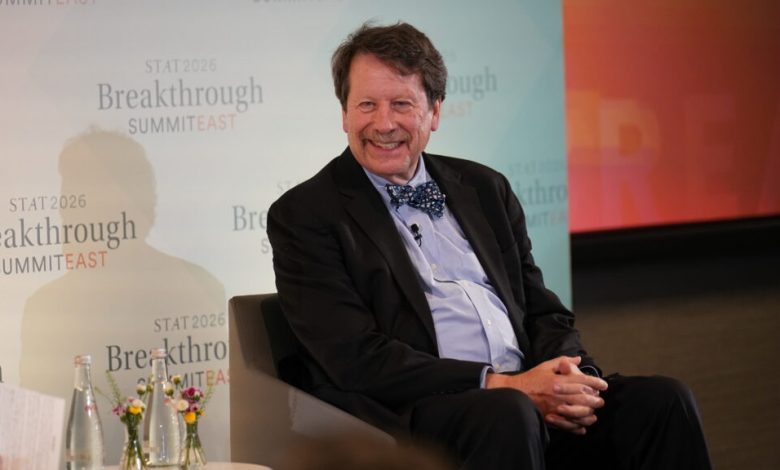
Hundreds of individualized treatments for rare diseases could become available over the next decade — but only if government regulators handle the new therapeutics properly.
At least that’s how Robert Califf, former commissioner of the Food and Drug Administration, sees it, he said at STAT’s Breakthrough Summit East on Thursday. New bespoke gene therapies, which may only treat a small number of patients, could hold great promise in the aggregate, he suggested, if the agency can properly assess them.
“But if we don’t get this right, we could end up in a dead end that sets things back by a number of years,” he said.
And that’s just the beginning of the opportunity — or peril — ahead for the agency, he said. But the future of the agency, as well as its current responsibilities, is at risk, Califf said, because of upheaval under the Trump administration — which has been driven by political goals upending business as usual.
“What’s changed now is that there’s a view in this administration that everything is political,” he said. “What’s happening now is [health secretary Robert F. Kennedy Jr.] decides the policy, and then scientists are dispatched to get the right answer, which is the one that he wants, and if not, you’re fired.”
Trump administration officials have previously defended their actions, arguing they rely on “gold-standard science” to make decisions, and that they are bringing transparency and objectivity back to health care. HHS officials did not immediately respond to request for comment.
But Califf, who served as commissioner in the Obama and Biden administrations, said some of the changes being made by Trump officials could threaten independent science. Offering bonuses for government employees reviewing drugs faster, as FDA leaders have planned, isn’t a good idea, he said. The timing of drug reviews is part of a “finely tuned machine,” he said, which could be disrupted by monetary incentives. And removing animal testing could create worse data on medicines’ safety and efficacy, he said.
Califf also said he worries that politics is seeping into the agency, and that outsiders are attempting to exert influence on the regulatory process.
“If someone can have a dinner at Mar-a-Lago and impact that decision, that’s really a serious problem,” he said.
Still, Califf doesn’t want the agency to stand still as new opportunities and needs emerge. Artificial intelligence, for instance, could allow evidence generation at “a much faster rate,” if used appropriately, he said.
And the federal government should step up, he argued, to consider how drugs are working — medically and economically — after they’re approved. The venture could include the major sub-agencies of HHS, which focus on disease control, research, insurance coverage, economics, and safety and efficacy.
But at least one aspect of the Trump administration got praise from Califf: the leadership of Chris Klomp, who spoke earlier in the day at the summit.
“I would go to work for that guy … he’s very impressive,” Califf said. “I really liked what he had to say, but there’s a dissonance between what he was saying and what the situation is at FDA.”
The former commissioner’s comments come amid ongoing turbulence at the FDA. This week, the agency’s top infectious disease regulator announced his departure. That comes weeks after Vinay Prasad, another top official, announced his departure, his second time leaving the administration.
Unexpected decisions from the agency on vaccines and rare disease drugs have worried leaders of pharmaceutical and biotech companies, who fear instability at the agency — and political considerations overriding scientific ones — could be detrimental to their business.
Some industry leaders have begun lobbying the White House and Congress to get favorable decisions at the agency, shifting longstanding rules of engagement between the industry and government.
“If FDA were a company … everybody would be shorting the stock,” Stelios Papadopoulos, chairman of the board of biotech company Exelixis, Inc., said earlier at the summit. “It’s beyond scary.”
Credit: Source link