Colombian college student Gabriela Alonso Jaramillo explains her country’s politics to the apolitical
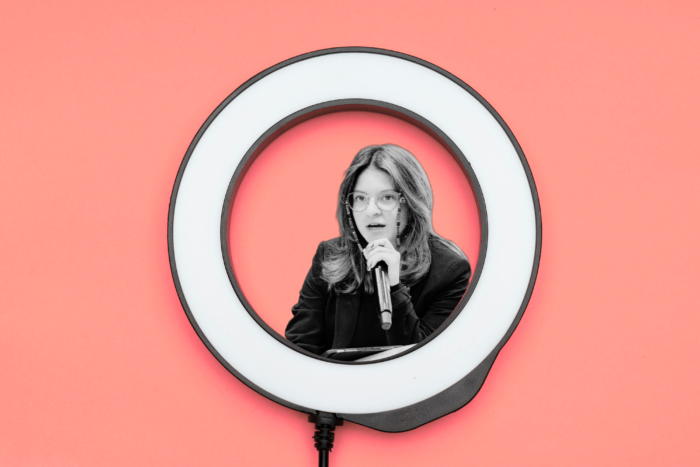
The data is in: News creators and influencers are a major source of news for Americans, especially people under 30. This is the third edition of Creators of Record, an occasional series of interviews with popular creators about how they do their jobs.
In Colombia, Gabriela Alonso Jaramillo is an anomaly. In a country where polarization is rising and youth voter turnout is low, she says she’s the only one in her group of friends who cares about local and national politics. The 23-year-old public affairs and political science double major at the University of the Andes in Bogotá was alarmed when a classmate in her political science major told Alonso that she aspires to be apolitical.
“I, as someone who studies the same major, wondered how she could say that,” Alonso said.
After Alonso worked on a local political campaign in 2023 and saw how candidates courted (or didn’t) youth voters, her friend’s feeling made more sense. Politics feels inaccessible to many young people, Alonso realized, and most politicians don’t understand how to reach them in genuine ways. She started a TikTok account called Política para apolíticos (Politics for the Apolitical) where she explains Colombian politics in a clear, straightforward way. Her goal is to help viewers understand how government and power works in the country.
Alonso’s videos are educational explainers that range from breaking down the day’s major stories to spelling out how institutions like the Supreme Court and Congress work.
“The first thing they tell us [in my public affairs major] is that you are going to govern for the people and you must understand that people don’t understand exactly what you understand,” she said. “You have to find a way to translate for that person so they can understand what you are doing.”
Today, Alonso has nearly 300,000 followers on TikTok and 58,000 on Instagram. According to the Reuters Institute for the Study of Journalism, she is one of the most followed news creators in Colombia. Many of her videos garner hundreds of thousands of views, and she routinely goes viral. She doesn’t think of herself as a journalist, though she writes a weekly column for El Espectador, one of Colombia’s largest newspapers. She hopes to run for Congress one day.
Alonso makes her videos relatable and fun in an attempt to get young people informed about and interested in politics and to build trust. She doesn’t assume any prior knowledge on her audience’s behalf. When she mentions the Constitution, for instance, she calls it “a rule book for Colombia” and flashes an image of the “Da Rules” book from the animated series Fairly Oddparents.
“If Peppa Pig were president of Colombia in 2026, these are the most important issues she would face,” Alonso said in one January video. There, she highlighted the country’s most pressing problems using the cartoon pig. She flashed graphics of Peppa Pig wearing an army uniform to talk about security, Peppa Pig holding a broken piggy bank to talk about the economy, and Peppa Pig wearing scrubs and a surgical mask to talk about healthcare.
In another video, she used characters from Gossip Girl to illustrate the different types of power in Colombia and how each one impacts politics and public policy.
As Colombians head to the polls at the end of May to elect their next president, Alonso wants to make sure they have all the information they need. FIFA World Cup sticker albums are wildly popular in Latin America, so she designed her own album and trading cards, featuring the presidential candidates instead of soccer players. She uses the album as a prop in her videos, and commenters ask where they can buy it.
Alonso and I chatted in February via Zoom about her political savvy, how she keeps herself informed, and the tension between content creators and legacy journalism in Colombia today.
Our conversation below has been translated from Spanish to English, and edited for length and clarity.
Hanaa’ Tameez: Why did you start Política para apolíticos?
I feel like there’s a pattern: When [politicians] are campaigning, they need us young people, and when they get elected, they completely forget about us. So I said, “How cool would it be to have a more active youth, that participates more in democracy and, above all, is more informed?” In Colombia and in many other countries, the population that most abstains from voting is young people.
That was the main reason, and the other is that since we were in regional elections [when I started in 2023], there was a lot of information, but also disinformation. It was very difficult to find candidates’ proposals and platforms without bias, without disinformation, without attacks. And that’s what I aimed for.
Tameez: Why do you think this work is important right now?
Alonso: In Colombia, we are in a very difficult political moment. I think this year is going to be fundamental for what happens a few years from now, and I think that since we have so much access to social media, there is so much misinformation that does a lot of damage to democracy. It’s essential that people can have a medium where they say, “I feel comfortable with what they are saying here because I don’t feel like they are trying to indoctrinate me or impose a political position on me.”
Tameez: Why was it personally important for you to do this work?
I really like politics, I really like the public sector. Someday I would like to be a congresswoman, to be able to make laws in the country, and I think it is necessary because the Congress of the Republic, which is where laws are made, is precisely the institution that Colombians trust the least.
Hanaa’ Tameez: How did you define your niche?
Alonso: A classmate in my political science major told me, “I’m going to be apolitical.” And I, as someone who studies the same major, wondered how she could say that. It is also a debate whether apolitical people exist or not, but I think it is a population that no one had spoken to and I think it is a group that can be decisive in an election if they’re informed and if they vote correctly. I didn’t really know how many apolitical people were out there until the account grew and the reception has been huge. Obviously not as many people who consider themselves apolitical follow me anymore. There are some who do and they tell me, but there are others who are super informed and still like the videos. So I think the niche has been expanding, but how cool that there are people who feel comfortable that they won’t be treated badly because they don’t understand something.
Tameez: Tell me about your production process. Where do your ideas for videos come from?
It’s also about knowing how to read the moment. When I see that everyone on TikTok is talking about a topic, a video on that topic is going to catch on.
[But] there are topics that people are not interested in that might seem super important to me. There were two videos that I thought were going to go viral, and nope, people did not care. The former chancellor of Colombia wrote a letter accusing [President Gustavo Petro] of consuming drugs and going AWOL for three days on a trip to Paris. I thought this was a scandal. I made that video and it didn’t do as well as I thought [it would].This other video, to this day I still don’t understand [why it didn’t go viral]. It was leaked that the FARC dissidents were in contact with the army and that they were getting information, money, routes to pass through so they wouldn’t be caught. And I I kept saying this was a scandal. How is it that our army has ties with an armed group? The video got 30,000 or 40,000 views, which is very little for what I am used to.
Tameez: Why do you think they didn’t catch on?
Alonso: I think they didn’t become as big of a scandal as they should [have]. Maybe the media didn’t make such a big fuss about it. I don’t know. Honestly, it’s hard for me to understand.
Tameez: How long does it take you to script, edit, and publish a video?
Alonso: It depends on the video. A short, easy one can [take] 10 to 12 hours. There was one I had to make that was super complicated, explaining the pension reform. It took me a month.
Tameez: Why?
Alonso: I mean, because if I don’t understand it myself, how am I going to make someone else understand it?
Tameez: How do you find information for your videos?
Something else I do a lot, which I think is super important, is that I follow all the elected politicians, because each one explains what happened using their own language. They might say, “It’s terrible the labor reform collapsed. It attacks the workers.” That is already a political position. Another one says it’s good that it collapsed because it wasn’t economically viable. In other words, understanding the language of politicians is also essential in creating content, because I always show both sides — the good and the bad — and I take it from what they themselves express.
Tameez: How do you verify the information in your videos? What is your fact-checking process?
I also rely heavily on artificial intelligence. I think there are a lot of people who demonize it, but I believe that if you use it well, it’s your right hand for anything. If I write a script, I tell it “You are a ten-year-old boy, tell me if you understand [this].” It helps me with metaphors and with data.
Tameez: I saw a video you posted where you said something like “If it’s in the Constitution…” and then you explained what the Constitution is.
There are people who seriously know nothing. You take for granted that people know things. My video explaining the difference between government and State got, like, 200,000 views. I feel like the first mistake is [assuming] that people understand or that people know. People love things explained simply, like with playdough and doodles.
Tameez: Who is your audience?
The majority [63%] are women and 37% are men. The only ones who correct me or leave comments are men. They make comments that my voice is too deep, that I look a certain way, that this is wrong, blah blah blah.
Tameez: How does that affect you?
Currently, in Colombia, there is a humanitarian crisis. There is a massive security crisis in the municipalities and main cities. Armed groups are also out of control. An Indigenous senator was kidnapped. Last year Senator Miguel Uribe was assassinated.
At this moment, I might be a public figure, but I am not a politician. But the day I get into politics, I’m going to worry more. For those who are in politics in Colombia, there are no security guarantees.
Tameez: How is your relationship with your audience?
Alonso: I always reply to the comments on TikTok. The vast majority of my comments are thanking [viewers] for taking the time to watch the video, because I know it’s not the most interesting one [on the internet]. When there are funny comments, I reply to them, too. I have about 800 people on Instagram Close Friends. I try to post both political stuff and personal stuff [there], like what I’m watching. Right now, since we are in elections, there are a lot of campaign billboards, so I take pictures of them and do polls for people to vote whether they like them or not.
Tameez: How has this changed your relationship with social media and information consumption? How do you manage to disconnect? Because making videos isn’t your full-time job.
Alonso: It’s a hobby [laughs]. I set aside an hour at night to turn off my phone. I think it’s too addictive. I try to keep a certain distance because it’s very harmful to mental health. Especially X, I think it’s the worst.
Tameez: As a student and a news creator, how do you sustain yourself financially?
Alonso: Honestly, my parents pay for everything. I think I am very privileged in that sense. They pay for my education, which isn’t cheap either. In my previous job, the money I made was for my personal use. I bought a new cell phone with it. But well, I quit, so there is no more money coming in.
Tameez: Is Politica para apoliticos a profitable hobby?
Alonso: I have never received a single peso for any video.
Tameez: Nothing?
Alonso: Nothing. The agencies that hire influencers almost always have a policy barring someone who talks about politics, religion, or sexuality. That doesn’t work for me. Sometimes people want to offer me money to speak well of a candidate, and I know that if I do that, it goes completely against the project.
Tameez: What are some of the unexpected costs?
Alonso: The ring light, the microphone. I have a DJI camera, which is quite expensive. Since we’re in the middle of election season, I’m going to make a World Cup-esque album, but for elections. It cost me USD $500 to have the album made.
Tameez: How has your view of legacy media in Colombia changed since you started Apolíticos?
I believe traditional [journalists] have to stop attacking influencers and content creators and instead seek alliances, to find a way to spread information quickly, to read the audience. I believe they need each other to know how to reach the new generations that don’t consume print newspapers, that don’t watch news programs.
Tameez: What lessons do you think traditional journalism can learn from content creators like you, and vice versa?
And what can we learn? I think that there are still many content creators who are intentionally sensationalists. They intentionally misinform because they only care about views and engagement. If they don’t take seriously what they do, well, it’s their problem, but they are misinforming and creating a crisis in the trust that a person has with the media and with how they get informed. For example, people consider my TikTok account to be a news outlet. For me it’s a TikTok account, but there are people who consider it a media outlet and I could go out and misinform if I wanted to and I’m sure that many people would believe me.
Tameez: What challenges do you see for news creators in 2026?
Alonso: I think the main one is financing. I think it’s very difficult to sustain yourself without having to sell out, without having to speak well of X or Y thing because they are going to pay you.
Tameez: How has Apolíticos changed your career path?
Alonso: I don’t know how long Apolíticos will last. I don’t think it can last a lifetime, because if one day I run for Congress, I don’t know how coherent it will be for me to be a congresswoman and defend some things, and come out in a video doing others. I think there won’t be enough time. I don’t think it’s a financially stable project. But work-wise it has opened many doors for me so I’m also very grateful for that.
Credit: Source link