Japan’s Nikkei slips, S&P 500 and Nasdaq futures fall, Euro Stoxx 50 futures dip

Ueda’s remarks bolstered the yen, dragged the Nikkei down by 1.89 percent, and lifted Japanese government bond yields to their highest levels in 17 years
Stocks across the Asian market slipped on Monday following a strong finish to November, as the Japanese yen rebounded and government bond yields in Japan rose to their highest levels since 2008.
Investor focus remained on the yen, which strengthened to 155.55 per U.S. dollar after Bank of Japan Governor Kazuo Ueda offered the clearest indication yet that an interest rate hike could be forthcoming. In a speech to business leaders, Ueda said the central bank would weigh the pros and cons of raising rates at its upcoming policy meeting in two weeks.
Following a strong equity rebound in November, driven in part by investors brushing aside concerns over a potential AI bubble, traders are now searching for new catalysts to sustain momentum, with this week’s focus squarely on incoming economic data.
Asian shares dip as focus remains on yen
In the Asian stock market, MSCI’s broadest index of Asia-Pacific shares outside Japan eased 0.09 percent on Monday, after posting almost a 3 percent weekly gain last week, its first rise in four weeks.
Ueda’s remarks bolstered the yen, dragged the Nikkei down by 1.89 percent, and lifted Japanese government bond yields to their highest levels in 17 years. The two-year Japanese government bond (JGB) yield, which is most sensitive to the Bank of Japan’s policy rate, climbed 3 basis points to 1.02 percent, while the 10-year yield rose 7 basis points to 1.87 percent, marking their highest levels since June 2008.
Investors have been closely watching the yen in recent weeks, uncertain about the timing of the next rate hike and wary of fiscal policies under Prime Minister Sanae Takaichi.
South Korea’s Kospi eased 0.16 percent. Meanwhile, Hong Kong’s Hang Seng rose 0.50 percent.
U.S. stock futures slide
In the U.S. stock market, futures fell, with S&P 500 futures down 0.67 percent and Nasdaq futures 0.85 percent lower. Investor attention this week is set on U.S. economic data covering manufacturing and services activity, along with consumer sentiment.
If the figures point to a slowdown without signaling a recession, market sentiment would likely stay positive, while the U.S. dollar could weaken, following its usual seasonal pattern.
The dollar index, which tracks the U.S. currency against six major peers, stood at 99.414, largely unchanged for the day. The index has fallen 8 percent so far this year, with the bulk of the decline occurring in the first half.
Investors are eyeing remarks from Federal Reserve Chair Jerome Powell later in the day for hints on the central bank’s plans ahead of next week’s meeting. Markets are currently pricing in an 87 percent chance of a rate cut, following a series of dovish comments from policymakers in recent days. Traders are also focused on holiday consumer spending, as sales data from Black Friday and Cyber Monday gradually emerge.
European stock futures slip
In the European stock market, Euro Stoxx 50 futures dipped 0.48 percent, while DAX futures fell 0.56 percent. Cryptocurrencies also tumbled, as both bitcoin and ether slipped more than 5 percent, underscoring waning risk appetite among investors.
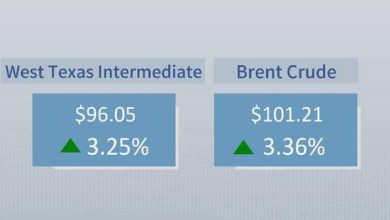
In commodities, Brent crude futures were up $1.27, or 2.04 percent, at $63.65 a barrel, while U.S. West Texas Intermediate rose $1.23, or 2.10 percent, to $59.78.
In the precious metals market, spot gold gained 0.47 percent to $4,239.02 per ounce as of 6:52 GMT, after touching its strongest level since October 21, while U.S. gold futures for February delivery edged up 0.28 percent to $4,266.90.
Silver jumped 0.38 percent to $56.94 per ounce after hitting an all-time high of $57.86 earlier in the session. Platinum surged 0.70 percent to $1,684.20 and palladium gained 0.44 percent to $1,456.80.