Power Metallic Mines expands land package in Quebec – ICYMI
Power Metallic Mines Inc (TSX-V:PNPN, OTCQB:PNPNF) CEO Terry Lynch talked with Proactive about the company’s latest exploration activities and expansion plans.
Lynch explained that the company has significantly increased its land package at its Nisk polymetallic project in Quebec, now holding seven of eight key targets that could define a new district comparable to Sudbury, which hosts 33 mines.
Proactive: Terry Lynch is joining us now. He’s the CEO Power Nickel and the also the newly listed Power Metallic Mines. Welcome, Terry. Good to see you.
Terry Lynch: Good to see you as well.
So, first off, for those not familiar with Power Metallic, what’s the story? Why the new listing?
Well, Power Metallic Mines is a spin-out from Power Nickel. At Power Nickel, we had amassed quite a valuable collection of non-nickel assets — including VMS, molybdenum, uranium, and lithium. As we started to drill and get results, we realized these assets deserved their own vehicle. So, we listed Power Metallic on the TSX Venture and OTCQB to unlock their full value.
Let’s talk about the copper side of the story. You’ve made some significant land moves lately.
That’s right. We now have control over seven of the eight borehole EM targets in the area. These targets were identified using borehole electromagnetics — it’s a high-conductivity tool that helps us pinpoint where the mineralization might be. By locking down that land, we’ve massively improved our chances of a meaningful discovery.
What’s your vision for the area? Do you see district-scale potential?
Absolutely. We’re thinking in terms of a Sudbury-type play. Sudbury has 33 mines and counting. We think the ground we now control gives us a real shot at building something of that scale. It’s early days, but the pieces are there: multiple targets, proven mineralization, and new drilling success.
And you’re drilling now?
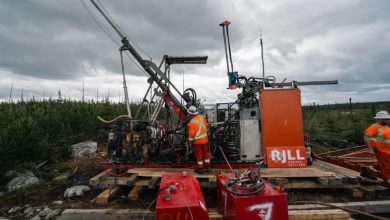
Yes, we’ve got four rigs turning — two helicopter-supported and two land-based. We’re doing about 2,000 meters a week. The plan is to drill 20,000 to 25,000 meters by mid-September, then another 25,000 by year-end. That’s a 50,000-meter program in 2024 alone.
What’s the total drill target?
We’ve mapped out a 100,000-meter program — and we’re funded for it through 2026. The team is excited. This is a rare opportunity to do exploration at scale, and we’ve got the budget and structure to support it.
How are you choosing your drill targets?
The borehole EM is key. Instead of just drilling blind, we can “see” 150 meters around the hole. That gives us a tremendous advantage. It’s like lighting up the underground in 3D. We’ve had about a 50% success rate hitting sulfides so far — that’s a strong number in exploration.
What about metallurgy — are you able to extract what you’re finding?
We’re working on that now. The metallurgy team is testing recoverability of the sulfide mineralization. That work should wrap up in the fall, and we’re optimistic the results will confirm strong economics.
When can investors expect assay results?
Assays should start flowing in mid-August and then we’ll be reporting every two to three weeks. That gives us a consistent news stream — perfect for driving interest and keeping people informed over the next 18 months.
Quotes have been lightly edited for clarity and style