Stock market today: Live updates
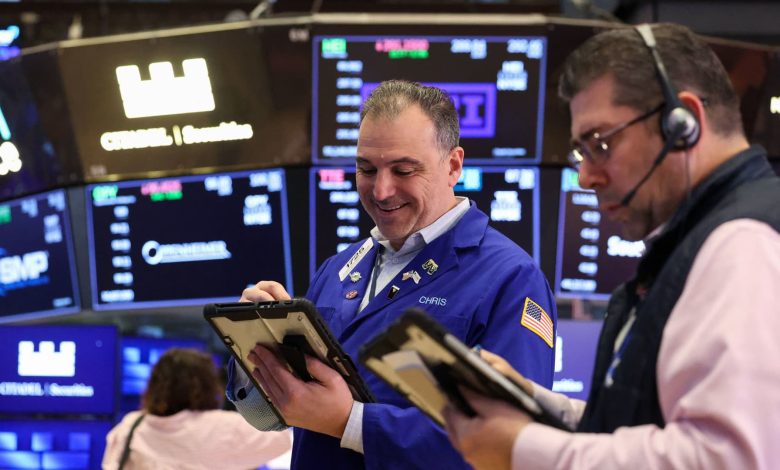
Traders work on the floor at the New York Stock Exchange (NYSE) in New York City, U.S., April 8, 2026.
Brendan McDermid | Reuters
The S&P 500 rose slightly on Friday, with the index on pace to post a solid weekly gain, as traders kept an eye on the fragile two-week ceasefire between the U.S. and Iran.
The broad market index traded up 0.1%, while the Nasdaq Composite moved higher by 0.5%, bolstered by gains in key semiconductor stocks such as Nvidia and Broadcom. In contrast, the Dow Jones Industrial Average slipped 158 points, or 0.3%.
With the S&P 500’s move, the index has jumped nearly 4% this week, tracking for its best week since May. The Dow has gained more than 3% week to date, while the Nasdaq is on pace to rise almost 5%.
Inflation was top of mind for investors this week as they assessed a number of key reports amid concerns that rising energy prices spurred by the conflict in the Middle East would ripple through the U.S. economy.
March’s consumer price index report showed that inflation was in line with expectations, standing at 0.9% for the month and 3.3% on an annual basis. That incorporated a 10.9% jump in energy costs due to the conflict.
When excluding energy prices, however, the report revealed inflation was tame last month. Core CPI increased just 0.2% for the month and 2.6% compared with a year ago, coming in below expectations. Inflation had been sticky at 3% heading into the U.S.-Iran war.
Nevertheless, the war has still led to a jump in inflation fears. According to a University of Michigan survey released Friday, consumers are anticipating that inflation will jump to 4.8% over the next year. That’s up a full percentage point from March’s reading.
“Since the Hormuz chokepoint was closed for an extended period, we should expect another one or two hot inflation prints, driven by transportation services and some durable goods categories. The second order effects will likely add another 0.2 over the next few months,” said by Jeffrey Roach, chief economist at LPL Financial. “The Fed clearly is on hold for the next several meetings.”
President Donald Trump on Thursday warned that Iran should not charge fees to oil tankers that are traveling through the Strait of Hormuz, writing in a post on Truth Social: “They better not be and, if they are, they better stop now!”
Oil prices increased a bit as concerns around the strait’s reopening hovered over the market. West Texas Intermediate crude futures were last trading above $99 a barrel, and international benchmark Brent crude futures were last above $96 a barrel.
In the prior trading day, oil prices came off their highs of the day, while the S&P 500 rose after Israeli Prime Minister Benjamin Netanyahu said that the country had agreed to negotiate with Lebanon “as soon as possible.” Tehran’s parliamentary speaker Mohammad Bagher Ghalibaf cited Israel’s continued attacks on Lebanon as a violation of the ceasefire agreement between the U.S. and Iran.
Israel has also faced pushback from other nations for its actions against Lebanon. British Prime Minister Keir Starmer recently called Israel ordering strikes on that country “wrong.” He has also said that he is “fed up” over energy bills in the U.K. moving up and down as a result of actions made by Trump and Russian President Vladimir Putin.
Trump on Tuesday evening agreed to a two-week extension of his deadline for Iran to reopen the strait — a move that sent the major averages surging more than 2% on Wednesday, with the Dow notching its best day since April.
The Middle East conflict, which has been going on for nearly six weeks, resulted in the closure of the key waterway.