Real ‘code red’ in AI is in college grad job market: Sen. Mark Warner
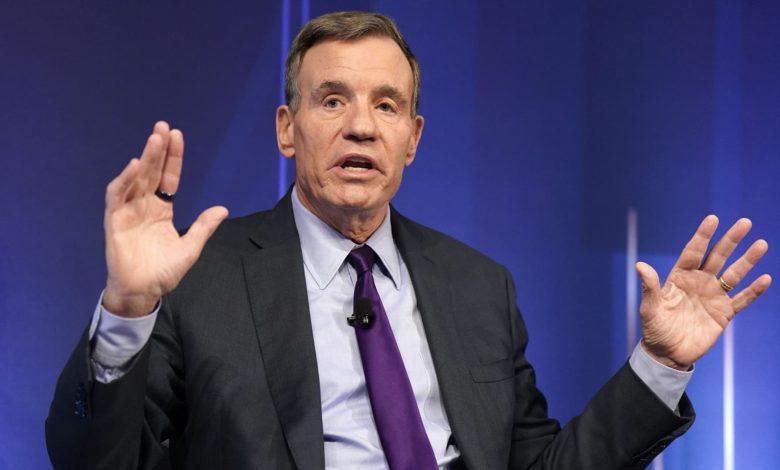
Unemployment among recent college graduates hit 9% in November, but that will seem like a low jobless rate among young Americans in the years ahead if government and industry do not begin to proactively address the risk of AI job displacement, says Democratic Senator Mark Warner of Virginia.
Speaking at the CNBC CFO Council Summit in Washington, D.C., on Wednesday, Warner told CNBC Senior Washington Correspondent Eamon Javers that he fears the unemployment rate among recent college grads could reach 25% over the next three to five years if the AI issue is not addressed. Warner is working with Republican Sen. Josh Hawley of Missouri on an effort to require data collection on AI-linked job losses. Warner said his biggest fear is not related to the recent layoffs from the corporate sector, but the jobs that will never be created.
“What I am more worried about than the recent announcements, the 15,000 or 14,000 job losses at the big tech companies, is the job dislocation that takes place in terms of jobs not being created in the first place,” Warner said. “Many big banks have shared with me they are cutting interns and first-year hires in half, and planning to do so next year too.”
“I think that number could go to 25%,” he said of the joblessness among recent college graduates.
In addition to the widespread frustrations among this cohort of young Americans entering the workforce, after having spent hundreds of thousands of dollars on college financing, “We will have a lot of parents pissed off,” Warner said. “I don’t think we have our arms around this,” he added.
He said efforts in recent years to proactively deal with the looming jobs crisis have backfired.
“If we go way back in time to four years ago, the answer was to make everyone a coder, and that was not the right solution set,” he said.
Warner’s goal is to develop a way to measure the impact of AI on job losses over the next five years, working with companies, and not necessarily only tech companies, to measure the AI impact. If collaboration between government and industry does not occur, or isn’t successful, Warner says his fear is that “we could end up with kind of an anti-innovation populism coming from both the left and right.”
“It will be a tough, tough policy issue,” he said. But he added that getting it wrong is not an option given polling data that shows how worried the majority of Americans in the 20 to 30 age range are about AI. “The numbers are stunning,” he said.
Warner stressed there will ultimately be jobs created by AI, and it will “add enormously to productivity,” but an interim program is critical to get the job transition period right. “I think there will be a whole new raft of AI-centric jobs created, but I think there will be this gap period,” he said. “I am making a major bet as someone trying to get rehired now as a senator this will be an issue in 2026, and even much more so in 2028, the issue of our time,” he added.
AI is becoming a more popular choice of college major.
Warner’s preference is to engage with industry rather than have a government-designed program for data collection, but he conceded it won’t be easy to bring all the relevant parties together. There are questions over whom to involve, between the big banks and accounting firms, the AI platform companies, and the chip makers, but he insists that “sorting that out will be one of the biggest policy issues of the next few years.”
“We’ve got to get the data set … which will be hard, but I think we can get there,” Warner said.
The technology sector will have to bear some responsibility, and “the folks who really upset me,” he said, are the figures within tech who say it is not their problem and 50% of the population will need to be provided a universal basic income and the government will have to pay for it.
In his view, the social media industry regulatory failures are a cautionary tale.
“The government record of getting this stuff right is pretty awful,” he said, referring to the 2017-2018 period of attempts to put guardrails on social media. There were many hearings, but ultimately, “We did none of it,” Warner said. “If we look back, most parents would say if we put in some guardrails we might have a lot healthier generation of young people, and that will be tiny compared to AI disruption,” he said.
“I am a tech guy, pro-growth and pro-innovation,” said Warner, who was a venture capital investor and telecommunications executive before becoming a senator. “There is not an obvious answer. The well-intentioned answer was to go become a coder … we were wrong,” he added.
Warner said other proposed solutions for what could hit the white-collar job market don’t inspire confidence yet either. “CEOs constantly say one thing is we will have this great growth of traditional skills jobs which used to be called trades, and I think there will be, but when we get to the point of asking how many of you are encouraging your daughter or son to be a carpenter, no one raises their hand. We will have to do more than lip service,” Warner said.
Speaking in a separate interview with CNBC senior finance and banking reporter Leslie Picker later in the morning at the Summit, former U.S. Treasury Secretary Robert Rubin said recent estimates that AI could wipe out 50% of white-collar jobs, or over 50% of all works hours, do not need to be precisely correct to be directionally correct about the magnitude of the issue. He said during his tenure as Treasury Secretary in the Clinton Administration, there was a plan proposed alongside NAFTA to proactively deal with job dislocation through a combination of retraining and social safety nets, but once the Democratic Party lost Congress, the ideas were never implemented.
AI job displacement, Rubin said, is a “vast multiple of that problem.”
“We do not have the public programs and we need them imperatively,” said Rubin, who has been working with an AI tutor twice a week for over two years to learn more about the technology. But he added that he doubts in the current political environment the U.S. can do what is needed.
“Whether that 50% number is right or wrong, the more you know about AI, the more I think replacement of human effort by AI is very substantial and we should be dealing with it, but we’re not,” Rubin said.