Analysis: The dangers of the Trump administration using faith to justify its war
American presidents have long sought God’s benediction in wartime and for soldiers heading into the fire of battle.
But the Trump administration’s willingness to imply divine endorsement of its authority and to cloak its war in Iran with faith-based righteousness threatens to erode yet another long-held political tradition.
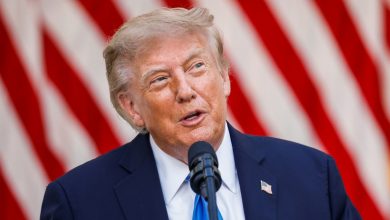
Defense Secretary Pete Hegseth frames his briefings with scripture and presents America’s troops as almost spiritual warriors. President Donald Trump posted an AI image of himself as a Christ-like figure on social media. And Vice President JD Vance rebuked Pope Leo XIV’s understanding of theology after the pontiff warned that God doesn’t bless those who drop bombs.
Such rhetoric is bringing the United States closer to the holy war imagery that many previous presidents worried about and that makes so many Middle East conflicts intractable.
Iran’s Islamic Republic has long claimed to be enacting Allah’s will and lauds martyrdom in war as a divine reward. Israeli Prime Minister Benjamin Netanyahu explained the current war partly by invoking Purim, the Jewish holiday that marks the salvation of the Jews from a plot to destroy them by the Persian Empire as told in the Book of Esther.
The Trump administration’s increasing religiosity reflects a hardening of Republican ideology and the influence of a more radical evangelical creed that coincided with the rise of MAGA. It highlights the increasing willingness of top party officials to seek to highlight their own religious doctrines, even at the risk of offending people of other faiths or non-believers.

This may be partly about personal belief. But it’s also a power play as various party officials court evangelical Christians — an important pillar of Trump’s weakening base. “That’s not so surprising,” said Jim Guth, professor of politics and international affairs at Furman University. “(But) the very, very explicit and very sectarian way they did it is certainly unprecedented.”
For many religious Americans, talk of spirituality in politics is hardly controversial. But faith is not necessarily partisan. Some believers worry that their religion is being misused to justify war. And questions loom over whether constitutional separations between religion and state institutions are being respected. While it offers solace to many, overt religious rhetoric can marginalize others. This is an especially acute issue in the military, where many faiths are practiced. And Americans also have the right to follow no faith at all.
Trump’s modern predecessors have tended to avoid presenting Middle East wars as religious ventures. They hoped to deny legitimacy to adversaries who preach jihad or holy war and were conscious that Christian overtones can create political complications for allied Muslim nations. They can also act as recruiting sergeants for terror groups and make Americans targets overseas. After all, one of Osama bin Laden’s rationales for declaring war on the US was the presence of US troops or “crusaders” in Saudi Arabia in the first Gulf War in 1990-1991.
After the 9/11 attacks in 2001, President George W. Bush slipped once by referring to the “war on terror” as a “crusade.” Later, he said, “Ours is a war not against a religion, not against the Muslim faith.”
Hegseth, by contrast, believes politically correct language hobbles US “warfighters.” He has the Jerusalem Cross, a religious symbol related to the Crusades, tattooed on his chest.

Hegseth is the clearest embodiment of the new religious tone to how the US frames the war.
The Pentagon has argued in statements to CNN and other outlets that his frequent Christian rhetoricis no different from prayers said by George Washington at Valley Forge or the distributing of Bibles to the troops by President Franklin Roosevelt in World War II.
Criticism of Hegseth does not question the sincerity of his faith. It focuses instead on whether he should leverage it so prominently in his duties as a public official. The defense secretary often implies divine approval of the US war. He, for instance, compared the rescue of a US pilot in Iran over Easter to the resurrection.
Faith and religion by their nature are absolutes. But the diplomacy needed to end wars must be provisional and sufficiently loose to allow adversaries to claim different outcomes. Many Middle East wars over land or resources have frustrated peacemakers’ efforts because of their religious dimensions.
Hegseth also uses faith in a way that critics worry weakens the guarantees of a true democratic society, such as a free press. On Thursday, for example, he cited a parable to compare journalists who fault US propaganda about the war with Pharisees, “the self-appointed elites of their time” who doubted Jesus’ “goodness.”


Hegesth is far from the first military leader to portray campaigns in biblical terms. In his orders for D-Day, Gen. Dwight D. Eisenhower referred to the allied invasion of Europe as a “Great Crusade” and asked for “the blessing of Almighty God upon this great and noble undertaking.”
But in generations since, the United States has become more religiously diverse, even secular. “I think the country is just very different, and it’s really anachronistic, in a way, to see this kind of religious language being used by public officials in this case,” Guth said.
Some religious leaders worry about the spectacle of partisan politicians assuming divine motives.
It becomes “all the more alarming because it is so clearly associating the president and his administration with the assumed will of God and even the likeness of God,” Bishop Mariann Budde, of the Episcopal Diocese of Washington, told CNN’s Kasie Hunt on Wednesday.
A sense of religious justification may be comforting to those who fight and their leaders. But many protagonists in wartime think they have God on their side. President Abraham Lincoln noted in his second inaugural address that soldiers in the Union and Confederate armies “both read the same Bible and pray to the same God, and each invokes His aid against the other.”

The administration is so convinced of its course that it’s willing to challenge the man Roman Catholics believe to be St. Peter’s successor — the pope.
The pontiff is not backing down.
“Jesus told us, blessed are the peacemakers. But woe to those who manipulate religion and the very name of God for their own military, economic or political gain, dragging that which is sacred into darkness and filth,” Leo said during a visit to Cameroon on Thursday. His rebuke of the “masters of war” could have referred to multiple leaders in Africa, or globally. But the context of his disagreement with the White House was clear.
The president’s beef with the Holy See is not over scripture. Trump simply offers no quarter to anyone who criticizes him — whoever they are. He insisted Thursday he had a “right to disagree with the pope,” a week after the Holy Father took exception to Trump’s warning that all of Iranian civilization could “die” if the Tehran regime didn’t agree to his terms to end the war.
This is a clash between the world’s two most prominent Americans, who both have vast followings. The former Robert Prevost, Chicago-born, lived a life of piety and austerity. Trump, the billionaire New Yorker, built a brand defined by ostentation and has publicly voiced doubts that he’s headed to heaven.
“Leo should get his act together as Pope, use Common Sense, stop catering to the Radical Left, and focus on being a Great Pope, not a Politician,” Trump posted on social media recently, perhaps forgetting that popes are often major political figures. And he might be prejudicing GOP prospects among America’s more than 50 million Catholics.


The administration’s attacks on the pope are not going down well in Europe, either. “Today, there (are) two American leaders: One is the real hero of (the) American dream, but that is the Pope Leo, Pope Prevost, not President Trump,” former Italian Prime Minister Matteo Renzi told Isa Soares on CNN International.
Vance, as he often does, has made a show of defending the president. The vice president said this week that it was “very, very important for the pope to be careful when he talks about matters of theology.” Vance’s willingness to spar with the pope on dogma showed him again as a most unusual politician who relishes ideological rather than superficial political fights.
His critics, however, perceive arrogance and ambition in a relatively recent convert to Roman Catholicism, whose faithful generally regard the doctrinal teachings of a pope as infallible. As James Massa, the chairman of the US Conference of Catholic Bishops’ Committee on Doctrine, said in a statement. “When Pope Leo XIV speaks as supreme pastor of the universal Church, he is not merely offering opinions on theology, he is preaching the Gospel and exercising his ministry as the Vicar of Christ.”
These are deep waters that the administration is entering as it implies the endorsement of the highest authority for its war in Iran. Wars rooted in moral certainty can lose strategic direction. A sense of divine purpose can blur decision-making and offer absolution from battlefield transgressions. This is precisely why many presidential administrations stopped short of sending religion to war.

Credit: Source link