Meet the Glorious Gold ETF Crushing the S&P 500, the Nasdaq-100, and the Dow Jones in 2026
Every major U.S. stock market index was recently trading in the red for 2026, as investors flocked to cash and other low-risk assets amid the ongoing geopolitical conflict in the Middle East.
However, with tensions now potentially cooling, markets have been recovering. As of the close on Tuesday, April 14, the Dow Jones Industrial Average was up 0.3% for the year, while the S&P 500 and Nasdaq-100 indexes were sitting on returns of 1.6% and 2.5%, respectively.
Yet, the SPDR Gold Trust (GLD +1.33%) has delivered a far more impressive year-to-date return of 11.7%. This exchange-traded fund (ETF) directly tracks the price of gold, and it’s crushing the stock market for the second straight year after delivering a blistering 64% return in 2025.
With economic and political uncertainty still at elevated levels, conditions are ideal for further upside in the shiny yellow metal. So, can this ETF build on its momentum in the remainder of 2026?
Image source: Getty Images.
Gold is benefiting from several tailwinds
Gold has been widely recognized as a store of value for thousands of years. It’s still legal tender in many U.S. states today, but you’d struggle to find someone spending the yellow metal at their local shopping mall given its scarcity, not to mention the hefty value of a single ounce.
Only 219,890 tons of gold have been pulled from the ground in all of human history, so it’s much harder to come by than other precious metals like silver, which is roughly eight times as abundant. The yellow metal doesn’t produce any revenue or earnings, which is why some investors like Warren Buffett avoid it, but it has become a reliable safe-haven asset during times of heightened uncertainty.
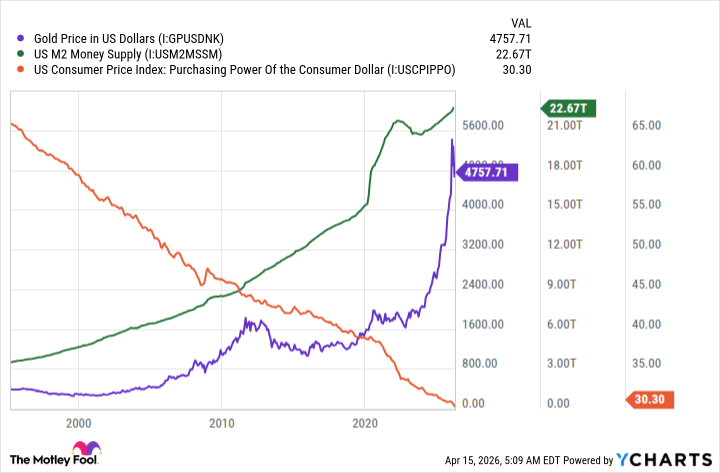
Moreover, because of its status as a store of value, gold tends to be an excellent hedge against inflation. Many countries used to be on the gold standard, which restricted their ability to print additional money unless they had an equivalent amount of physical metal on hand. The U.S. government abandoned this mechanism in 1971, and money supply has since exploded, eroding the value of the dollar by around 90%.
There is a clear long-term relationship between America’s soaring money supply, the falling purchasing power of the U.S. dollar, and the rising value of an ounce of gold.
Gold Price in US Dollars data by YCharts
Some prominent investors own gold precisely because they believe the money supply will continue rising. Hedge fund titans Paul Tudor Jones and Ray Dalio have both expressed concerns about soaring government spending and the national debt, which recently crossed a record high of $39 trillion.
Referencing historical examples, they believe the U.S. might have no choice but to “inflate away” its debt by devaluing the dollar even further, which can be achieved by dramatically increasing the supply of money. In theory, this will increase the value of gold in dollar terms.
Can gold continue to beat the market?
The U.S. government ran a $1.8 trillion budget deficit in fiscal 2025 (ended Sept. 30), and another trillion-dollar deficit is in the cards for fiscal 2026. This will bolster the conviction of any investor who owns gold because they believe money supply will be higher in the future. However, gold’s 60% return in 2025 certainly wasn’t normal, so investors need to manage their expectations.
Gold has delivered a far more modest compound annual return of just 8% over the last three decades. It has actually underperformed the S&P 500 index, which gained an average of 10.7% per year over the same period. Like gold, stocks are also hard assets, so a declining U.S. dollar will lift their perceived value, too. But they have the added benefit of producing revenue and earnings; hence their outperformance relative to gold (which produces neither).

Today’s Change
(1.33%) $5.85
Current Price
$445.93
Key Data Points
Day’s Range
$445.32 – $448.70
52wk Range
$291.78 – $509.70
Volume
9.7M
While it’s clear that investors are better off owning stocks in the long run, it might be a good idea to own at least some gold because it does occasionally deliver explosive short-term returns, as was the case in 2025 and so far in 2026. In fact, Ray Dalio believes investors should park around 15% of their portfolios in the yellow metal, which is much higher than the typical allocation of 5% to 10% recommended by financial advisors.
An ETF like the SPDR Gold Trust can be a good alternative to physical metal. It can be bought and sold through any mainstream investing platform with a few clicks, and its expense ratio of 0.4% makes it relatively affordable to own. That means an investment of $10,000 would incur an annual fee of around $40.
An equivalent quantity of physical metal, on the other hand, would be far more expensive to store and insure, and it can be tricky to sell in a hurry if the investor needs fast access to cash.