Albritton on SSUT lawsuit: ‘Politics has repercussions’
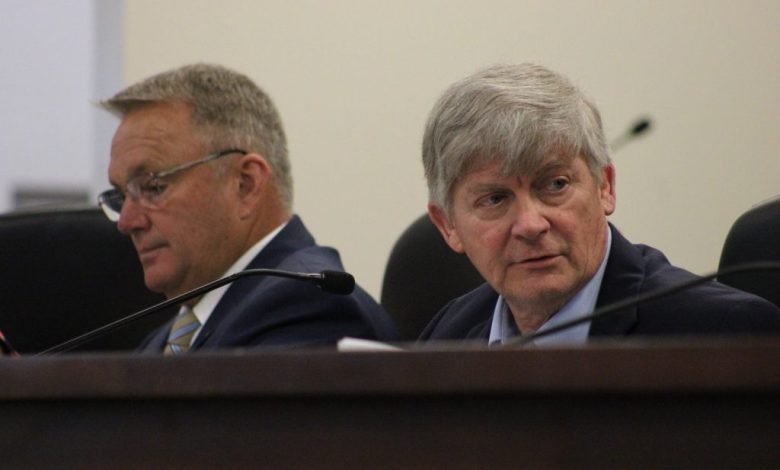
Sen. Greg Albritton, chairman of the powerful Senate General Fund budget committee, wanted to send a message Thursday to Alabama cities considering joining a lawsuit against the state over the distribution of sales taxes collected from online purchases.
“Politics has repercussions, decisions have consequences and this decision, this poor decision to bring this suit, is going to have long-lasting difficulties,” Albritton told Alabama Daily News.
Earlier in the day at the State House, Albritton, a member of the Legislative Contract Review Committee, moved to delay four proposed legal contracts from state agencies.
The contracts don’t pertain to sales tax collection or the August lawsuit filed by the cities of Tuscaloosa and Mountain Brook. But Albritton used the public meeting to speak against the lawsuit he’s previously called a “money grab” by municipalities. They argue they’re losing money on the current tax distribution formula of hundreds of millions of dollars per year.
“My perception personally is that this lawsuit is dangerous,” Albritton said. “It threatens the fiscal viability of the state that we in the Legislature has worked hard to achieve.”
He said the judiciary should not be deciding tax policy for the state.
“We don’t know what a court will do. If the court puts a stay (on the collection or distribution of online sales taxes), everybody gets hurt by that.
“The last thing we need constitutionally is to have the courts involved with taxation proceeds.”
The issue
In August, Tuscaloosa, Mountain Brook and Tuscaloosa City Schools filed a lawsuit in Montgomery Circuit Court arguing that many participating merchants with physical presences in Alabama should be paying traditional state and local sales taxes.
They want the state to revamp the tax collection system so retailers with stores and facilities in the state remit to the state for online purchases the same state and local taxes they would for in-store purchases.
The 8% tax on online purchases, formally called the Simplified Sellers Use Tax or SSUT, began in 2016. Fifty percent of online sales tax revenue collected goes to the state where it is further split, 75% to the state General Fund and 25% to the Education Trust Fund. The other half is split among local governments, 40% to counties on a population basis and 60% to municipalities on a population basis.
That formula was worked out in legislation nearly a decade ago. It is a reliable source of growth in the state’s General Fund, totaling $357 million for the state in fiscal 2025. So far this fiscal year, it’s been a source of growth. while another major revenue stream, interests on state deposits, declines.
For traditional, in-store purchases, all of the state’s 4% sales tax collected goes to the state’s Education Trust Fund, which supports K-12 schools, community colleges and universities in the state. And cities and counties have the option of local taxes on brick-and-mortar purchases. Tuscaloosa, for example, has a 3% sales tax, and the county has a separate 3%. So, a total tax of 10% is added to in-store purchases there.
Tuscaloosa and other municipalities argue they’re losing out because their populations do a significant amount of online shopping and too much of their tax dollars spent online are going elsewhere.
“We want sales taxes to be collected in Alabama the way they’ve always been collected, and that’s by destination sourcing,” Tuscaloosa Mayor Walt Maddox said on a recent episode of Capitol Journal.
“Physical nexus matters … the way that SSUT has been created, it’s ignoring physical nexus.
“… If you buy it local, those dollars should stay local.”
The state has filed a motion to dismiss the lawsuit. The Association of County Commissions of Alabama also opposes changes to the SSUT formula. The next hearing on the suit is set for Jan. 21.
Next week is a deadline for other entities to join the lawsuit. That’s what prompted Albritton’s State House remarks, he told ADN.
“I’ve gotten wind that others are jumping in on this, and many of those that are jumping in are those same people that are coming to me with their hands out, wanting money,” the budget chairman said.
He said some municipal leaders are being led down a “primrose path without knowing what the repercussions are.”
He said during the meeting and again to ADN that legislation would be the proper way to handle municipalities’ concerns over the tax revenue distribution.
There has been SSUT legislation in recent years.
Legislation last year by Rep. James Lomax, R-Huntsville, would take local deliveries out of the SSUT system and apply the local and state sales tax rates to them. It did not pass.
An effort in 2024 to raise the SSUT died amid opposition from Republicans who didn’t want to raise a tax, even if it put it on par with the tax paid on purchases made in person.
Maddox in a Thursday statement to ADN said multiple cities for nearly a decade have engaged the Alabama Department of Revenue and the Legislature to fix the legal issues with the SSUT.
“We believe these issues are valid – one of them being ADOR exceeding its authority granted by the Legislature,” Maddox said. “Seeking a legal remedy is not an action we have taken lightly; however, our responsibility is to protect our citizens, educate our children, and invest for the future. Unfortunately, SSUT jeopardizes these sacred responsibilities.”
The SSUT was worth a total of $851.1 million in 2024, up from $386.3 million in fiscal 2020, according to the Alabama Department of Revenue.
“As is evident from the recent Black Friday and Cyber Monday data, the issues of SSUT are growing exponentially,” Maddox said. “This is dangerous to the fiscal viability of cities and schools that depend upon locally generated sales taxes.”
“Senator Albritton has a passion for his district and our state, and I share that passion for the people of Tuscaloosa. Multiple solutions have been proposed since 2017, and I firmly believe as leaders with authentic conviction, we can find a way forward.”
Per the contract review committee’s rules, any member can hold a contract for up to 45 days. He or she can release them at any point but after 45 days, they automatically advance.
No other members questioned Albritton’s actions Thursday.
The delays are on four contracts with private attorneys. Three of them would provide legal counsel to various committees of the Alabama Legislature. The Legislature’s 2026 session begins Jan. 13, a few days before Albritton’s hold on the contract would be up, should he not end it earlier.
The Legislative Services Agency requested the contracts and Director Othni Lathram Thursday afternoon said the delay will not affect the legislative process.
“Committees will be staffed as usual for session,” he said.
The fourth contract was for an attorney to represent the state pharmacy board in litigation and disciplinary hearings.
Albritton is not the first lawmaker to use contract review to make a point.
Last year, Sen. Chris Elliott, R-Josephine, placed temporary holds on about $80 million in state contracts — the committee’s entire monthly agenda — in an effort to pressure the Alabama Alcoholic Beverage Control Board into complying with a 2023 law.
“If there’s a fight on this, just remember that the Legislature did not start this fight,” Albritton said at the State House. “But I think we have enough of the responsibility and obligation to conduct a good one to protect the public and protect their public monies.”
Credit: Source link