Gold and silver slipping as oil prices and dollar gain strength
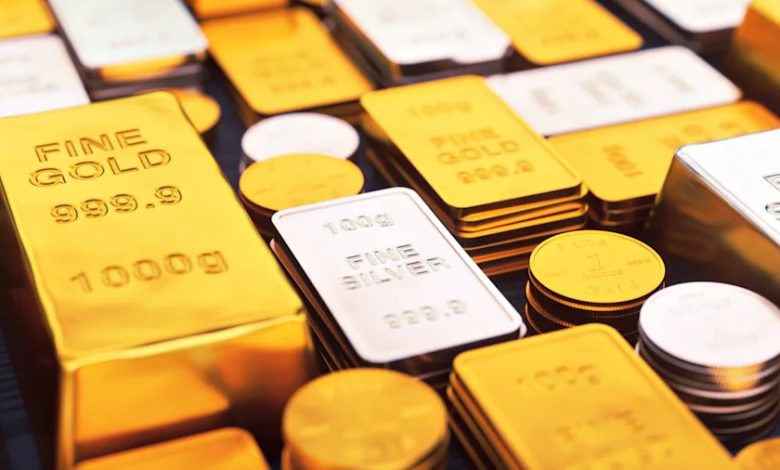
Gold (GC=F) June futures opened at $4,715.60 per troy ounce on Friday, down 0.2% from Thursday’s closing price of $4,724, and down nearly 1% from Thursday’s opening price. The gold price moved lower in early trading, at $4,700.20 at 6:35 a.m. ET.
Silver (SI=F) May futures opened at $75.56 per ounce on Friday, basically even with Thursday’s closing price of $75.50. Compared to yesterday’s opening price, silver is down 3%. The price of silver continued to slide in early trading, at $74.83 as of 6:35 a.m. ET.
Higher oil prices and a stronger U.S. dollar are putting downward pressure on gold and silver prices. Over the last five days, Brent crude oil (BZ=F) prices have been up nearly 11.5%, and the U.S. dollar index (DX-Y.NYB) has been up 0.70%.
Israel and Lebanon agreed to extend their ceasefire by three weeks, but the tensions in the Middle East do not seem to be lifting. With the Strait of Hormuz closed, the resulting supply chain issues have sent energy prices soaring and have injected real inflationary concerns in the U.S. and abroad.
The opening price of June gold futures on Friday was down 0.2% from Thursday’s close. Here’s a look at how the gold price has changed versus last week, month, and year:
-
One week ago: -1.2%
-
One month ago: +8.7%
-
One year ago: +42.7%
On Jan. 29, gold’s one-year gain was 95.6%.
24/7 gold price tracking: Don’t forget you can monitor the current price of gold on Yahoo Finance 24 hours a day, seven days a week.
Want to learn more about the current top-performing companies in the gold industry? Explore a list of the top-performing companies in the gold industry using the Yahoo Finance Screener. You can create your own screeners with over 150 different screening criteria.
The opening price of May silver futures on Friday was even with Thursday’s close. Here’s how the opening silver price has changed versus last week, month, and year:
-
One week ago: -8.3%
-
One month ago: +9.4%
-
One year ago: +126.7%
Learn more: How to invest in silver: A beginner’s guide
A gold investment can add stability and inflation protection to your portfolio. But it can also dilute your gains when stock prices are rising quickly. Finding the right balance between gold’s diversification benefits and profiting from growth potential in other assets can be challenging.
Even the experts are divided on how to achieve the correct balance. Below, five experts explain their recommended gold allocations, which range from 0% to 20%.
Learn more: How to invest in gold in 4 steps
Robert R. Johnson, professor at Creighton University’s Heider College of Business, does not advocate gold investing. In his words, “while having a small position in precious metals may dampen portfolio volatility in the short-run, the tradeoff between slightly dampened volatility and the lost long-term return is certainly not a prudent one, particularly for Gen Z/millennials with long investing time horizons.”
Brett Elliott, director of content and SEO at American Precious Metals Exchange (APMEX), recommends setting an allocation that aligns with your investing goals.
Growth-oriented investors may be comfortable with an allocation of 10% or 15%, according to Elliott. But income investors will prefer a smaller position, because gold provides no yield. A 2% to 5% gold allocation can provide some resiliency without an excessive drag on income potential.
Learn more: Who decides what gold is worth? How gold prices are determined.
Blake McLaughlin, executive vice president at Axcap Ventures, said historical data support a gold allocation of 5% to 8%. “Gold may not offer the outsized return potential of private investments, but the metal holds a set of attributes that are increasingly hard to ignore,” according to McLaughlin. Those attributes include the metal’s resilience amid economic uncertainty and geopolitical unrest.
Thomas Winmill, portfolio manager at Midas Funds, believes most investors will benefit from a long-term gold allocation of 5% to 15%. Winmill specifically advocates investing in gold mining companies through a mutual fund.
Your risk tolerance and current mix of financial versus hard assets can guide you to an appropriate allocation, according to Winmill.
-
Risk tolerance: Keep your allocation percentage low if you tend to panic in volatile cycles.
-
Financial vs. hard assets: Financial assets are stocks and bonds. Hard assets include tangible items like real estate, gold, collectibles, classic cars, and equipment. If you have no home equity and your wealth is primarily in financial assets, you can set your gold allocation higher. Or, if your home is paid for and more valuable than your stock portfolio, gold investing may not be necessary.
Learn more: Thinking of buying gold? Here’s what investors should watch for.
Vince Stanzione, CEO and founder at First Information, recommends a 20% gold allocation, specifically in physical gold or a gold ETF. Stanzione argues for a higher exposure to gold as a wealth protection strategy. As he says, “gold keeps with inflation and gold retains its purchasing power,” while paper currencies are devaluing around the world.
Learn more: Gold IRA: Benefits, risks, and how it differs from a traditional IRA
Whether you’re tracking the price of gold or silver since last month or last year, the price-of-gold chart and the price-of-silver charts below show the precious metal’s change in value so far this year.
More silver coverage from the Yahoo Finance team: