ACC Center for Racial Justice and Black Futures becomes Athens’ first dedicated African American history center | City News
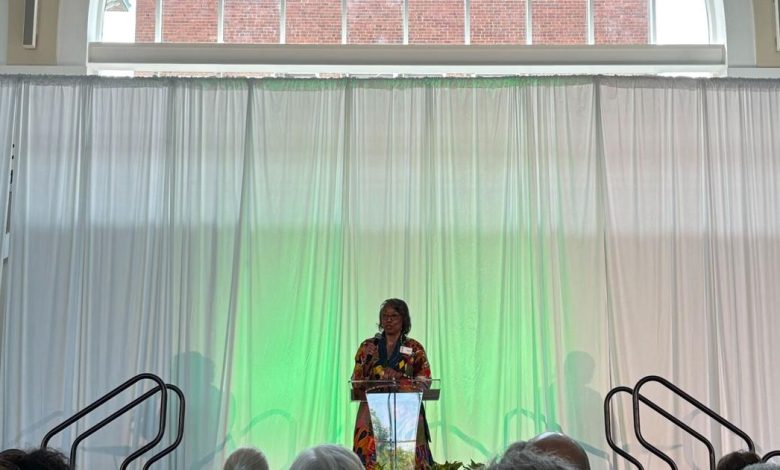
Activists, local government officials and community members celebrated the official launch of the Athens-Clarke County (ACC) Center for Racial Justice and Black Futures (CRJBF) on Thursday at the Classic Center.
The history center, which will be located at the Classic Center and is the first of its kind in Athens, aims to honor Black history in Athens, telling the stories and experiences of those that helped shape Athens’ culture.
One of those stories is Linnentown, a Black neighborhood in Athens that was displaced in the early 1960s by an urban renewal project to make room for student housing on the University of Georgia’s campus.
Hattie Thomas Whitehead, the president of the board of directors of CRJBF and former Linnentown resident, spearheaded the Athens Justice and Memory Project as a resident-led effort to recognize and address the impact of urban renewal on the community and its residents.
The ACC government passed a resolution in 2021 to support the project, with Athens Mayor Kelly Girtz issuing a proclamation apologizing for the displacement of Linnentown residents while committing to work towards atonement for the harm caused.
Work on the Linnentown Project today estimated the property loss to the families of the neighborhood to be over $5 million dollars. Through an agreement with the Justice and Memory Project, the ACC government allocated 2.5 million dollars towards affordable housing and the establishment of the history center.
The event announced and celebrated their goal to have the center open in the fourth quarter this year.
Teresa McLean and Alison Huff, board members of the ACC for Racial Justice and Black Futures, were in attendance at the event.
A neighbor of Whitehead’s, Huff joined the board of directors as a founding member after reading Whitehead’s memoir. McLean met Whitehead at a social justice panel in 2020 and was compelled by what she shared. She joined the board soon after.
“Everyone will come and be drawn to [the center] and learn about the history and acknowledge the history,” McLean said.
Speakers at the event included Whitehead, Girtz, Georgia state representative Spencer Frye, President and CEO of the Classic Center Paul Cramer and UGA alumna and member of the Justice and Memory project Charlene Marsh.
Girtz reemphasized his commitment to the project and highlighted the importance of the Black community to Athens’ history and culture.
“We’re going to be bringing a rich future that involves now a very clear recognition that Black Athenians are part of what makes Athens, Athens,” Girtz said.
Frye, who wrote the foreword for Whitehead’s memoir, agreed, highlighting the significance of Whitehead and the center’s work to Athens.
“What a tremendous moment in time that we have right now to honor the community that built this city,” Frye said. “The effect that [Whitehead] will have on the future generations is immeasurable.”
Marsh, who conducted extensive research into the destruction of Linnentown while interning at Historic Athens, also expressed hope for the center’s future and legacy.
“What excites me most about this center is what I know that it will mean for the next generation,” Marsh said. “Their exposure to the numerous, previously concealed and often unheard narratives … will ignite a fire in their hearts that will make them greater stewards of the community that they call home.”
Some of the goals of the center include illuminating the rich and diverse histories of Black Athenians and surrounding communities, igniting a commitment to justice and truth-telling and inspiring young people to build a fair and inclusive future
“The vision that we have is rooted in history and truth-telling and a future for our youth here in Athens,” Whitehead said. “We have to inspire our young folk. Some of them have lost hope. We’ve got to inspire them … We want to do that at the history center.”
The future center will provide historical exhibits, school and student group programming, youth leadership event opportunities and community gatherings.
“[This is] proof that a grassroots and small-town project [can] open minds and inspire and ignite,” Huff said. “Any little thing that we do today is like the proverbial pebble in the pond — the ripples will be unbelievably influential.”