Pope to EU lawmakers: Seek unity, not conflict that leads to destruction
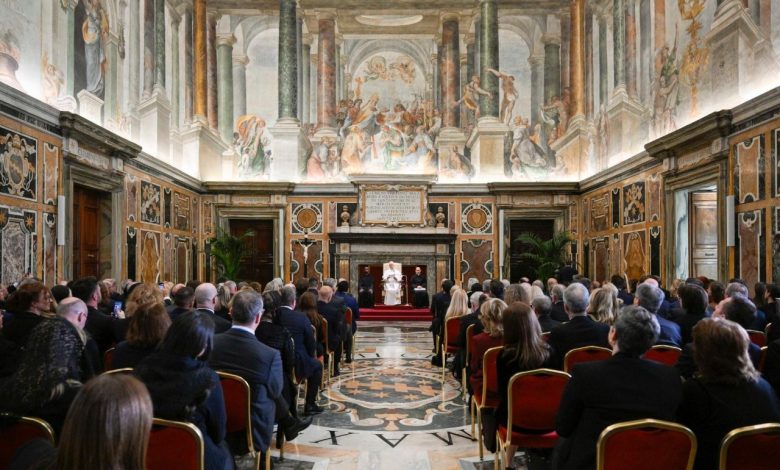
Pope Leo XIV urges European People’s Party lawmakers to reject ideology, rebuild trust with citizens, and pursue a form of politics rooted in the common good by seeking unity over conflict.
Vatican News
Pope Leo XIV met in the Vatican on Saturday with parliamentarians from the European People’s Party.
In his address, he recalled some of their earlier meetings, with Pope St. John Paul II and Pope Benedict XVI, as well as a message sent by Pope Francis in 2023 when he was unable to receive the group in person.
Echoing Benedict XVI, Pope Leo said he appreciated “your Group’s recognition of Europe’s Christian heritage.”
The Pope noted that the European project arose “from the ashes of the Second World War,” not only to ensure that such a conflict would never happen again, but also to foster cooperation capable of overcoming “centuries of division.”
He pointed to the influence of figures such as Adenauer, De Gasperi, and Schuman, who were “inspired by their personal faith” and saw Christian principles as “a common and unifying element” in rebuilding the continent.
Then, quoting Pope Francis, he said that “unity is greater than conflict,” explaining that true unity “has the courage to go beyond the surface of conflict and to see others in their deepest dignity.” Conflict, by contrast, “fosters the pursuit and assertion of power, and ultimately leads to destruction.”
The role of politics
Turning to the role of politics, the Pope said that “the primary task of any political action is to offer an ideal vision,” which requires “a broad view of the future” and a readiness to make “difficult and even unpopular choices when necessary for the common good.”
In this context, he went on to recall that politics can be understood as the “highest form of charity,” precisely because it is directed towards the good of all.
At the same time, however, he warned against the distortion of ideals into ideology. “Pursuing an ideal does not mean glorifying an ideology,” he said, describing ideology as “the result of a distortion of reality and a kind of violence imposed upon it.”
He continued by stressing that it “twists ideas and subjugates people to its own agenda,” ultimately “stifling their true aspirations.” He added that modern Europe itself emerged from recognizing “the failure of the ideological projects that had destroyed and divided it.”
A strong identity
Referring to the identity of the European People’s Party, the Pope went on to stress that “the people are at the heart of your commitment, and you cannot set them aside.”
Citizens, he said, are “not merely passive recipients of political proposals but active participants sharing responsibility for every political action.”
He described being present among the people and involving them in political processes as “the best antidote to populism… and to elitism,” both of which he noted are “widespread tendencies in today’s political landscape.”
The Pope then highlighted what he called “the steady decline in harmony, cooperation, and mutual engagement between the people and their representatives.”
To address this, he called for “a genuine sense of ‘the people'” to be rebuilt through “personal contact between citizens and their representatives.”
He added that in the era of “digital triumph,” political action oriented to the common good requires “a return to the analogue.”
Christian heritage
Addressing those inspired by Christian Democratic values, the Pope said this means “rediscovering and embracing the Christian heritage” while maintaining “the necessary distinction between prophetic religious witness… and Christian witness expressed through concrete political choices.”
“Being a Christian in politics does not mean being overtly confessional,” he said, but rather requires “allowing the Gospel to guide the decisions that have to be made, even those that may not attract easy consensus.”
He also emphasized the importance of preserving “the connection between natural law and positive law, and between Christian roots and political action.”
Challenges facing European Union
Pope Leo then turned to the concrete challenges facing Europe. He called for a “realistic perspective that starts with people’s concrete concerns,” including the need to promote “dignified working conditions” in response to “a market that is increasingly dehumanizing and unfulfilling.”
He spoke of the need to enable people “to overcome the fear of starting a family,” a fear he said is “particularly prevalent in Europe.”
On migration, he urged politicians to address “the root causes” while “caring for those who suffer” and recognizing “the real capacities for welcoming and integrating migrants into society.”
He also called for a non-ideological approach to major issues such as “care for creation and artificial intelligence,” noting that the latter offers “great opportunities” but is also “fraught with danger.”
Bringing his address to a close, the Pope reflected on the meaning of freedom, urging leaders to invest in a freedom that is not reduced to “mere personal preferences” but is “rooted in the truth,” safeguarding “religious freedom as well as freedom of thought and of conscience in every place and circumstance.”
Finally, he warned against what he described as a “‘short-circuit’ of human rights,” which ultimately “gives way to force and to oppression.”
Credit: Source link