Why International Stocks Could Massively Outperform U.S. Equities in 2026
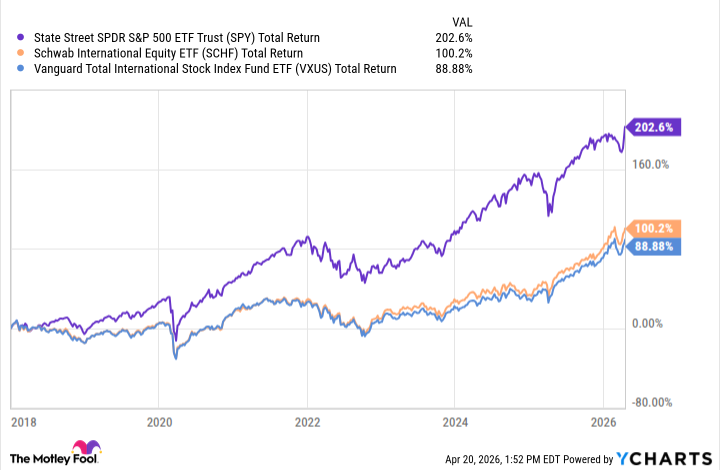
For the better part of the past couple of decades, a portfolio of American stocks offered U.S. investors more than enough diversification. Adding foreign stocks to the mix, in fact, would have resulted in underperformance.
Will AI create the world’s first trillionaire? Our team just released a report on the one little-known company, called an “Indispensable Monopoly” providing the critical technology Nvidia and Intel both need. Continue »
As the old adage goes, though, nothing lasts forever. Despite the recent heroic recovery of most domestic growth stocks, investors would be wise now to make a point of adding some international exposure to their holdings here, for a couple of reasons.
The first reason is the most obvious one. That’s the likely fallout from the military conflict between the United States and Iran.
Regardless of where you may stand on the underlying issue itself, there’s no denying it’s proving costly in terms of funding it, as well as in terms of disrupting international trade. Already forming strategic alliances in response to new import (into the U.S.) tariffs, several nations have since deepened their trade agreements in an effort to avoid dealing with an unpredictable United States. This means less need for trade with U.S. companies themselves.
The impact of this dynamic isn’t fully realized yet. It’s still coming, though. For perspective, the International Monetary Fund recently dialed back its 2026 GDP growth outlook for the United States from an already-modest 2.4% to 2.3%, en route to an even-weaker 2.1% next year. Meanwhile, the IMF still expects worldwide GDP growth of 3.1% this year despite the global impact of the Middle East conflict.

As for the other reason why international stocks are apt to outperform U.S. stocks this year, it’s got everything to do with the advent of artificial intelligence (AI) and the fact that the U.S. economy is largely driven by services — 73%, according to the Federal Reserve — and just 16% from manufacturing (with the remainder from government spending).
And it matters. As a team led by Bank of America‘s chief global strategist Michael Hartnett pointed out in February, since artificial intelligence offers far more value to factories in the form of automation and efficiency than it does to industries like restaurants or retail that are still built around interactions between employees and customers, China and other production-oriented economies can use the this tech to outpace the U.S. economy. Moreover, Hartnett and his team believe this underlying dynamic could help foreign stocks outperform domestic stocks for a full decade.