NC treasurer rolls out internship, clubs to boost financial literacy
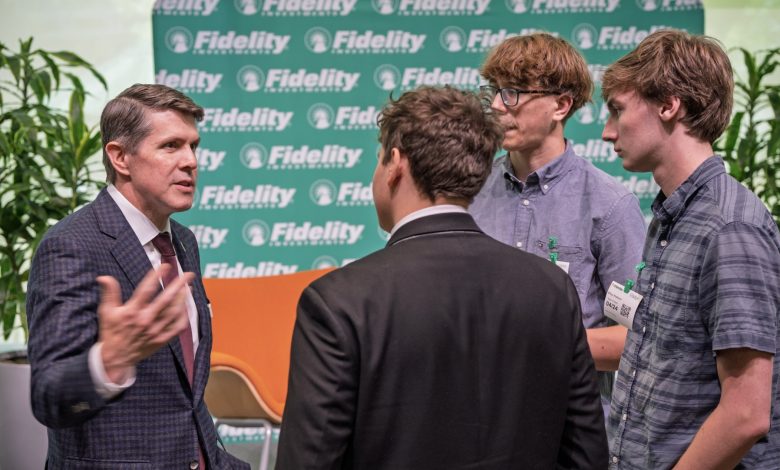
North Carolina State Treasurer Brad Briner announced the creation of an internship program for high school students within his department that will promote financial literacy across the state.
The announcement was made on Friday against the backdrop of the North Carolina Personal Finance Challenge state championship at Fidelity Investments, Durham. Associates judged high school students from across the state as they tested their knowledge of economic principles through problem-solving and critical thinking skills.
The department also plans to launch financial literacy clubs at high schools across the state using the information from its award-winning Finance Fridays newsletter. Additionally, a new statewide financial literacy competition for students will be announced this fall.
The initiatives will build upon the financial literacy requirement for high school seniors.
In a phone interview on Thursday, Briner told Carolina Journal that the treasurer’s office wanted to expand its financial literacy efforts, building on its Finance Fridays with the Treasurer newsletter. The department was recently recognized with an Excellence in Financial Literacy Education (EIFLE) Award from the Institute for Financial Literacy as the national 2026 Government Organization of the Year for advancing financial education through the newsletter, which is being reproduced and distributed nationwide.
The internship will be open to juniors and seniors throughout the state. A student will be selected for a fall, spring, and summer internship, and will include one-on-one mentorship with leadership throughout the department, a day of shadowing at Fidelity in RTP, and working on the curriculum for the financial literacy clubs. Students who complete the internship will also receive a $500 scholarship for future education.
The treasurer told CJ that his office will work with other organizations to create clubs at high schools that don’t have them, and will augment those that already have them with a prepared curriculum based on the Finance Fridays newsletter.
“So, we spent a lot of time designing this, trying to think about how we extend the financial literacy effort, but also how we meet the students where they are,” he said. “What is it that they want out of this, and how can they not only learn from it, but maybe help design some things for the state of North Carolina going forward. So, we’re really leaning in on the intersection of financial literacy and what we do as a state, as some of the contest and subject matter.”
The subject matter is advanced, well beyond the days when high school students were learning how to write checks.
“They’ve known that for a long time, and could probably all trade stocks at this point, crypto too, for that matter, but what’s the next level and how sophisticated can we be with them augmented by AI?” the treasurer said. “The answer is pretty darn sophisticated. One of the things we’re noodling on is how to solve some of the thorny financial problems that we have as a state and turn these teams loose on proposing creative solutions for them. Whether that’s the right size of the Rainy Day Fund as an example, or how we should think about disaster recovery and relief. Financially, these are really complicated, really hard financial and policy conversations that we’re going to see if we can work our way into financial literacy clubs.”
Sohum Kunde, a sophomore at Green Level High School in Cary, who has been piloting the internship program this semester, found out about the internship by emailing the department after checking out their website and the newsletter.
He told CJ in a telephone interview on Friday that he became interested in finance when he was very young, and credits his father, who helped him write a book on investing called, “The T4 Trading Strategy: An Essential Blueprint for Stock Investing,” which was released on Amazon in February.
“So, honestly, from a very young age, my father, who, although he’s a physician, has always had this passion for investments, and from a young age, I would always speak with him about it,” he said. “We would discuss certain topics, and that actually led me to recently publish my book on finance and investing called The T4 Trading Strategy, where we basically simplify investing concepts for young investors. And really, that was just something that I worked on with my father, and that started my passion for it.”
Kunde spends Friday afternoons at the treasurer’s office and has met various people, including Briner and Kevin SigRist, chief investment officer of the North Carolina Investment Authority.
“It’s really a great experience,” Kunde said. “I’m super blessed to be able to do this, and the whole mission for this is to spread financial literacy because there’s a stat that only 65% of adults can correctly answer financial literacy questions, so starting young and ensuring that these kids learn about financial literacy through these different clubs is a goal that we have at the treasurer’s office.”
Kunde said the clubs will go over each section or issue of the newsletter, and every month, four meeting slides will be shown in classrooms across North Carolina, covering different financial literacy topics. He said they hope to start a pilot club at his school and soon after implement clubs at other schools across the state.
After high school graduation, he told CJ that he would like to attend an in-state school like UNC-Chapel Hill or Duke University. After college, he wants to possibly work in public finance, become an academic author, or work in the treasurer’s office.
Briner told CJ the drive to implement all of these initiatives is very personal to him, recounting his own family story, like he did last year, at the launch of his Financial Literacy Initiative at Wake Technical Community College’s Scott Northern campus.
As a young boy growing up in Dallas, Texas, Briner saw his father lose his job not once, but twice.
“My dad losing his job, all those things, and that’s not all financial literacy, but certainly made things worse,” he said. “They didn’t have a rainy day fund. They didn’t really know what to do and figure it out, and we came out maybe better for it. But that’s the personal side, and then, professionally, I see it all the time where people, they’re scared off, to be honest, by the complexity they perceive of these really important subjects.”
The treasurer said they want to help people take control of their financial destiny at a young age, and this is a really important way to do that.
“I see really smart people who are really successful otherwise stumble later in life because they just refuse to engage, and so we want to make it fun,” Briner said. “We want to make it interesting.”