The bond market is sleepy. A sharp move may be coming.
Prices in the $31 trillion U.S. Treasury market have been steady for so long that traders fear a sharp change in rates is coming—rather than a slow drift—once a major catalyst hits.
The Treasury market has been quiet lately, with 10-year debt barely straying from a yield of 4.3% in April. For traders, that means chances to make money from changes in U.S. debt prices have been nearly nonexistent. Yields move in the opposite direction of prices.
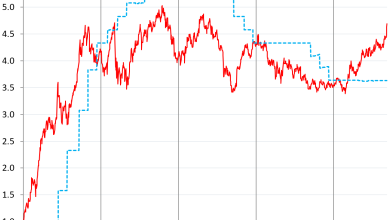
Bollinger Bands provide additional evidence of market calm. The technical indicator measures volatility by taking an average of yields over the past 20 days. Then it envelopes it with two bands—one above and another below the average. The theory is that when the bands compress or shrink toward the average, it means the yields are barely moving and a pronounced move in either direction is likely.
For the 10-year yield, the space between the bands is at 0.111 percentage points, the narrowest since Jan. 16.
This dynamic “implies a coiling that will eventually resolve in a sharp repricing,” wrote BMO Capital Markets’ head of U.S. rates strategy, Ian Lyngen. It is also “consistent with the lack of conviction in US rates at the moment.”
“Recall that the same pattern was in place in early January and it ended in a selloff—albeit a comparatively brief one,” Lyngen added.
While testimony from Federal Reserve chair nominee Kevin Warsh did nothing to wake up the sleepy Treasury market, there are catalysts for a breakout this week and beyond.
The Fed meeting on Tuesday and Wednesday could move the market. Four other major central banks are also meeting this week: Bank of Japan on Monday and Tuesday, Bank of Canada on Wednesday, and the European Central Bank and Bank of England on Thursday.
The advance estimate for gross domestic product for the first quarter also arrives Thursday, along with the personal consumption expenditures price index for March.
Earnings from big tech names like Amazon, Meta, Microsoft and Apple are on deck as well.
“This is one of the busiest weeks of the year on the economic calendar,” wrote Ed Yardeni, founder of Yardeni Research.
Meanwhile, the Treasury is set to make its two-part announcement on its quarterly financing estimates on May 4 and May 6. Wall Street broadly expects the Treasury to increase the sizes of long-term debt starting in 2027.
But investors shouldn’t completely discount the news—any signal that increases will happen sooner will disrupt the market. More debt equals lower prices as investors have more supply to choose from.
Updates on the Strait of Hormuz—its effective opening or a further escalation of war—could also impact the market, particularly given the fear that higher oil prices could increase inflation. The magnitude of change in yields depends on the gain or fall in oil prices.
A lid on the rates markets can’t stay tight forever.
Write to Karishma Vanjani at karishma.vanjani@dowjones.com.