Korea Stocks Overcome Iran War Shock, Draw Global Investors’ Attention
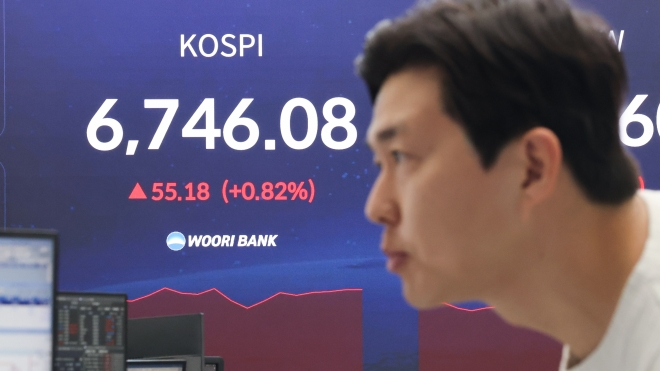
The KOSPI, which had wavered in the wake of the Iran war, has regained its balance and set new all-time highs, once again opening a commanding lead over global equity markets. Having surpassed the UK market in total capitalization, the KOSPI’s transformed status is prompting global investors to raise their expectations.
According to Investing.com on Tuesday, the KOSPI has gained 56.59% year-to-date, the highest among major global stock markets. The gap with second-ranked Taiwan’s Taiex index (34.40%) has widened further, and the advance is markedly ahead of Japan’s Nikkei 225 (18.22%), the Nasdaq (8.27%), and the S&P 500 (6.04%).
The lead has held in the short term as well. Over the past month, the KOSPI rose 26.08%, the highest among global equity markets. During the same period, it outpaced Taiwan’s Taiex (19.51%), the Nasdaq (15.01%) and the Nikkei 225 (13.44%). Analysts say the Korean stock market’s resilience has been confirmed, as upward momentum has held even through the external shock of the Iran war.
The global market capitalization rankings are also shifting. As of last Friday, when the KOSPI broke above the 6,600 level, the Korean stock market overtook the UK to become the world’s eighth largest by capitalization. According to Bloomberg, based on Friday’s close, the combined market cap of listed Korean companies had risen more than 45% this year to $4.04 trillion (about 5,929.5 trillion won), surpassing the UK’s $3.99 trillion, which gained only about 3%. As recently as the end of 2024, the UK market had been roughly twice the size of Korea’s.
The current global market cap rankings run as follows: the United States ($75.04 trillion), mainland China ($14.84 trillion), Japan ($8.19 trillion), Hong Kong ($7.41 trillion), India ($4.97 trillion), Canada ($4.49 trillion), and Taiwan ($4.48 trillion). Korea now sits in eighth place behind them, while Taiwan also overtook the UK in April, underscoring the rise of Asian equity markets.
The expansion of Korean and Taiwanese market capitalization is being led by Samsung Electronics (005930.KS), SK hynix (000660.KS) and Taiwan’s TSMC. “The rapid rise of Korea and Taiwan is not a tactical asset allocation but a structural shift rooted in AI hardware competitiveness,” said Francesco Chan of J.P. Morgan Asset Management in Hong Kong. “Global capital is being reallocated around advanced foundry and the memory supercycle.”
The standing of Korea’s flagship semiconductor stocks among global listed companies is rising quickly as well. SK hynix, with a market cap of $620.4 billion (about 910.9 trillion won), has climbed to 18th globally, entering the top 20 for the first time, and at one point rose as high as 16th. Samsung Electronics, with a market cap of $985.6 billion (about 1,447.1 trillion won), currently ranks 13th. If the rally continues, it could overtake 11th-ranked Walmart ($1.06 trillion) and 12th-ranked Berkshire Hathaway ($1.032 trillion), putting a move into the top 10 within reach. However, 10th-ranked Tesla ($1.46 trillion) is still seen as a high hurdle.
Global investment banks are also rapidly raising their targets on the back of the KOSPI’s surge. Market forecasts are being lifted beyond the previous 7,000 level toward 8,000. JPMorgan has set its KOSPI target as high as 8,500, while Goldman Sachs raised its 12-month target to 8,000 to reflect fundamental improvements across semiconductors and industrials. With its resilience in absorbing the external shock of the Iran war now confirmed, the KOSPI is being re-evaluated as a core destination for global capital rather than a short-term rally.
The view among domestic brokerages is also spreading that such projections are not necessarily excessive. Lee Eun-taek, an analyst at KB Securities, focused on the pace of gains after the index broke through its previous peak. “Looking at past cases in which the market quickly returned to its previous peak and then continued to surge, additional gains of 40% to 60% followed over roughly three months,” he said. “Simply applying that to the present, it is possible to calculate that the KOSPI could reach the 8,000–10,000 range between July and August.”