AI Stocks Were Just Put to the Test. Here’s How They Fared.

Artificial intelligence (AI) stocks led gains in the major benchmarks over the past few years, with chip designers, cloud computing stocks, and other key players roaring higher. They advanced in the triple and even quadruple digits as investors rushed to get in on what may be seen as the next big thing in technology.
But in recent times, these players were put to the test. Late last year, investors began to worry about the formation of an AI bubble as valuations of these stocks, and the S&P 500 in general, reached record levels. At the same time, tech giants spoke of their plans to continue pouring billions of dollars into AI infrastructure. This, too, sparked concern in the investment community, with the risk being that any dip in demand could leave these companies with extra capacity they might be unable to monetize.
Meanwhile, the general investing environment was tough for growth stocks — investors don’t like uncertainty, and the war in Iran brought a big dose of uncertainty to the market.
So, in the first months of the year, AI stocks were put to the test. Here’s how they fared.
Image source: Getty Images.
The valuation problem
We’ll start off by talking about the valuation situation. Investors watched the S&P 500 Shiller CAPE ratio climb to 40 — the only other time it surpassed that level was during the dot-com bubble in the early 2000s. That means stocks had reached a pricey level. The Shiller CAPE ratio is a particularly interesting metric as it considers stock price in relation to earning over a 10-year period. This accounts for any shifts in the economy.
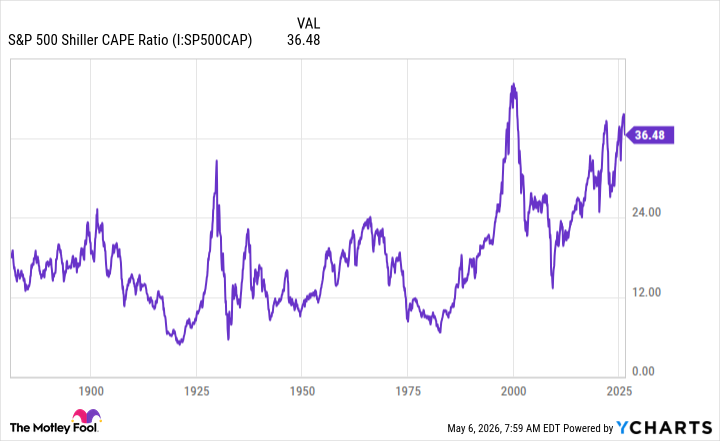
S&P 500 Shiller CAPE Ratio data by YCharts
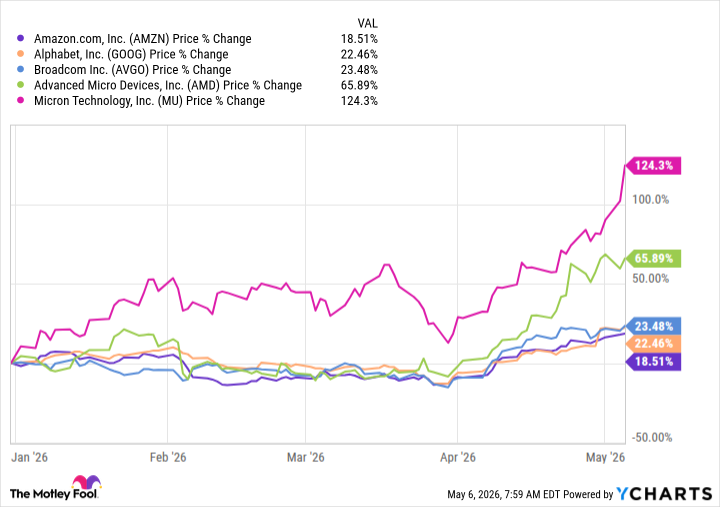
Worries about valuation did lead stocks to decline — particularly growth players and AI stocks. But this decrease didn’t resemble a bubble bursting: The market didn’t crash, and after declines in the first quarter of the year, many tech stocks have since advanced significantly.
Now, let’s consider the spending situation and revenue growth. Tech giants have committed to spending nearly $700 billion to support AI infrastructure growth this year — Amazon (AMZN +0.53%), which is part of this group, plans to invest about $200 billion so that its cloud unit, Amazon Web Services, may meet the demands of AI customers.

Today’s Change
(0.53%) $1.45
Current Price
$275.00
Key Data Points
Market Cap
$3.0T
Day’s Range
$272.26 – $277.80
52wk Range
$188.82 – $278.56
Volume
1.7M
Avg Vol
50M
Gross Margin
50.60%
Worries about AI spending
As mentioned, this sort of spending has worried investors amid concern that it won’t match the revenue opportunity. But signs we’ve seen so far say just the opposite. Amazon offered details in its recent shareholder letter and earnings report. The company says it’s not spending randomly but has solid customer commitments that are driving this spending. For example, “much of” the 2026 capital spending will be monetized over the coming two years based on these commitments.
And these companies’ recent reports of revenue growth and demand further support the idea that investment is bearing fruit.
CNBC’s Jim Cramer, in a recent piece about tech earnings, wrote: “This was the quarter where we realized that if you didn’t spend, you were already behind the 8-ball.”
Something to ease investors’ minds
All of this supports the idea that this spending is necessary, is driving current revenue, and is on track to supercharge revenue down the road, too. And this should ease the minds of investors who were concerned about big tech’s AI investments.
Finally, as I mentioned earlier, the backdrop hasn’t been very favorable for growth companies — such as AI players — that must invest and expand. The war in Iran put pressure on oil prices and put in jeopardy a major shipping route for goods. Meanwhile, the general uncertainty of war often prompts investors to turn away from growth stocks and toward stocks seen as “safer,” such as pharmaceutical or consumer staple companies.
We saw this rotation earlier in the year, but as AI valuations improved, earnings came in strong, and tensions in Iran eased, AI stocks have rebounded. Today, with fresh signs of progress toward a peace agreement, this headwind may be about to lift.
Meanwhile, in spite of the challenges this year, AI companies have proven the strength of the long-term AI story — and many of these stocks have recovered and gained in recent weeks. AI stocks were put to the test and came out victorious — and that’s great news for current and future investors in these hot stocks.