Trump visits China for high-stakes talks with Xi Jinping, and crypto markets are watching closely
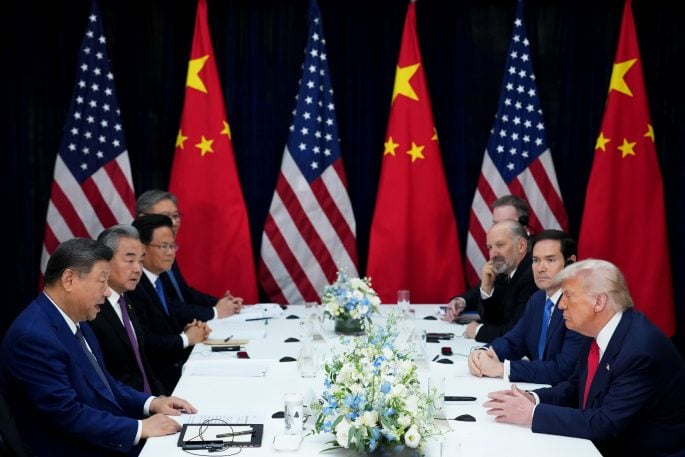
Donald Trump is heading to Beijing for a face-to-face meeting with Chinese President Xi Jinping on May 14-15, marking the first time during his current term that the two leaders will sit across from each other on Chinese soil. The agenda reads like a greatest hits album of geopolitical tension: trade imbalances, technology restrictions, Taiwan, and the US-led conflict with Iran.
Prediction markets are pricing a 94.3% probability that Trump actually makes the trip by the end of May 2026. For crypto investors, the more interesting number might be this: previous US-China de-escalations have historically bumped major token prices by 2-4% in the short term.
What’s on the table in Beijing
Trump’s trade agenda hasn’t changed much since his first term, when tariffs were slapped on $360B worth of Chinese goods. The core pitch remains the same: make trade fairer, bring manufacturing jobs back to America, and reduce dependence on Chinese supply chains. This time around, rare earth minerals are a particular focus, given their critical role in everything from semiconductors to electric vehicles.
In the past month, Beijing blocked a $2B Meta acquisition, a move that underscored just how deep the technology rivalry runs between the two nations.
Beyond trade and tech, the summit could potentially unlock up to $50B in cross-border technology investments. That figure matters for crypto because a meaningful chunk of blockchain innovation depends on hardware supply chains that run through China.
Trump has promised to create a national Bitcoin stockpile, positioning the US as a crypto-friendly superpower. China, meanwhile, implemented a sweeping ban on digital asset trading back in 2021 and has shown little interest in reversing course.
Historical context: trade wars and Bitcoin’s track record
Trump’s first-term trade war, spanning roughly 2017 to 2021, created the kind of sustained market turbulence that crypto traders know well. During periods of peak geopolitical uncertainty, Bitcoin often moved in the opposite direction of traditional risk assets.
The crypto market has also become significantly more institutionalized since the last round of US-China trade drama. Spot Bitcoin ETFs now exist. Major financial institutions hold digital assets on their balance sheets. That means the transmission mechanism between geopolitical events and crypto prices is faster and more direct than it was during Trump’s first term.
What this means for investors
A successful summit that eases sanctions and opens up cross-border investment flows would be broadly bullish for risk assets, crypto included. The 2-4% historical bump from prior de-escalations might even understate the potential move, given how much tension has accumulated.
Crypto analysts have been cautioning that a failure to reach agreements could trigger intensified sell-offs. China’s role in critical supply chains affecting blockchain technology and mining operations means that any escalation in trade restrictions would hit the crypto ecosystem in ways that go beyond simple sentiment shifts.
The prediction market’s 94.3% confidence that Trump makes the trip suggests the market is already pricing in the visit itself as a near-certainty. Investors should be watching for concrete deliverables: specific tariff reductions, technology transfer agreements, or any language around digital asset cooperation.