AI protectionism opens new front for G7
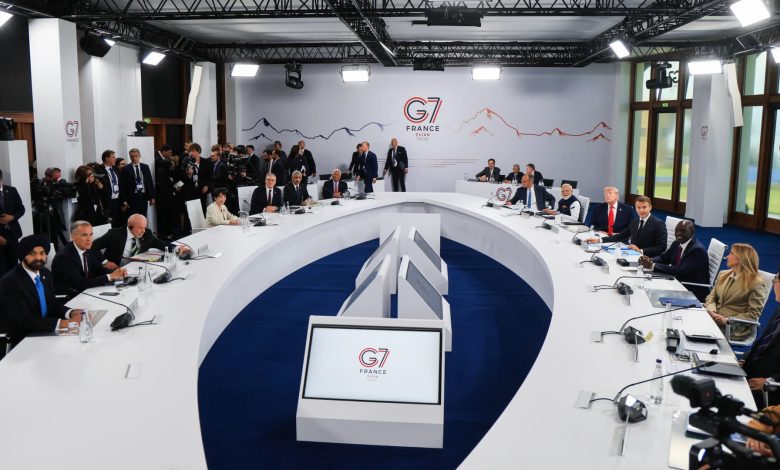
Leaders pose ahead of a work meeting as part of the G7 summit, in Evian, eastern France, on June 16, 2026.
Ludovic Marin | Afp | Getty Images
Hello, this is Leonie Kidd writing to you from London. Welcome to today’s edition of the Daily Open newsletter.
A new battleground has emerged — access to AI models.
This will dominate the G7 leaders’ agenda today, as they are joined in Evian-les-Bains by the CEOs of Anthropic, OpenAI and 11 others.
Concerns that U.S. protectionism will usher in a new era of control has raised concerns from Brussels to Beijing.
What you need to know today
G7 leaders spent their first day of meeting in Evian-les-Bains debating the toughest conflicts facing the world today — a resolution to the Iran war and the ongoing aggression in Ukraine.
But today, another battleground will take centre stage: access to AI.
Leaders in Europe have called on the US to reconsider a directive on AI that suspends certain models for foreign nationals. According to the Financial Times, U.S. Commerce Secretary Howard Lutnick met with European officials on the sidelines of the G7 summit to discuss their concerns.
AI giant Anthropic was ordered to pull its Fable 5 and Mythos 5 models to comply with an export control directive from the U.S. government, citing national security concerns.
G7 leaders will be joined by the CEOs of OpenAI, Anthropic and MistralAI, as well as representatives from Meta, Google DeepMind and others.
In Paris today, CNBC will attend the VivaTech conference and speak to the European Commission’s tech chief, Henna Virkkunen, who has warned Washington against “discriminatory” action around AI, saying Europe should be seen as a “trusted partner.”
Meanwhile, U.S. President Donald Trump has signalled he could send the details of his Iran agreement to Congress for approval. Lawmakers from both the Democratic and Republican parties are raising questions, asking to see the accord and saying they should vote on any final deal.
Global stock markets continue to hold near record levels, with the Dow closing at a new intraday high, while Japan’s Nikkei also hit another peak during the Asia-Pacific session. Futures are pointing to a more muted session in the U.S. and Europe today.
The big economic marker comes with the Federal Reserve’s rate decision, set to take place later today. It also marks the first time new Chairman Kevin Warsh takes the stage. According to the latest CNBC Fed Survey, he is expected to hold rates steady but remove the easing bias in his post-decision statement.
In corporate news, SpaceX options have signalled “expensive” and “dangerous” bets on the first day of trading. According to strategy group Susquehanna, there is a 15% chance for the stock to rise by 50% and a similar possibility that it loses half its value in the next three months.
Michael Burry, “The Big Short” famed investor, has said he has no position in SpaceX and said betting against the stock is too expensive, even as he questioned the group’s near-$3 trillion valuation.
“Tempted by that one. But no thank you,” Burry said of the shorter-dated option.
SpaceX shares closed up almost 5% on Tuesday.
— Leonie Kidd
And finally…
Snap unveils $2,195 AR glasses as CEO Evan Spiegel bets on post-smartphone future
Snap CEO Evan Spiegel is betting consumers are so tired of looking at smartphone screens that they’ll be willing to pay over $2,000 for augmented reality glasses that bring digital visuals into a user’s field of vision.
“Almost 20 years since the launch of the iPhone, people are ready to think about computing differently,” Spiegel said in an interview with CNBC.
On Tuesday, the Snap co-founder debuted Specs, his company’s first AR device geared toward the broader public instead of developers. At $2,195 with a $200 refundable deposit, Specs are more than 15 times the price of Snap’s $130 camera-only Spectacles that debuted in 2016 and never became a hit.
— Jonathan Vanian