Area political figures who contributed to our nation’s 250-year history | Local
America’s 250 years have been filled with defining political moments, and Southwest Ohio has contributed its share of leaders along the way. From local offices to the national stage, the region has produced figures who helped shape the region’s political landscape and, at times, the nation’s direction.
What follows is a partial list of non-president political figures from across the region, presented in no particular order, whose leadership, decisions and actions left their mark on our history.
Clement Vallandigham
Vallandigham, one of Dayton’s most controversial political figures, was a prominent lawyer and Democratic leader. A champion of states’ rights and opponent of President Abraham Lincoln’s Civil War policies, Vallandigham led the anti-war “Peace Democrats,” or Copperheads.
Arrested in 1863 and convicted of treason, he was banished to the Confederacy but remained influential in Ohio politics. In June 1871, Vallandigham accidentally shot himself while demonstrating a defense strategy for a murder trial using what he believed was an unloaded gun. He died the next day and is buried in Dayton’s Woodland Cemetery.
“Vallandigham’s career shows how changeable American politics can be,” Leo DeLuca, director of community relations for Dayton History, told this news outlet. “His Democratic Party stood for states’ rights and slavery, a position that would be unrecognizable under that banner today. His legacy is a reminder that parties don’t stay fixed. They shift, split, and reassemble as the country’s conflicts and coalitions change.”
John Boehner
John Boehner rose from local office in Butler County’s West Chester Twp. to nearly 25 years in Congress, ultimately serving as Speaker of the U.S. House, Smith said.
His most prominent position was as Speaker of the House from 2011 to 2015, where he led major budget and debt negotiations and managed internal party conflicts during a politically divided era.”
“John Boehner is influential for his long political career and national leadership,” said Brian Smith executive director of the Butler County Historical Society. “He began his public service in Butler County as a Union Twp. trustee, establishing a strong local reputation before serving in the Ohio House of Representatives and then in the U.S. House of Representatives for over two decades.
During his time in Congress, Boehner emerged as a leading Republican figure and helped develop the ‘Contract with America,’ shaping national policy.
Paul Sorg
Paul Sorg was an industrialist in Middletown who had a brief, but effective political career, according to Sam Ashworth, president of the Middletown Historical Society’s board of trustees and a former executive director.
“Due to the death of George Houk in 1894, Sorg was elected to fill the vacancy to the fifty-third Congress from Ohio’s Third district,” Ashworth said. “While in congress, Sorg championed the cause of veterans of the Civil War and was a delegate to a national Conference on Trusts in 1899.”
Barry Levey
Barry Levey served eight years as a member of the Ohio House of Representatives from 1936 to 1971.
“In 1986 he was appointed to the 4th District’s Ohio Senate seat, serving from 1987 to 1995,” Ashworth said. “He became the only member of the Ohio Legislature to chair both the House and Senate Judiciary Committees.”
Levey went on to serve as chairman of First National Bank of Southwestern Ohio and First Financial Bancorp.
William Bebb
William Bebb was an early and important leader in both Butler County and Ohio, according to Smith.
“He began his career as an educator, helping establish local schools and co-founding an institution that educated future leaders,” he said. “His work connected education to civic and political development, laying a strong foundation for community growth.”
Bebb later became Governor of Ohio before the Civil War, where he focused on economic stability, reducing state debt, and expanding public education. He also guided the state during the Mexican‑American War period. “Bebb also supported infrastructure development and promoted anti-slavery ideas, helping shape Ohio’s identity as a free state,” Smith said. “His later contributions to national politics and federal administration further expanded his influence.”
Lewis Campbell
Lewis Campbell was a Hamilton editor, lawyer and community leader who served multiple terms in Congress.
“Campbell was influential for his wide-ranging political and civic contributions,” Smith said. “Based in Hamilton, he was closely tied to Butler County, where he initially worked as a newspaper editor shaping local political opinion. He later became a lawyer and community leader, supporting economic growth through infrastructure development.
Campbell, as chairman of the U.S. House of Representatives’ Ways and Means Committee, had “a significant influence on national economic policy,” Smith said. “He strongly opposed the expansion of slavery. During the Civil War, he served in the Union Army and later took on a diplomatic role as U.S. Minister to Mexico.”
Warren Gard
Warren Gard made “significant contributions” to both local law and national policy, Smith said. “He began his career as Butler County prosecutor, where he helped shape federal legal policy during World War I and improve trust and professionalism within the justice system,” he said.
After serving as a judge and strengthening local court practices, Gard advanced to the national level as a member of the U.S. House of Representatives during the World War I era, Smith said. In Congress, he served on the House Judiciary Committee, contributing to legal policymaking, including legislation that incorporated the Boy Scouts of America. He also participated in diplomatic and international efforts.
Samuel Shellabarger
Samuel Shellabarger was born near Enon just weeks before Clark County was created in 1818, according to Clark County Historical Society at the Heritage Center. He studied law with Congressman Samson Mason, who also introduced him to politics. During his time in Congress, the major national issues were slavery and Reconstruction.
“Samuel Shellabarger was in Congress during the Civil War, so he had an impact on policy during an important time,” said Natalie Fritz, archivist and outreach director for Clark County Historical Society. “He supported abolitionism, fair trials for runaway slaves, and admitting Black troops to the U.S. Army. After the war, he was involved with Reconstruction and argued that an amendment that seemed to propose equal suffrage wouldn’t protect freed Blacks from voting laws that was discriminatory in the Jim Crow era.”
During Reconstruction, he broke a major Congressional deadlock by rewriting a key amendment so both sides could accept it.
David Hobson
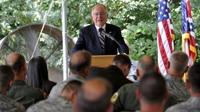
Former Rep. David Hobson speaks during the ground breaking ceremony for the new David L. Hobson Communications Complex at the Springfield Air National Guard Base Friday, August 5. Staff photo by Bill Lackey
Born in Cincinnati, David Hobson became a strong advocate for Springfield and Clark County during his years in Congress, according to Clark County Historical Society. First elected in 1990 after serving in the Ohio Senate, he focused on health care, government spending, national security, and helping Ohio’s former industrial towns attract new jobs and high‑tech investment.
He secured millions in federal funding for projects such as the Heritage Center, the Springfield Technology Park, and improvements at the Air National Guard base. A bipartisan problem‑solver, Hobson sponsored 46 bills, co‑sponsored more than 1,000, and was widely respected for working across party lines.
“Dave Hobson was very influential to economic development in our area in Springfield and Clark County,” Fritz said. “He worked to bring new jobs here in high-tech manufacturing, supported the Technology Park construction in the early 2000s, and showed a lot of support to the Air National Guard Base. He also earmarked money for projects, including money that helped our now 135-plus year old building, the Heritage Center, to be renovated and opened as a museum of the county’s history.”
J. Warren Keifer
Joseph Warren Keifer was born in Bethel Twp. in 1836 and later became a lawyer in Springfield. Even before he could vote, he gave 50 campaign speeches for Republican John Fremont, despite being too young to vote. When the Civil War began, he enlisted as a private and quickly rose to Major General. After the war, he avoided running for national office out of respect for his friend Samuel Shellabarger, but he eventually served in the Ohio State Senate and then in Congress, including one turbulent term as Speaker of the House.
After losing reelection in 1884, Keifer returned to practicing law before returning to Congress from 1905 to 1911. He served on the Appropriations Committee and was known for speaking often and voting based on his own judgment rather than strictly following party lines.
“J. Warren Keifer became the first person from Ohio to be the Speaker of the House, which is a powerful position, which gave him, and our area, a stronger voice in national legislation,” Fritz said. “He voted his conscience, not with strict party lines, which was rare then and is even rarer today.”
JD Vance
A native of Middletown, James David “JD” Vance currently serves as the nation’s 50th vice president. He rose to national prominence 11 years ago with the book “Hillbilly Elegy,” which is a memoir. Vance was elected to the U.S. Senate in 2022 and was selected as U.S. President Donald Trump’s running mate in the 2024 presidential election. He resigned from Senate before his vice presidential inauguration. His connection to southwest Ohio began when his grandparents moved to Middletown from Kentucky and had three children, including his mother, Beverly Vance Aikins, who still lives in the city. JD Vance spent his school years in the Middletown School District, graduating from Middletown High School in 2003.
Credit: Source link