Fintech Mynt plans to raise $1.5 billion in Philippines’ largest IPO

Happy Monday and welcome back to Asia Tech Review, your curated digest to keep up to date with tech news across Asia.
We’re looking at record IPO filings again after Mynt, a fintech in the Philippines backed by China’s Ant Group and top US private equity funds, went official with plans to raise as much as $1.5 billion. If it hits that target, it would surpass Monde Nissin, the food and beverage giant that raised $1 billion in 2021.
To keep up with our issues, follow us on LinkedIn or WhatsApp. Please do share Asia Tech Review with people you know who want to get smart about Asia tech.
In addition to writing Asia Tech Review, I help great startups and tech companies tell their story through narrative, content and comms. Check out Fully Drafted to learn more.
Fresh after Jio filed what could be a record IPO in India, there’s now a contender for a highest-ever listing in the Philippines. Fintech business Mynt filed for an IPO that could raise as much as $1.5 billion and value it at $11 billion.
Mynt operates GCash, a popular payment and lending wallet that claims more than 40 million monthly active users. The company has a serious pedigree. It was founded by leading operator Globe, conglomerate Ayala and China’s Ant Group in 2015 when fintech first got started in Southeast Asia. It raised more than $1.2 billion from backers that include Japan’s MUFG bank, private equity firms Warburg Pincus and Bow Wave. Notably, just under 65% of ownership is from foreign entities.
Despite the huge numbers, Mynt itself is only raising P16.1 billion ($264 million) in funds for itself, most of the fresh capital will be exits for its investors, who stand to do pretty well as Mynt previously raised at a valuation of around $2 billion.
Mynt is in the position of most mature fintech companies in Southeast Asia in that it has hit decent scale on its payment business, and now it needs to grow its lending and financial services income to really hit scale.
Last year, the company did net income of $284 million (P17.2 billion) on revenue of $1.31 billion (P79.7 billion), passing the billion-dollar milestone for the first time. Revenue from the first quarter of this year ($342 million or P20.7 billion) gives it about the same annual run rate.
That lack of growth is down to a slump in payment revenue after the domestic regulator stopped allowing in-app access to online gambling games.
That move came into effect in August, and it reduced Mynt’s payment take rate from 0.31% in Q1 2025 to 0.25% in Q1 2026. In turn, payments accounted for just 57% of all income in Q1 2026, a reduction of more than 10% since 2023 but that’s also down to the company diversifying into credit, investing, insurance and more.
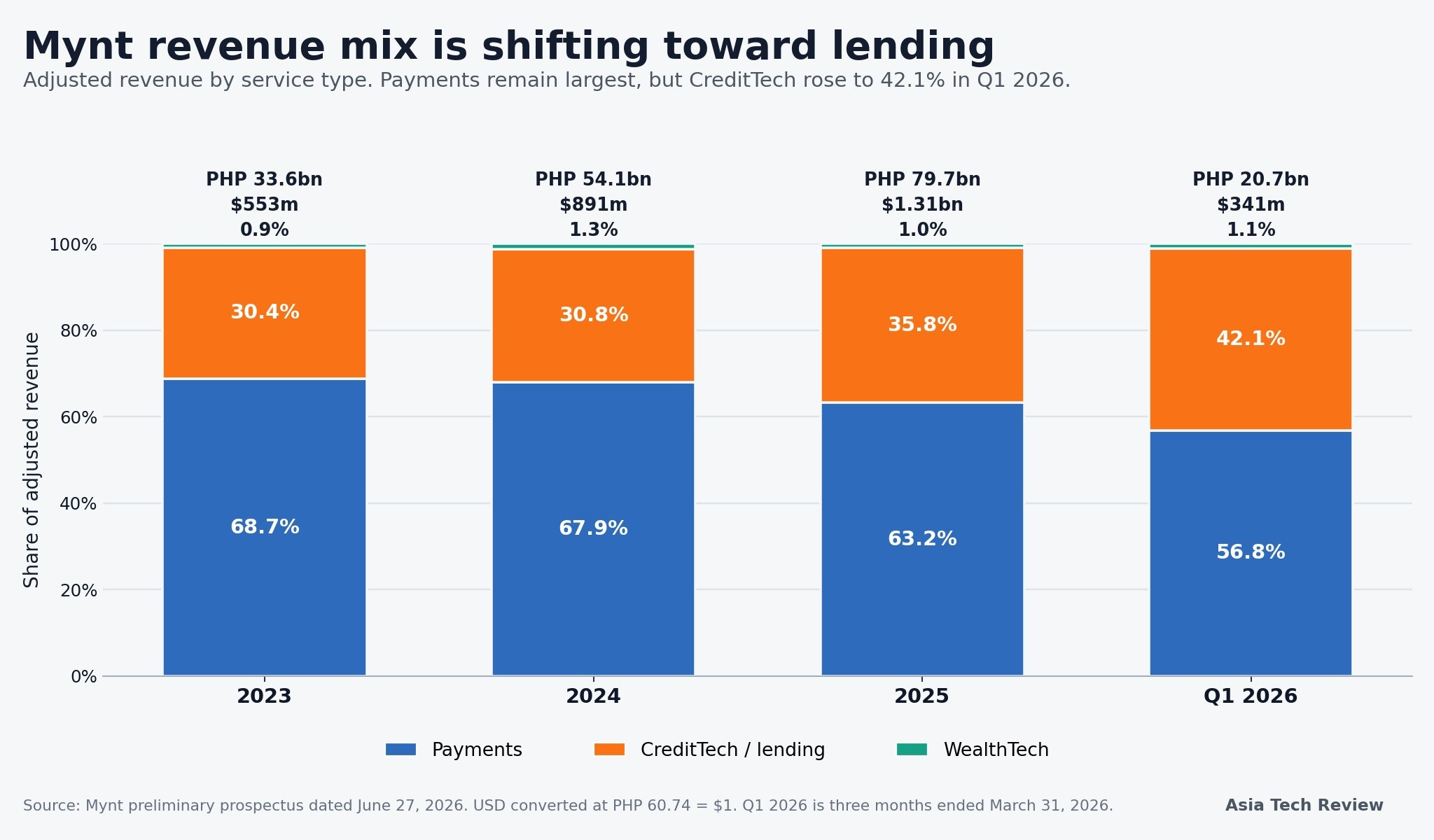
Credit is the main area where Mynt’s revenue is growing, having increased 48% year-on-year during Q1, but that also brings its own warning.
Mynt says that 87.7% of its total loan portfolio sits on its own books, meaning it is directly exposed rather than simply passing borrowers to dedicated lending partners. That on-book exposure was worth about $925 million as of Q1 2026. Its lending products (GLoan, GGives, Borrow Load and GLoan Sakto) are unsecured and not collateralised, guaranteed or insured. As of Q1 2026, 5.1% of loans were non-performing.
That means the business comes with a fair bit of risk. It also underlines how important Mynt has become as a financial gateway since 78% of its users are located outside Metro Manila, while 92% come from “lower-income groups.” For many of these users, GCash has almost become their bank, although it isn’t in the domestic digital bank space.
A core question for investors is whether Mynt can manage that credit risk and grow the lending book meaningfully.
In that respect, there are strong parallels with PayPay in Japan, which we wrote about in March prior to its US IPO. It became the country’s main payment app but is struggling to grow its financial services book.
As an emerging market business, Mynt is less about taking business from banks and lenders and more about creating new financial consumption habits. With a strong user base and plenty of capital, it’s in the best position to make that impact.
We might get to see more on Philippines fintech if Maya, Mynt’s rival, comes good on its plans to list in the US. The company, which includes telco PLDT and Tencent among its backers, is reportedly planning to raise as much as $1 billion for its Stateside listing.
South Korea’s Samsung Group and SK Group will reportedly announce as much as 2,000 trillion won ($1.3 trillion) of investments over the next decade as part of President Lee Jae Myung’s flagship industrial strategy [Bloomberg]
DeepSeek founder Liang Wenfeng was apparently motivated to raise external capital ($7.4 billion) for the first time after being ‘spooked’ by the capabilities of Anthropic’s Mythos model preview in April [The Information]
Australian AI infrastructure firm Firmus Technologies is partnering with Nvidia and Singapore-based DayOne to build its first data centre in Indonesia, a 360-megawatt AI Factory campus in Batam [Bloomberg]
India’s seed-and early-stage startups are raising almost twice as much per round as they did a year ago, according to data collected by Tracxn [Economic Times]
Kunlunxin Technology, the AI chip firm majority owned by Baidu, is targeting a $50 billion valuation for its planned Hong Kong IPO [The Information]
China’s onshore technology IPOs are on track for their strongest year since 2023 after raising $3.1 billion from stock market listings in China this year to June 18, a more than 5X year-on-year increase [Reuters]
China’s office workers are worrying whether their jobs can be done by artificial intelligence, and whether their companies will make the switch [South China Morning Post]
Anthropic is tightening restrictions on access to Claude in China, but users keep finding new workarounds, from proxy services to fake identities sourced on Telegram [Wired]
If you’ve ever visited China, you’ll know how hard it is to navigate without core payment apps and local services. Well, Tencent is testing an app designed to help overseas visitors navigate daily life in China with travel, dining and shopping, and, of course, digital payment options [Bloomberg]
Researchers claim that Z.ai’s GLM-5.2 matches the latest US models at finding security bugs [Wall Street Journal]
A look at South Korea’s four vocational “meister” schools that train students to work in semiconductor manufacturing [New York Times]
Amazon CEO Andy Jassy is on tour in India and, in fairly softball media interviews, he said Amazon will look at acquisitions in India and continue to work with the government on expanding AI capabilities—as background, much has been written about Amazon falling off the pace in India [Economic Times]
Apple is lobbying the Trump administration for permission to source memory chips from CXMT, the Chinese supplier blacklisted by the Pentagon over alleged ties to the People’s Liberation Army [Financial Times]
OpenAI appointed Prabhjeet Singh, the former president of Uber India and South Asia, as its first India managing director [TechCrunch]
Byju’s global lenders are reportedly in talks to take a roughly 30% stake in one of the edtech firm’s partly-owned units in exchange for dropping all legal action against founder Byju Raveendran [Reuters]