Space stocks surge across the board! Rocket Lab’s $8 billion…
Two pieces of news coincided on the same day, driving broad-based buying across the sector.
The first catalyst was Rocket Lab’s acquisition of Iridium.The acquisition is valued at approximately $8 billion on an enterprise value basis, making it one of the largest M&A deals in the commercial space sector in 2026.What captured market attention was not merely the scale of expansion. It was widely perceived as a step toward ‘vertical integration’—encompassing everything from rocket launches to operating satellite constellations. Integrating launch services, satellite manufacturing, and satellite communication networks within a single corporate group could create significant advantages in cost structure, customer base, and service deployment.This move can be seen as Rocket Lab directly approaching the business model pioneered by SpaceX, which has led the commercial space industry until now.
The impact of this news rippled outward—from the companies directly involved to their peers and ultimately across the entire thematic sector.
First waveThe parties directly involved were affected as follows: buyer Rocket Lab rose on expectations of expanded business scope post-integration, while seller Iridium surged sharply as markets priced in the acquisition premium.Both companies were at the center of the day’s rally in space-related stocks.
The second waveAnother effect was a reassessment of peer companies operating in adjacent fields such as satellite communications, space infrastructure, and Earth observation.Associated buying also flowed into AST SpaceMobile and Planet Labs.This occurred because the vertical integration theme extended beyond the individual acquisition news, prompting a broader revaluation of the entire space infrastructure sector.
The third waveThe third effect was capital inflows into the broader thematic area. Space-related ETFs such as the Procure Space ETF saw buying interest, with funds flowing into wide-ranging themes including ‘satellite communications,’ ‘commercial space,’ ‘defense and security,’ and ‘private space infrastructure.’The rise in ETFs indicates not only stock-specific catalysts but also stronger demand for buying space-related equities as a group.
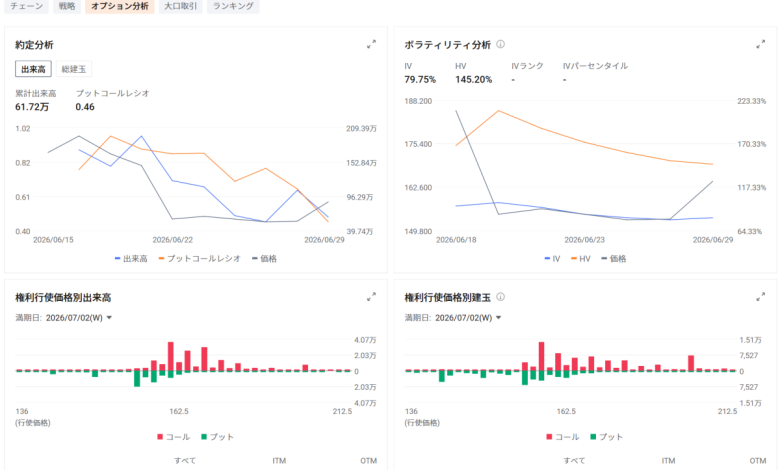
Option market activity also reflects this overheated sentiment.In the nearest expiration month, several stocks show call volume significantly exceeding put volume. The call/put volume ratios reached approximately 2.6x for Rocket Lab, 2.3x for AST SpaceMobile, 2.4x for SpaceX, 5.0x for Planet Labs, and 6.4x for Iridium. Even on an open interest basis, Iridium stands at about 3.7x and SpaceX at about 2.6x in favor of calls, indicating bullish positioning dominates in the short term.
Meanwhile, Iridium—the acquisition target—has a relatively low call implied volatility (IV) of around 63% compared to other space-related stocks. This reflects the typical structure of M&A stocks, where the market tends to price in convergence of the stock price toward the acquisition price.
However, the options market should not be interpreted as uniformly bullish.Overall, IV levels across these stocks remain elevated: SpaceX’s call IV is around 290%, Planet Labs’ put IV is approximately 260%, and AST SpaceMobile’s put IV is about 200%, all pricing in extremely large potential price moves. Higher IV makes options more expensive, and even if the stock moves in the anticipated direction, profits may be difficult to realize due to time decay and potential IV contraction—especially in stocks like Planet Labs and AST SpaceMobile, where put IV exceeds call IV,indicating high costs for downside hedging and suggesting the market remains wary of sharp downward moves.
Going forward, two key focal points emerge.
First is SpaceX’s inclusion in the Nasdaq-100 on July 7. Attention will center on how much index-linked fund inflows support its share price and how broadly this effect spreads across the entire space sector. Demand-supply imbalances can occur around major index additions, but since this catalyst is often priced in ahead of time, there’s a risk of a ‘sell-the-news’ reaction post-inclusion, warranting caution against simplistic upside expectations.
Second is whether the integration between Rocket Lab and Iridium actually progresses. Several steps remain before deal closure, including shareholder approval, financing arrangements, and regulatory review by competition authorities. While the vertical integration scenario is compelling, execution risks have not disappeared.
The recent broad rally in space-related stocks reflects the simultaneous firing of two catalysts on the same day: expectations of industry reshaping driven by a massive M&A deal and anticipated fund inflows from SpaceX’s index inclusion.Conversely, whether these two assumptions will continue to be substantiated by actual earnings and supply-demand fundamentals going forward will be the key determinant of whether current market interest proves to be a fleeting thematic rally or evolves into a more sustained re-rating.
This article uses partial automatic translation.
-moomoo News Zeber
This document is prepared solely for informational purposes and does not constitute a recommendation to invest in or trade any specific financial instrument. Investors are solely responsible for their own final investment decisions and the resulting outcomes. Financial instruments carry risks including price volatility, credit risk, and liquidity risk. Principal is not guaranteed and losses may occur. The company assumes no liability whatsoever for any damages arising from the use of this document or from investment decisions made based on its content. Option trading involves the risk of losses exceeding the initial investment. Please be sure to review all key documentation—including the Contract Pre-Conclusion Document, Subscription Agreement, and other materials—covering important matters such as risks and fees, and trade only at your own discretion.


![[Picture] – moomoo Community](https://thewallstreetledger.com/wp-content/uploads/2026/08/1786673965_1200x-390x220.jpeg "[Picture] – moomoo Community")