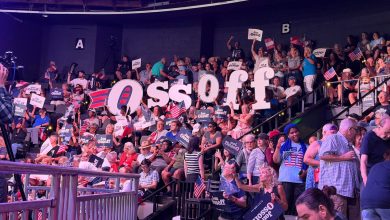
Poll: Most Americans think the U.S. has strayed from its founding principles
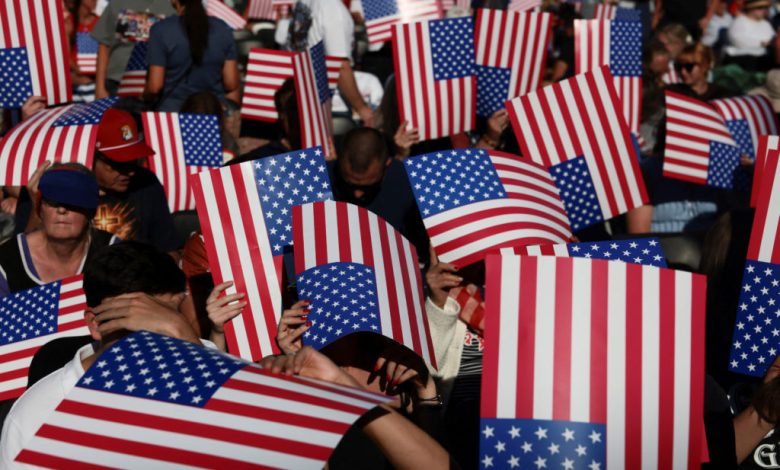
Most Americans believe the country has moved away from its founding principles as the nation prepares for its big 250th anniversary, a new PBS News/NPR/Marist poll finds.
Eighty-three percent of U.S. adults feel America has strayed from the ideals the country was founded on two-and-a-half centuries ago.
Among them, close to half of Americans — 47% — say the U.S. has “moved far away” from these principles, joined by 36% who said America has “moved somewhat away” from them. Another 16% said the country “pretty much still represents” those principles.
About two-thirds of Americans — 65% — say they are “very proud” or “proud” to be an American. Another 35% say they’re “not too proud” or “not proud at all.”
Graphic by Steff Staples/PBS News
Michael D. Holcomb, a Trump supporter who lives in rural northeast Indiana, said it’s not hard for him to be very proud of the country.
“I’ve been patriotic ever since I can remember,” the 72-year-old said. “I started out with nothing. Nobody gave us a hand up or anything, and both my wife and I are retired now. We’re living comfortably and we did it all with the help of ourselves and God.”
But Morgan Fisher, an independent in Huntsville, Texas, said she’s not so proud of the country today. To Fisher, 24, it’s “embarrassing” that the U.S. has poor infrastructure and, unlike many other developed nations, does not offer universal healthcare.
“We are currently sending more money to different countries, such as Israel, rather than investing in our own citizens,” she said. “We all struggle with bills, but being worried about where your next meal is coming from is just ridiculous.”
READ MORE: How Americans are marking the country’s big 2-5-0
Yet sidling those feelings around American pride is a strain of optimism.
“Americans are not ready to toss in the towel,” said Lee Miringoff, director of the Marist Institute for Public Opinion.
How Americans see the nation’s founding ideals
As part of the “America at a Crossroads” series, Judy Woodruff traveled to Vermont to explore what it means to be an American and reflect on what the founders built. Watch the segment in the player above.
Over the last 50 years, Americans’ views of whether the country is living up to its nascent promise has flagged. In 1976, ahead of the nation’s bicentennial, the Roper Organization polled Americans about the nation’s founding principles in the wake of the Vietnam War and President Richard Nixon and the Watergate scandal.
At the time, 30% of adults believed America had moved far away from its founding principles. Today, according to Marist’s poll, that’s jumped to 47%.
“The numbers have gone in the wrong direction,” Miringoff said.
To Beverly Gage, Yale University historian, the shift around ideals may depend, in part, on how people are thinking differently about those founding principles today. There are certain principles, like the embodiment of slavery, that would be good to have moved away from, she said.
But Gage thinks there’s a deeper concern among Americans about some of the nation’s highest ideals — namely, the declaration that all men are created equal, the belief in the pursuit of happiness and the belief in some form of democracy.
“There are lots of people that are really questioning, in this moment, whether those things are true anymore,” she said.
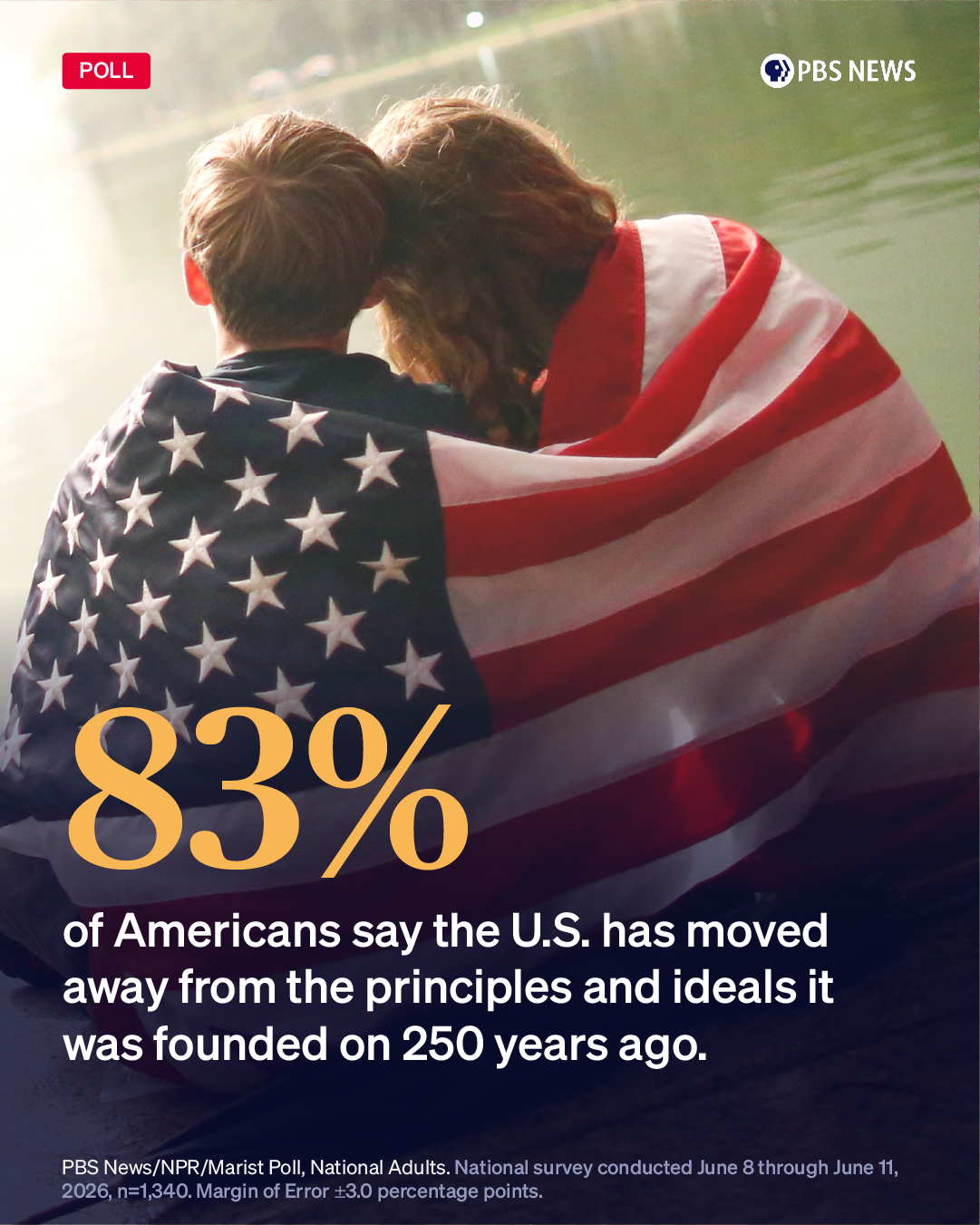
Graphic by Steff Staples/PBS News
Miringoff said that the change reflects Americans’ concern about democracy at risk. (The poll also found that 82% of Americans believe the future of democracy faces a serious threat, up from 78% in February.)
Broken down by party, 53% of Democrats believe that the nation has moved far away from the ideals of the Founding Fathers, while 48% of independents and 42% of Republicans agreed with that sentiment. Republicans (20%) were more likely than Democrats (13%) to say that America still reflected those ideals.
Erica Cates of Appleton, Wisconsin, recalled her excitement around age 9 when the nation celebrated its bicentennial in 1976 – the joy of finding a commemorative coin and everyone donning red, white and blue garb.
Cates, now 58, said this milestone moment, 50 years later, feels like the “celebration has been taken over by just turning it into a big political rally.” She likened President Donald Trump to a “carnival barker” who’s not providing a lot of historical context around his planned anniversary events.
Cates, a Democrat, compared Trump to Gerald Ford, the Republican president who oversaw the nation’s 200th birthday.
Ford “didn’t make it about him. He made it about us,” she said.
How Americans feel about the country right now
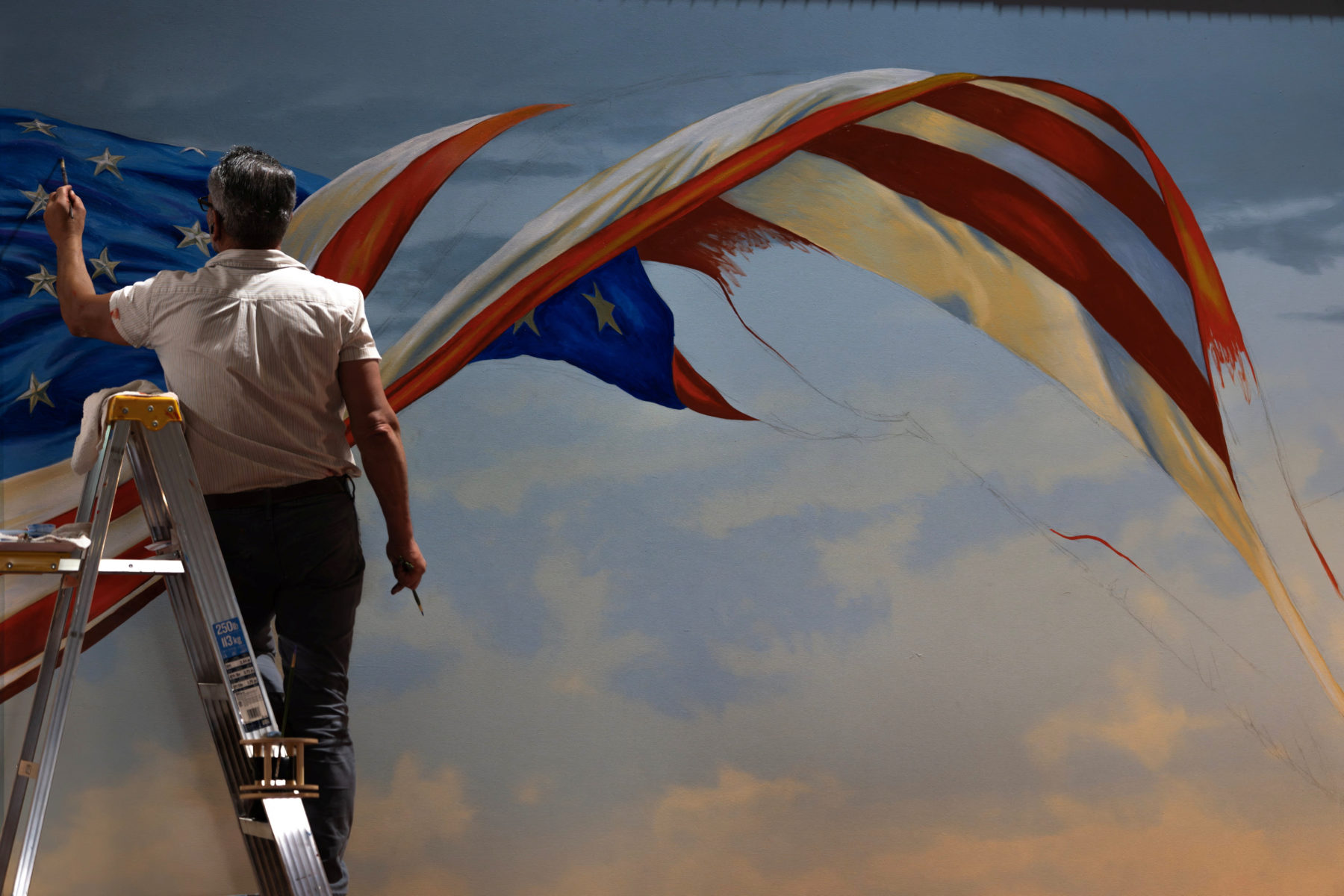
Painter Scott Lobaido works on a painting Thursday at the Great American State Fair on the National Mall. Photo by Nathan Howard/Reuters
The gap between Americans who are proud and those who aren’t widens significantly when looking along political lines. Ninety-three percent of Republicans say they are proud, compared to 61% of independents and 45% of Democrats who would say the same.
Holcomb, an independent who has largely voted Republican, said he has enjoyed the Trump-led semiquincentennial events, which to him try to “show that the country isn’t as bad as people say.”
Veronica Valdivia-Vera, an independent in Ann Arbor, Michigan, is not proud to be an American right now. A naturalized citizen and Mexican American, Valdivia-Vera cited the ongoing immigration enforcement efforts of U.S. Immigration and Customs Enforcement agents as a major cause for concern.
“It’s embarrassing what is happening in this country,” the 50-year-old said. “It’s embarrassing every time President Trump puts foot on an international stage.”
READ MORE: Comparing the mood of America’s 250th anniversary with its 200th in 1976
Still, more than a half of Americans — 53% — believe that the nation’s best days are ahead. That includes 65% of Republicans, 52% of independents and 48% of Democrats.
“They’re still proud, and to some degree, hopeful that we can, at least in the next few years, improve our standing on these kinds of issues that are right now very much front and center for a lot of people,” Miringoff said.
More Americans believe they may have to resort to violence to get the country back on track
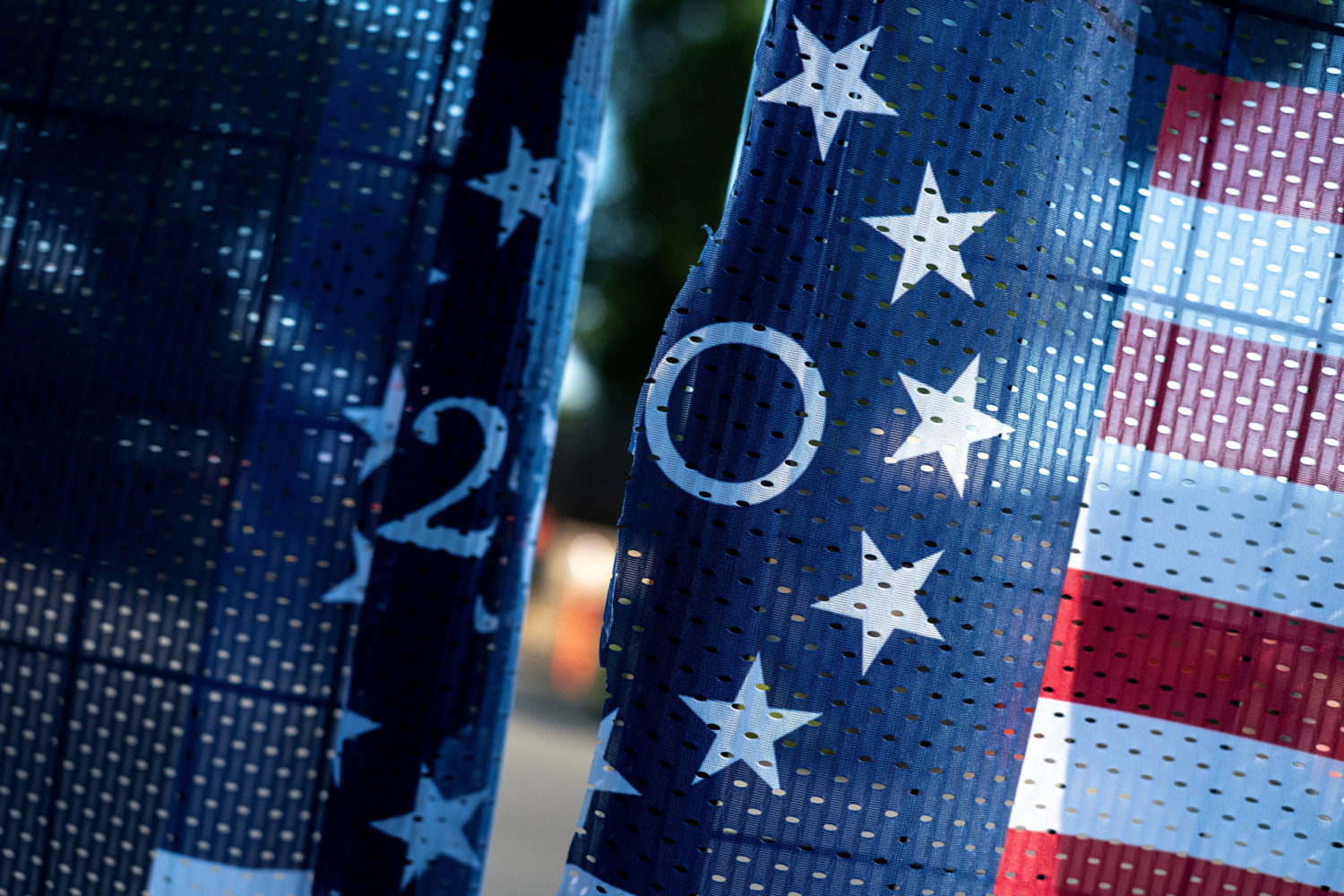
A damaged sign for America 250 at the Great American State Fair in Washington, D.C. Photo by Nathan Howard/Reuters
Thirty-seven percent of adults believe that Americans may have to resort to violence to get the country back on track. That includes 12% who say they strongly agree with that statement.
When Marist asked this question in October, 30% believed that violence may be necessary to course-correct the country.
The finding reflects the view that “the normal functioning of our government is not moving things quickly, or even in a way that’s beneficial to innovation,” Miringoff said, leading to the idea that more extreme measures need to be taken. This is a view held by some on the left and some on the right, he added.
Gage said there’s historical precedent for that fervor for violence. It’s been there from the nation’s beginning.
“Violence is very much a part of the American story,” she said, adding that our founding is a story of violent rebellion against an established government. “It’s baked into the American DNA in lots and lots of ways.”
What makes the current moment distinct, Gage said, is the “seeming popularity or resignation to the idea that violence might become necessary.” There’s also the “widespread nature of gun ownership and the ways that violence can be turned into mass violence much more easily than it could in the past,” she added.
Cates, who has participated in “No Kings” protests in Wisconsin, hopes political violence isn’t necessary.
“I’m hopeful that when people rise up together and use what the Constitution has laid out for us, that some sort of violent turn of events would not need to happen,” she said.
PBS News’ Doug Adams, Matt Loffman, Kyle Midura and Jonah Anderson contributed to this report.
PBS News, NPR and Marist Poll conducted a survey from June 8 to 11, 2026, that polled 1,340 U.S. adults by phone, text and online with a margin of error of 3.0 percentage points, and 1,162 registered voters with a margin of error of 3.3 percentage points. For Democrats, the margin of error is 5.6 percentage points; Republicans, 5.7 percentage points; independents, 5.9 percentage points.
Credit: Source link