Large companies are changing their financing channels from corporate bond issuance to bank loans. As..
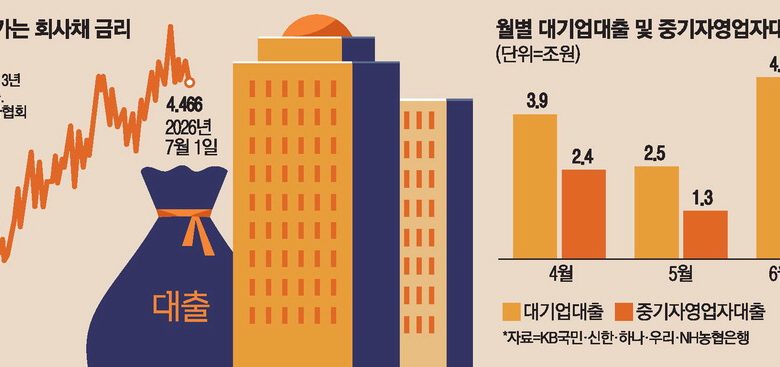
Large companies are changing their financing channels from corporate bond issuance to bank loans. As the interest rate on corporate bonds has risen by 1 percentage point in six months, procurement costs have grown, more and more large companies are knocking on bank doors again. In line with this, banks are also aggressively operating by offering preferential interest rates to large companies with good creditworthiness and low possibility of delinquency.
According to the financial sector on the 2nd, corporate bonds (three years without guarantee) AA-interest rates recorded 4.466% as of the 1st. This is an increase of 0.99 percentage points in six months compared to 3.476 percent at the end of last year.
Until last year, interest rates on corporate bonds were stable. In October last year, interest rates fell below 3%. However, as large amounts of funds have been concentrated on the stock market this year, individual investors have left the bond market, and corporate bond rates have drawn an upward curve. On top of that, investor sentiment has been frozen due to recent events that have encouraged bond market tightness, such as JR Global REITs and applications for corporate rehabilitation of the central group. As a result, interest rates soared to 4.515% on June 11.
As corporate bond rates have soared, large companies with good credit ratings have begun to turn to bank loans. The balance of loans to large corporations by the five major banks (KB Kookmin, Shinhan, Hana, Woori, and NH Nonghyup Bank), which are often treated as loans to large corporations, has risen for six consecutive months since January this year, rising to 190 trillion 364.1 billion won as of the end of June. In the case of last month, it increased by 4.9285 trillion won in a month compared to May, the previous month. Compared to the end of the year, loans to large corporations increased by more than 20 trillion won in six months.
According to the five major banks, it is common for large companies with a credit rating of AA to lend at interest rates ranging from late 3% to early 4%. It is cheaper than issuing corporate bonds to raise funds. In June last year, the balance of loans to large corporations decreased by KRW 5.76 trillion in a month, so there was a focus on issuing corporate bonds rather than loans, but the situation has completely changed this year.
The banking sector is also growing corporate loans as a new food as the financial authorities continue to manage household loans. In particular, large corporate loans with delinquency rates below 0.1 percent are the safest lending destinations for commercial banks. Demand for investment is increasing amid the recent semiconductor and artificial intelligence (AI) boom, and as the corporate bond market is tight, banks are also actively entering the business of large companies.
However, unlike large corporations, loans for small and medium-sized companies and self-employed people are not easily growing despite the government’s all-round productive and inclusive financial pressures. The balance of mid-term loans by the five major banks was 674.4262 trillion won at the end of last year, which only increased by 8 trillion won to 682.7204 trillion won at the end of June this year. Considering that loans to large corporations, whose balances are less than a third, have increased by more than 20 trillion won during the same period, mid-term loans have actually remained flat.
In June, the balance even decreased compared to the previous month. The balance of mid-term loans, which was 684.4572 trillion won in May, decreased by 1.7368 trillion won at the end of June. It is the first time in six months that the balance of mid-term loans has turned negative since December last year.
Banks are saying that mid-term loans should be increased due to the authorities’ productive and inclusive financial stance, but they are not easily expanding it due to the high delinquency rate. At the end of May, the delinquency rate for mid-term loans by the five major banks reached 0.73 percent, compared with a delinquency rate of 0.09 percent for large companies during the same period.
An official from the banking sector said, “In the case of mortgage loans with collateral, it is difficult to increase them in the government’s stance, and mid-term loans have a high capital burden,” adding, “In the end, there are no special restrictions on expansion and we have no choice but to go to safe conglomerates.”
[Reporter Park Inhye]