Can Japan Shake Up the Markets… and Boost Gold Prices?

The remarks made Thursday morning by Japanese politician Nagahama went relatively unnoticed. Yet they deserve our full attention:
“Moderate BOJ rate hikes are important in rectifying excessive yen weakness”
He even added:
“Personally, I feel that the June rate hike was the appropriate decision. Delaying rate hikes would cause an excessive decline in the Yen currency and hurt households more”
These remarks reflect a significant shift in tone. Until now, Japanese authorities had primarily emphasized supporting the economy. Now, the priority seems to be gradually shifting toward defending the yen, whose weakness is having an increasingly direct impact on household purchasing power by driving up the cost of imports.
This concern is far from trivial. The yen has just fallen to its lowest level against the dollar in nearly forty years:
At first glance, this weakness might seem logical: U.S. rates remain significantly higher than Japanese rates, which favors investments in dollars.
However, the bond market is sending an increasingly clear signal:
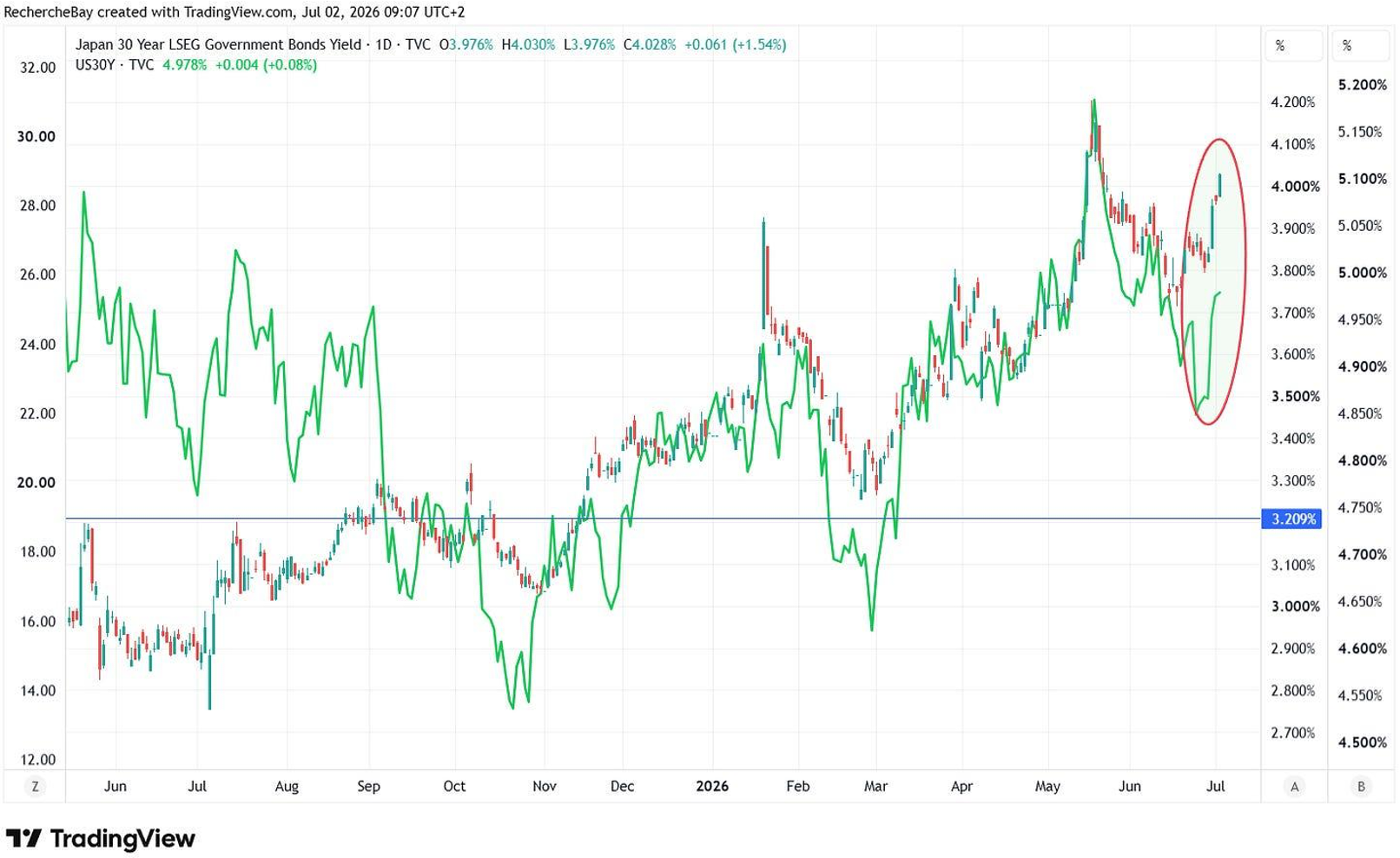
The chart above compares the trends in yields on 30-year U.S. and Japanese government bonds. For several weeks now, Japanese yields have been rising sharply, while U.S. yields have been stabilizing. The yield spread between the two countries is therefore narrowing rapidly.
Historically, such a trend has been accompanied by a strengthening of the yen. Indeed, the closer Japanese yields get to U.S. yields, the less incentive investors have to borrow in yen to finance dollar-denominated investments.
Yet this is precisely what makes the current situation particularly intriguing.
Despite this dramatic rise in Japanese rates, the yen remains extremely weak against the dollar. The foreign exchange market therefore still does not seem to be pricing in the message sent by the bond market.
This divergence is all the more striking given that Japanese authorities are now increasingly making statements in favor of monetary normalization. Markets seem to be gradually anticipating further rate hikes by the Bank of Japan to curb the yen’s weakness, which partly explains the rise in long-term yields observed in recent days.
In other words, the bond market is beginning to price in a shift in monetary policy in Japan, while the foreign exchange market continues to behave as if the yen were set to remain weak for the foreseeable future.
Two explanations are possible:
The first is that currency traders will eventually follow the bond market, causing the yen to appreciate — sometimes sharply.
The second is that the bond market is overestimating the Bank of Japan’s ability to continue its monetary tightening.
At this stage, recent statements by Japanese officials tend to reinforce the first scenario. The yen’s collapse is becoming a major political issue in Japan, as it directly fuels imported inflation and erodes household purchasing power. In this context, the BoJ may be forced to raise rates more quickly than markets had anticipated just a few weeks ago.
This is precisely what poses a growing risk to the yen carry trade. For more than fifteen years, investors have been borrowing trillions of yen at very low cost to finance purchases of U.S. bonds, stocks, credit, or other higher-yielding assets. If Japanese interest rates continue to rise and the yen finally begins to appreciate, some of these positions could be unwound, leading to a withdrawal of liquidity well beyond the Japanese market alone. The risk is that another factor could accelerate this shift: oil.
Japan imports virtually all of its energy. If the physical tightness observed in the oil market were to ultimately lead to a sharp rebound in prices — or even a short squeeze fueled by the record short positions currently seen in the futures markets — Japan’s energy bill would skyrocket immediately. Japanese importers would have to buy more dollars to pay for their oil and gas purchases, further intensifying downward pressure on the yen.
In such a scenario, the Bank of Japan could find itself forced to act much more quickly than it would like. It would then have two options: intervene directly in the foreign exchange market by selling dollars for yen, as it has done on several occasions in recent years, or accelerate interest rate hikes to make Japanese assets more attractive.
The first option is costly and often temporary; the second could trigger a shock not only in the Japanese bond market but also across all global strategies funded in yen.
This is precisely where the main macroeconomic risk lies.
An acceleration of monetary tightening in Japan would sharply increase the cost of yen-denominated financing and could trigger a widespread unwind of the carry trade. Investors would then be forced to reduce their positions across many asset classes in order to repay their yen-denominated loans, withdrawing some of the liquidity that has been fueling financial markets for over a decade.
Ultimately, the yen’s current weakness may not be merely a foreign exchange issue. It could become the starting point for a much broader readjustment of global liquidity. If a rebound in oil prices were to accelerate this trend, Japan might be forced to wind down one of the main drivers of international market financing sooner than expected.
It is undoubtedly this combination — oil, the yen, and the carry trade — that deserves the closest attention today.
This analysis ultimately leads us to consider an asset that could be directly affected by a potential shift in the monetary regime: gold.
For several weeks now, the price of gold has been correcting, not only in dollars but also in yen, driven by the strengthening of the greenback and lower inflation expectations linked to the decline in oil prices. In other words, the market has priced in a relatively optimistic normalization scenario: a strong dollar, falling oil prices, and continued capital flows into U.S. assets.
But if this interpretation were to be called into question, the situation could quickly reverse.
A rebound in oil prices, an acceleration of rate hikes by the Bank of Japan, or unwinding of the carry trade would all be factors likely to weaken the dollar and trigger a massive reallocation of capital. In such an environment, gold would naturally resume its role as a safe-haven asset in the face of financial and monetary risks.
For a Japanese investor, the stakes are even higher. If the Bank of Japan were ultimately to succeed in stabilizing and then strengthening the yen, the currency’s appreciation could initially put automatic downward pressure on the price of gold denominated in yen. But this trend would likely be only temporary. Indeed, unwinding the carry trade would also mean a sharp withdrawal of global liquidity, a rise in volatility in financial markets, and a reevaluation of the leverage strategies that have underpinned valuations for more than a decade. Historically, this type of environment tends to favor reserve assets, foremost among which is gold.
The recent correction in gold priced in yen could therefore present a particularly attractive entry point.
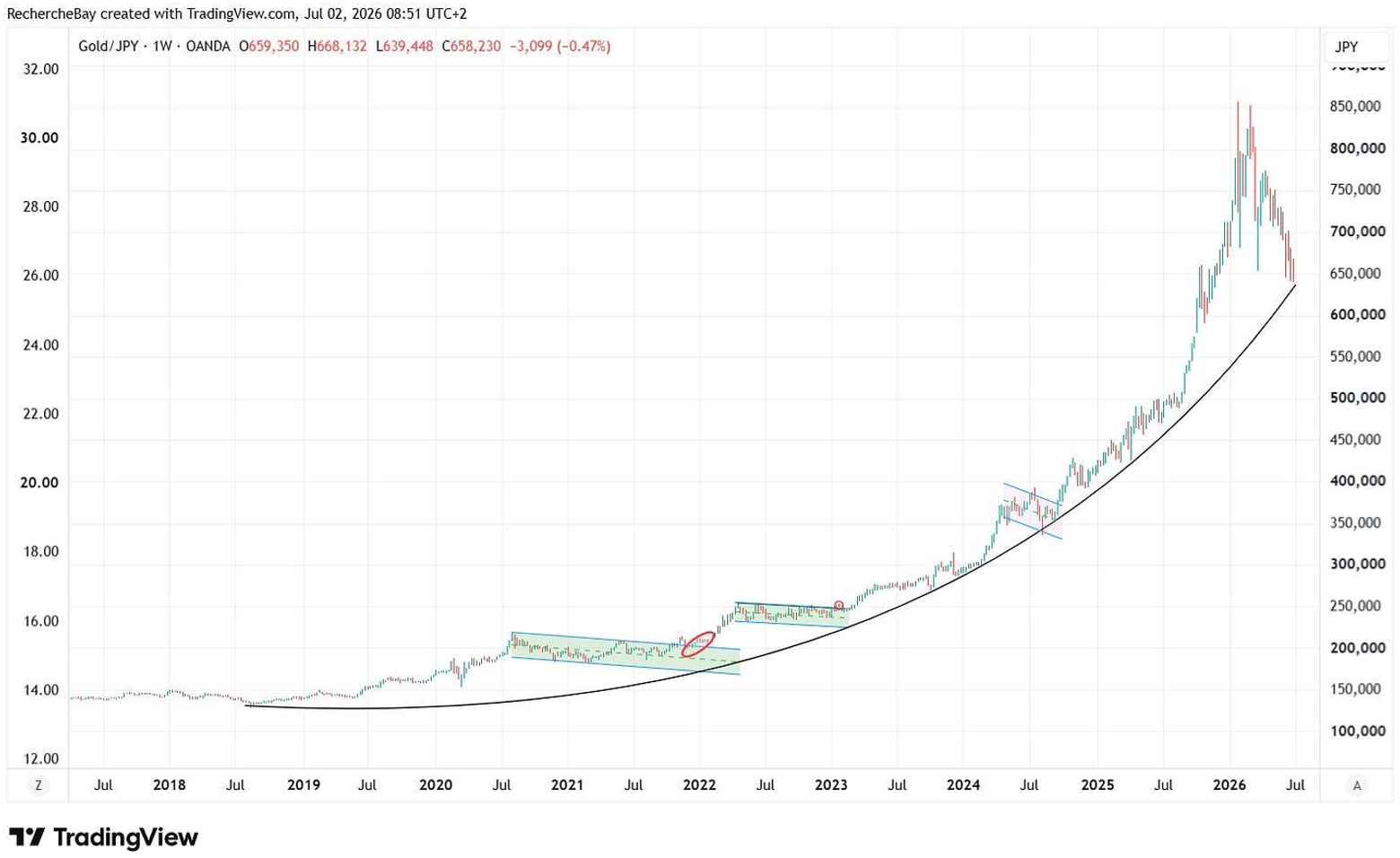
The market currently appears to be favoring the scenario of a persistently strong dollar and a gradual normalization of the global economy. If, on the other hand, Japan were to become the epicenter of a global carry trade adjustment, gold could quickly regain its status as a hedge against liquidity, currency, and financial stability risks.
In other words, gold priced in yen currently offers an interesting asymmetry: the optimistic scenario already appears to be largely priced in, while the risk of a shift in Japan’s monetary policy remains largely unpriced by the markets.
Reproduction, in whole or in part, is authorized as long as it includes all the text hyperlinks and a link back to the original source.
The information contained in this article is for information purposes only and does not constitute investment advice or a recommendation to buy or sell.