N.J.-based Holtec plans IPO to boost sales of its mass-produced small nuclear plants
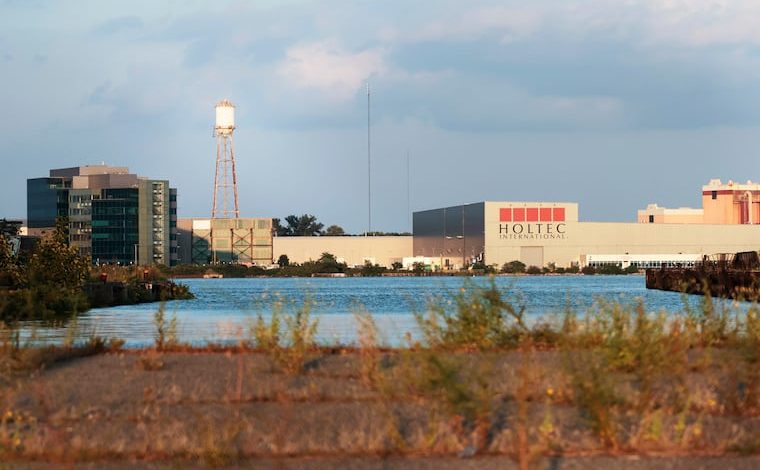
Holtec Nuclear Corp. plans an initial public stock offering that would transform the 40-year-old Camden company from the industry’s well-paid undertaker that shuts down aging uranium plants into a rapid-growth supplier of next-generation mini-nuclear plants and liquid batteries, the company said in a Securities & Exchange Commission filing earlier this month.
Holtec hasn’t settled on a date or floated how much money it wants to raise — or what part of IPO proceeds would go into bringing its factory goods to market versus how much would go to company founder Krishna P. Singh.
Singh and his family would remain the controlling shareholder, even as the IPO potentially boosts Singh’s compensation above last year’s $7.5 million with newly public shares and proceeds.
The 400-page IPO registration describes a highly profitable nuclear service enterprise preparing to market new power products. Holtec has spent years preparing these products, just as federal government support and industry demand brings nuclear power back into fashion.
The products include:
-
Uranium-fueled, water-cooled Small Modular Reactors, designed and mass-produced at the company’s factory on the Delaware River waterfront. The reactors could be sold or leased in groups by Holtec, and each unit swapped out so they can be refueled without shutting off all power.
-
The “green boiler,” a liquid solar-energy storage battery Holtec is testing at facilities that Singh owns in India.
In the statement, Holtec addresses “succession” issues under chief executive Singh, who turns 80 next year. The company says it has a full management team and succession plans in place. It also requires senior officials to travel separately so an accident won’t put them all out of commission.
The company president, who was promoted to the post in April after his predecessor departed, is Holtec veteran Rick Springman, 47. He earned a mechanical engineering doctorate at the University of Pennsylvania, as did Singh, donor and namesake of Penn’s nanotechnology labs. Springman joined Holtec in 2009.
The nuclear industry is attracting renewed interest and investment after decades punctuated by accidents at Three Mile Island (1979), Chernobyl (1986), and Fukushima (2011) when few, if any, new nuclear plants were built.
Nearly 100 existing plants provide nearly 20% of U.S. electricity, and the U.S. plants compose about a quarter of the global nuclear power industry, according to Holtec data.
Among fans of expanding nuclear power are President Donald Trump and private-equity investors building electricity-thirsty AI data centers.
On sales of $567 million last year, Holtec reported $395 million in net income — which looks at first glance like a very fat 70% profit margin.
But the statement notes that half the profits were due to gains on the company’s financial investments. Profits from Holtec products and services were still a comfortable $200 million for a margin of 35%. But that’s down sharply from sales of $766 million and profits of $333 million, the year before.
Most of Holtec’s sales and earnings flowed from an international business in which it is a leading provider: “decommissioning” and shutting down aging uranium-power reactors and building equipment to manage, store and transport spent uranium. Holtec makes that equipment at plants in Turtle Creek, near Pittsburgh; Orrville, Ohio; and Camden.
Holtec says its 2025 financial performance suffers by comparison to its unusually profitable 2024 results. The earlier year was boosted by extra revenues from shutting down the Indian Point nuclear reactor in New York and other payment-scheduling vagaries.
But the company expects U.S. decommissioning work will decline in the near-term, as fewer nuclear stations go out of service — a reversal from the 2010s, when power companies like Exelon shut plants like Three Mile Island because natural gas had become a cheaper fuel.
Since then, demand for nuclear power fast-growing power demand for investor-backed data centers have boosted interest in nuclear power. Aided by the U.S. Department of Energy taxpayer-subsidized loans, Exelon spinoff Constellation Corp. is reopening a Three Mile Island nuclear reactor, and Holtec plans to help bring others back online.
Holtec has been rated below NuScale Power, GE Hitachi and other developers in the competition among U.S. nuclear companies to win Department of Energy (DOE) approval for its modular nuclear plants. But in 2024, the DOE agreed to guarantee a Federal Financing Bank loan of up to $15 billion so Holtec could install its first commercial small reactors — model SMR-300 — at the former Palisades nuclear plant in Michigan, where Holtec was also the decommissioning contractor.
Holtec is also hoping the DOE will give it up to $400 million to speed the Palisades work.
Reopening Palisades is “in the final stages with all major upgrades” completed and smaller jobs done this year for reopening in early 2027, according to the registration statement. Holtec said it can install more small reactors through a partnership with Korea-based Hyundai’s engineering division. Holtec expects the small reactors will prove most attractive in countries that don’t already have nuclear power.
Small reactors could take longer to win regulatory approval, build and install than expected, Holtec says. And success isn’t guaranteed for the recently developed Holtec Green Boiler and new solar-based Holtec systems, which “could drive significant long-term growth opportunities.”
Among the litigation Holtec lists in its registration disclosures is a dispute with the company’s former outside accountants over what Holtec alleges was “inaccurate accounting and tax guidance” and a lawsuit by a former chief financial officer who alleged he was fired in a dispute over investor communications. The company denied wrongdoing.
Despite the recent surge of support for nuclear power, Holtec said, “negative public and political perceptions of nuclear energy” and news of nuclear accidents could still damage the company.
The statement adds, “Our business is dependent, in part, upon public and political support for nuclear power in the United States and other countries” and on projects that can last beyond a single U.S. presidency.