Berkshire Hathaway Earnings Beat As Abel Deploys Buffett’s Cash Hoard
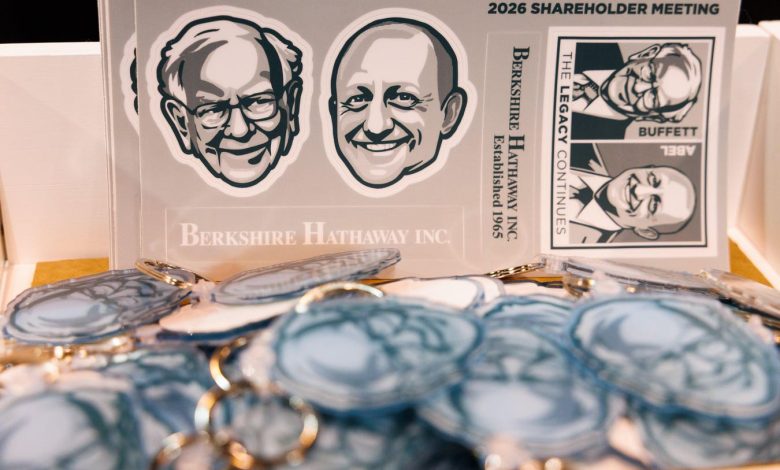
Warren Buffett remains Berkshire Hathaway’s chairman as Greg Abel, who took over as CEO at the beginning of the year, faces his major earnings tests: sustaining operating performance, deploying Berkshire’s massive cash hoard, and proving that disciplined capital allocation remains central to the company’s next chapter. (Nikos Frazier/Omaha World-Herald via Getty Images)
Omaha World-Herald via Getty Images
Berkshire Hathaway (BRK/A, BRK/B) reported second-quarter earnings of almost $25.7 billion, above the $12.4 billion in the same quarter of 2025, due to higher operating profits and investment portfolio gains. Operating earnings, which remove the distortion from market changes and better reflect the firm’s earnings power, grew by 16.3% for the quarter versus 2025. Per-share operating income increased by 16.5% for the quarter, with some more significant share repurchases. At the beginning of this year, Greg Abel took over as CEO, while Warren Buffett retains the title of Chairman. Ajit Jain remains as Vice Chairman of Insurance Operations.
Berkshire Hathaway 2Q 2026 Earnings Summary
Glenview Trust, Berkshire Hathaway
Berkshire’s most significant business by operating earnings is insurance, followed by the manufacturing, service, and retailing (MSR) segment.
Year-To-Date Operating Earnings
Glenview Trust, Berkshire Hathaway
Lower earnings at GEICO hurt Berkshire’s insurance earnings growth in the second quarter. Non-control businesses and other income rose significantly, primarily due to accounting for foreign currency (FX) swings on Berkshire’s non-dollar borrowing. Excluding the FX impact on the “other” segment, operating earnings were 5.2% higher than in 2025. If insurance and FX are excluded, the non-insurance businesses grew operating earnings by 17.8% over 2025.
Operating Earnings By Segment
Glenview Trust, Berkshire Hathaway
Insurance
The two most essential concepts in insurance investing are “float” and underwriting profit. In simple terms, float is created for insurance companies because insurance premiums are paid before any claims are made by the insured. Insurance companies can invest the float, sometimes for years, before reimbursing insurance losses. Berkshire’s float is about $1.1 billion higher than on December 31, 2025, at $177.5 billion. In general, the value of float increases as yields rise since an insurance company can earn more when investing the cash. Float per share was $123,979, above the $122,373 level at the end of 2025. Share repurchases also aided year-to-date growth in per-share float.
Insurance Float
Glenview Trust, Berkshire Hathaway
Unlike many insurance companies, Berkshire has a history of earning underwriting profits, meaning its float costs nothing and generates income, allowing it to profit from investing it. Berkshire has three main insurance businesses: GEICO, Berkshire Hathaway Primary Group, and Berkshire Hathaway Reinsurance Group. All three had a profitable underwriting quarter. Underwriting profit is the positive difference between the insurance premium and all insurance claims and expenses. For example, GEICO had a combined ratio of 91.2% in the second quarter, meaning that 91.2 cents of every dollar of insurance premiums was spent on losses and expenses. A combined ratio above 100% indicates an underwriting loss for an insurance company.
For the quarter, investment income was 9.1% below 2025, primarily due to lower short-term interest rates.
Insurance: Combined Ratios
Glenview Trust, Berkshire Hathaway, Bloomberg
Abel said at the annual meeting that the insurance business is “becoming a more challenging environment” with more “capital coming into the industry.” He expects a softening in the insurance business for the remainder of the year. The culprit in the 13.1% decline in operating earnings within insurance underwriting for the second quarter was GEICO. GEICO experienced an increase in claims frequency and average severity. In addition, higher commissions and advertising expenses weighed on the bottom line.
Railroad
Berkshire owns one of the largest railroads in North America, Burlington Northern Santa Fe (BNSF), which operates in the US and Canada. Railroad freight volume grew by 6.5% versus 2025, and operating earnings rose 6.3% versus last year. BNSF’s trailing 12-month operating ratio —operating expenses divided by revenue — deteriorated a bit in the second quarter, demonstrating a small step back in the trend of improving productivity gains.
BNSF: Trailing 12-Month Operating Ratio
Glenview Trust, Berkshire Hathaway, Bloomberg
BNSF continued to see improved productivity on a quarter-over-quarter basis, though.
BNSF Operating Ratio: Quarterly
Glenview Turst, Berkshire Hathaway, Bloomberg
Utilities and Energy
Berkshire Hathaway Energy (BHE) should generally provide steady, growing earnings, as it primarily consists of regulated utilities and pipeline companies. In addition, BHE typically generates significant tax credits from its renewable energy generation. For this reason, Berkshire focuses on after-tax earnings, which is “how the energy businesses are managed and evaluated.”
BHE: Year-To-Date After-Tax Earnings
Glenview Trust, Berkshire Hathaway
BHE was positive on the headline numbers, with after-tax operating earnings rising 26.9% year over year for the second quarter. After-tax earnings were driven by better results from the US utilities and natural gas pipeline business and higher federal income tax credits, partially offset by lower earnings from other energy businesses and real estate brokerage. Real estate earnings were lower than in the second quarter of 2025, primarily due to charges from the settlement of real estate industry litigation.
BHE: After-Tax Earnings
Glenview Trust, Berkshire Hathaway
Manufacturing, Service, and Retailing (MSR)
Pretax earnings grew by 25.8% versus the second quarter last year. This segment comprises many diverse companies so this analysis will highlight some of the group’s strengths and weaknesses.
MS&R Year-To-Date Pre-Tax Earnings
Glenview Trust, Berkshire Hathaway
Abel spoke at the annual meeting about Clayton Homes as a bellwether for Berkshire’s housing-related building-products businesses. As evidence of the pressure on that sector of the economy, Clayton’s pre-tax earnings for the quarter were 3.5% lower than in 2025. Despite the weakness in the sector, Berkshire acquired Taylor Morrison Home Corporation, a homebuilder, on July 24, 2026. It will be included in its building products group beginning next quarter.
On a positive note, robust aerospace demand has been a tailwind for Berkshire’s businesses in the space. Precision Castparts, which provides aerospace parts, grew pre-tax earnings by 34.2% year-over-year. The service group saw a 20.6% increase in pre-tax earnings for the quarter, primarily attributable to TTI, an electronic component distributor, and aviation services (NetJets and FlightSafety).
The 12.2% pre-tax earnings growth in consumer products was driven primarily by Duracell, Jazwares, and Brooks Sports. Unfortunately, the improvement in Duracell was due to the recognition of US tax credits rather than a fundamental business improvement. Brooks and Jazwares saw better sales and margins, in addition to trade tariff refunds received in the quarter.
The retailing group reported slightly higher pretax earnings, up 2.9% for the quarter. The most critical part of the retailing segment is Berkshire Hathaway Automotive (BHA), which owns more than 80 auto dealerships. BHA reported 5.1% higher earnings than in 2025. Pretax profits for the remainder of the retailing group declined by 2.8% due primarily to “sluggish customer demand.”
Pilot Travel Centers (PTC) is the largest operator of travel centers in North America under the Pilot and Flying J brands. On January 16, 2024, Berkshire acquired the final 20% and now owns 100% of the entity. PTC’s pretax earnings increased 143.7% due to higher gross margins and increased revenues due to higher fuel prices.
MS&R: Earnings Detail
Glenview Trust, Berkshire Hathaway
Non-Controlled Businesses & Other
This segment includes companies’ profits that must be accounted for under the equity method due to the size of ownership and influence on management. The after-tax equity method earnings have Berkshire’s proportionate share of profits attributable to its investments in Kraft Heinz (KHC), Occidental Petroleum (OXY), and Berkadia. Berkshire is Occidental Petroleum’s largest shareholder, with a 26.9% stake. More about the reasons for the Occidental investment is here.
The interest income improved due to “increased investments in U.S. Treasury Bills, which derived largely from capital distributions from Berkshire subsidiaries.” The foreign currency exchange rate gains were generated by Berkshire Hathaway bonds denominated in British Pounds, euros, and Japanese Yen. These foreign-currency swings are not a concern, as Berkshire has significant assets and earnings denominated in these currencies. Investment gains from non-U.S. dollar investments generally offset some of these losses and vice versa, depending on currency exchange rates.
Equity method earnings were higher due to better earnings at Kraft Heinz (KHC). Acquisition accounting expenses are also reflected in this segment. These expenses result from the amortization of intangible assets acquired by Berkshire. Finally, the loss in other earnings includes “unallocated general and administrative expenses, interest expense, income tax expense and interest income on certain intercompany loans.”
Other: After-Tax Earnings
Glenview Trust, Berkshire Hathaway
Investment Portfolio
Berkshire’s insurance company investment portfolio is currently 58% publicly traded stocks, with 38% in cash.
Investment Portfolio: $553.3 Billion
Glenview Trust, Berkshire Hathaway
After being a net seller of publicly traded equities for fourteen straight quarters, Berkshire was finally a net buyer of almost $19.8 billion in publicly traded stocks in the second quarter. Berkshire bought $23.5 billion of stocks while selling $3.7 billion, so it was another busy quarter. As previously announced, Buffett negotiated to buy $5 billion of Alphabet Class C (GOOG) and $5 billion of Class A (GOOGL), so that is the known portion of the purchases so far. The remaining actual transactions won’t be known until the upcoming 13F filing on Friday, August 14.
Summary And Scorecard
Short-term results are generally not meaningful for Berkshire, which is managed with a focus on increasing long-term value rather than meeting quarterly hurdles. This ability to exploit time arbitrage has served the company and its shareholders well over the years. The goal of the review is to assess whether the segments are generally operating as expected and to consider Greg Abel’s capital allocation decisions, which he became solely responsible for at the beginning of 2026.
Previously, Buffett provided a handy blueprint for Berkshire’s management goals. The first goal would be to “increase operating earnings.” Secondly, success in the “decrease shares outstanding” goal would boost operating earnings per share faster. Lastly, “hope for an occasional big opportunity,” allowing for a sizable cash investment at an attractive expected return. This analysis will use Buffett’s blueprint as a lens through which to evaluate how Berkshire is performing, even while Greg Abel is at the helm.
Increase operating earnings: Trailing 12-month operating earnings were 5.7% higher than last year. Notably, trailing 12-month operating earnings are only 1.6% below the all-time high set in the third quarter of 2025. Buffett says that operating earnings are the “most descriptive” way to view Berkshire, as they remove the short-term volatility of market fluctuations from net earnings.
Trailing 12-Month Operating Earnings
Glenview Trust, Berkshire Hathaway, Bloomberg
Decrease shares outstanding: Particularly since 2018, a significant capital allocation decision has been made to increase share repurchases. When Berkshire Hathaway actively repurchases shares, it signals that Abel believes its share price is below his intrinsic value estimate. If he is correct, the purchases are a value-creator for the remaining shareholders. Berkshire has stated that it would not repurchase stock if doing so would cause cash levels to fall below $30 billion, thereby ensuring the firm’s safety. After some small purchases in the first quarter, Berkshire repurchased over $4.5 billion of its stock in the second quarter.
Berkshire Hathaway: Share Repurchases
Glenview Trust, Berkshire Hathaway
Until an announcement in mid-2018, Berkshire had repurchased stock only when it traded at less than 1.2 times its price-to-book (P/B) ratio. While that constraint is now relaxed, it remains a good indicator of the general range of when aggressive repurchases are likely to occur. Berkshire only intends to repurchase shares when the “repurchase price is below Berkshire’s intrinsic value, conservatively determined.” The price-to-book ratio remains a reasonable proxy for gauging Berkshire’s intrinsic value. The stock repurchases in the second quarter were made at around 1.4 times book value, which is where we have seen previous buybacks. Still, Greg Abel’s judgment about its intrinsic value relative to other uses of capital can differ from the simple price-to-book ratio. While Abel had previously stated clearly that share repurchases remain part of his value-creation toolbox, he backed that up with action in the second quarter.
Berkshire Hathaway: Price-To-Book Ratio
Glenview Trust, Berkshire Hathaway, Bloomberg
A longer-term view of the positive impact of Berkshire’s share repurchases is illuminating. Since the start of more aggressive share repurchases in 2018, Berkshire’s operating earnings have grown at a 15.2% compound growth rate, while operating earnings per share have done 1.8 percentage points better at 17.0%.
Annualized Earnings Growth Rates
Glenview Trust, Berkshire Hathaway, Bloomberg
Hope for an occasional big opportunity: Even after being able to deploy some capital in the second quarter, Berkshire has a fortress balance sheet with cash and equivalents of $365.5 billion. Cash as a percentage of Berkshire Hathaway’s size remains elevated, at 28.9%. Though this analysis quotes the cash levels listed on the balance sheet at the end of the quarter, accounts payable for the purchase of Treasury Bills should be subtracted, resulting in a slightly lower total cash of $362.3 billion. In any case, the narrative remains unchanged. This cash hoard provides flexibility to take advantage of opportunities, including repurchasing its stock.
In addition to buying back a significant number of its own shares at reasonable prices, Berkshire was finally able to seize other reasonably large opportunities. Warren Buffett negotiated a $10 billion investment in Alphabet (GOOG, GOOGL) at a discount. Berkshire acquired Taylor Morrison Home Corporation, a homebuilder, on July 24, 2026, for about $6.8 billion in cash, with a total enterprise value of about $8.5 billion.
Berkshire Hathaway: Cash
Glenview Trust, Berkshire Hathaway, Bloomberg
Summary Conclusions
Greg Abel continued his reign as CEO with another better-than-expected earnings report. Berkshire’s second-quarter operating earnings rose by 16.3% year-over-year. The insurance business was the main detractor from earnings, in particular, GEICO. Foreign exchange gains were also a significant tailwind. Stripping out the impact of foreign exchange (FX) is probably a better measure of earnings growth, with a still respectable 5.2% year-over-year increase. Additionally, insurance earnings are inherently volatile, so excluding FX and insurance, operating earnings grew 17.8% year-over-year.
While the second quarter earnings were moderately better than expected and should improve 2026 estimates, insurance headwinds will likely keep Berkshire’s full-year operating earnings growth at the low to mid-single digits.
Abel was very focused on “operational excellence” as an opportunity for Berkshire going forward. It’s too early to judge progress there, but excluding insurance, the pre-tax profit margins of all segments except the BNSF railroad improved in the second quarter over 2025.
Intrinsic Value
Berkshire’s stock price underperformed the S&P 500 in the second quarter, rising by 4.3% versus a total return of 15.2% from the S&P 500. As stocks have rallied sharply since the end of the quarter, the year-to-date underperformance has widened through August 7: Berkshire Hathaway is up 3.5%, while the S&P 500 has a total return of 14.1%.
Estimated Year-Over-Year Intrinsic Value Growth
Glenview Trust, Berkshire Hathaway, Bloomberg
While poor short-term stock performance should generally be ignored, that is easier said than done. Using book value per share as a measure of intrinsic value, Berkshire grew its underlying value by 12.5% over the trailing twelve months. Despite this improvement in intrinsic value, the stock rose only 11.4% over the twelve months ending August 7. Berkshire is almost certainly not going to be able to grow operating earnings and intrinsic value as quickly as it once did, simply because of its size. Still, the fortress-like balance sheet and reasonable valuation should provide an attractive risk-to-reward for conservative investors. Finally, seeing significant capital employed in the second quarter, including the repurchase of shares at an attractive price, also bodes well for continued intrinsic value growth.