A $920,000 Portfolio That Quietly Pays You $5,400 a Month Without Touching Principal
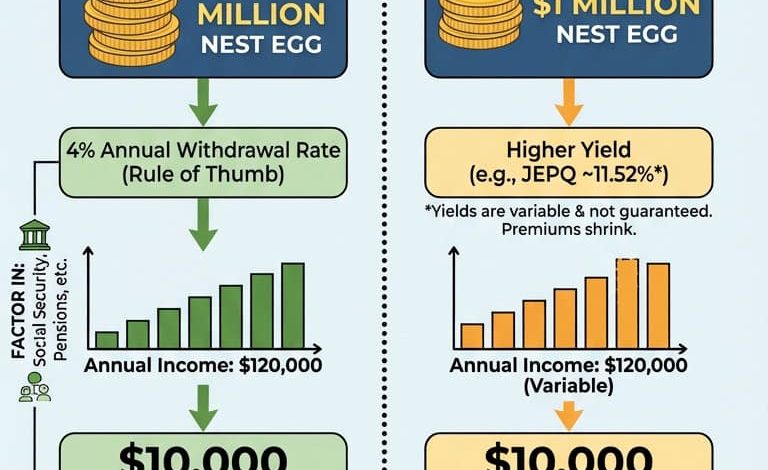
Sixty-four thousand eight hundred dollars a year. That is what $5,400 per month works out to, and it happens to be roughly what a comfortable retirement costs in most of the country once housing is paid off. The question is what portfolio can throw off that check every month without you selling a single share.
The math is unforgiving. $64,800 divided by $920,000 equals a blended yield of just above 7%. That number tells you exactly where on the risk spectrum you are standing. It is well above the 4.7% 10-year Treasury yield, which means you are getting paid a real premium, and you are taking real risk to earn it.
The Three Yield Tiers, With Real Capital Requirements
Conservative tier (3% to 4%). This is the dividend growth sleeve, anchored by broad dividend ETFs like Schwab U.S. Dividend Equity ETF (NYSEARCA:SCHD), whose top positions include QUALCOMM at about 7%, Texas Instruments at about 6%, and UnitedHealth Group at about 5% of net assets. At 3.5%, replacing $64,800 needs roughly $1,851,000 in capital. The upside: dividend growth compounds and principal tends to appreciate. The catch: you need almost twice the capital of the aggressive tier.
Moderate tier (5% to 7%). This is where the $920,000 story lives. Names like Realty Income (NYSE:O | O Price Prediction), Enterprise Products Partners (NYSE:EPD), and Altria (NYSE:MO) sit in this range. Realty Income currently yields around 5.2% with a $3.252 annualized dividend and 115 consecutive quarterly increases. Enterprise Products yields roughly 5.8%, with a Q3 2026 distribution of $0.56 per unit, up from $0.55. Altria yields around 6.5% off a $1.06 quarterly dividend. At a 6% blended average, $64,800 requires $1,080,000.
Aggressive tier (8% to 12%). Business development companies live here. Ares Capital currently yields 9.6% and paid a $0.48 quarterly dividend, unchanged for eight consecutive quarters. Main Street Capital pays a $0.265 monthly regular dividend plus a $0.300 quarterly supplemental, totaling $4.31 over the trailing 12 months. At a 10% blend, replacing $64,800 needs just $648,000. The tradeoff is the one investors keep learning the hard way: BDC distributions can be cut in recessions, and net asset values fluctuate with credit conditions.
Why 7% Is the Sweet Spot for $920,000
A blended sleeve that mixes Realty Income at roughly 5%, Enterprise Products near 6%, Altria near 7%, Main Street near 7% to 8%, and Ares Capital near 9%, with a slug of SCHD as the growth anchor, produces something close to a 7% weighted yield without leaning on leverage or covered-call NAV erosion.
Coverage matters more than yield. Realty Income’s 2026 AFFO guidance of $4.44 to $4.45 per share comfortably covers the $3.25 dividend. Enterprise Products reported 1.9x distributable cash flow coverage last quarter. Main Street beat consensus at $1.04 adjusted EPS versus $0.96. Those are the numbers that decide whether $5,400 keeps hitting the account next year.
The Insight Most Readers Miss
Here is the counterintuitive part. A 3.5% yield growing 8% annually doubles the income in nine years. A 10% yield that stays flat, or drifts down as principal erodes, is worth less in real dollars every year. With CPI running at a percentile rank of 81.8 over the past 12 months, flat distributions quietly lose ground. The 7% blended portfolio splits the difference: enough current income to live on, enough growth-oriented names to protect purchasing power.
What to Do Next
- Calculate your actual spending, not your salary. Many readers targeting $5,400 monthly actually need less once they subtract payroll taxes, retirement contributions, and commuting costs from their working-years budget.
- Compare 10-year total returns. SCHD returned 236% over 10 years, versus Ares Capital’s 236%. Nearly identical, but the paths are wildly different.
- Model the tax location. Enterprise Products issues K-1s, and BDC and REIT distributions are ordinary income. Keep them in IRAs when possible; hold SCHD-style qualified dividends in taxable.
One caveat worth stating plainly: a 7% yield carries real risk. BDCs cut dividends in credit downturns, MLPs can trim distributions when energy capex cycles turn, and REIT prices swing hard with the 10-year yield. The $920,000 works only if the underlying businesses keep earning what they pay out.
Contact [email protected] for any questions or corrections.