Hyperliquid Wants to Bring Perpetual Futures to the U.S. Here’s Why the CFTC Is the Way In
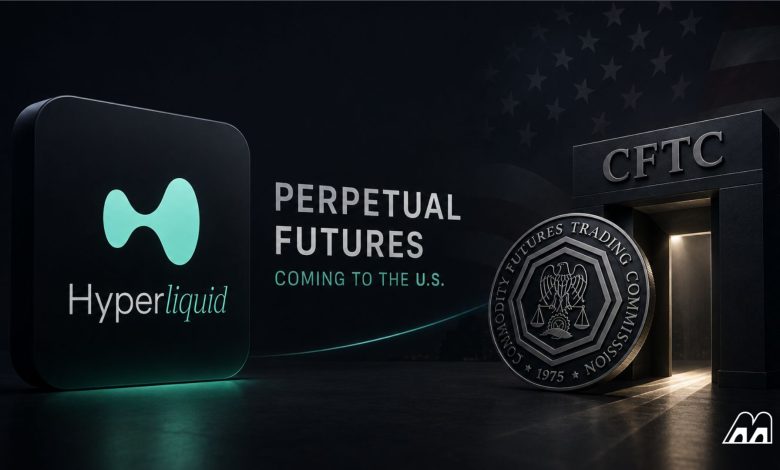
The largest decentralized perpetual futures exchange in crypto has decided it cannot afford to wait for Congress.
Hyperliquid is actively working with U.S. regulators to find a compliant path for offering perpetual futures to American traders, according to a report from The Information published on August 12. The push comes days after the U.S. Senate postponed the CLARITY Act vote until September, leaving crypto’s most important market structure bill in limbo through the August recess.
The CLARITY Act does not cover perpetual futures or vaults. Even if the bill passes, platforms like Hyperliquid would still need separate regulatory clearance. So instead of waiting for legislation that may not address its core product, Hyperliquid is going straight to the agencies.
What Hyperliquid Actually Wants From the CFTC
Jake Chervinsky, CEO of the Hyperliquid Policy Center, outlined the preferred path. The ideal scenario is not building a brand-new U.S. exchange from scratch. Instead, Chervinsky wants the CFTC to allow institutions that already hold U.S. licenses to offer perpetual futures trading on Hyperliquid’s blockchain infrastructure.
Hyperliquid currently geo-blocks American users entirely. It does not hold a CFTC-registered designated contract market license. Rather than applying for one and rebuilding its architecture to fit legacy compliance structures, the platform wants licensed intermediaries to act as the regulated access point while the blockchain handles execution, clearing, and settlement.
The CFTC already moved in this direction. In May 2026, it approved Kalshi’s BTCPERP contract as the first regulated perpetual futures product on a U.S. exchange. The same day, the agency granted Coinbase no-action relief to route customers into perpetual contracts listed on its offshore Deribit affiliate. CFTC Chairman Mike Selig has publicly advocated for bringing perpetual futures onshore since being confirmed in December 2025.
Chervinsky’s argument: if the CFTC already trusts licensed entities with perps, it should trust them to deploy that product on a blockchain that provides full transparency.

The Meetings Have Already Started
Hyperliquid has not been waiting for the right moment. The Hyperliquid Policy Center, funded by the Hyper Foundation with 1 million HYPE tokens, has been running a coordinated regulatory campaign since launching in February 2026.
On July 14, representatives including Hyperliquid Labs founder Jeff Yan and Sullivan & Cromwell LLP met with the SEC’s Crypto Task Force. According to an SEC memorandum, the discussion covered the Hyperliquid ecosystem’s technology and potential pathways for compliant on-chain market access.
Days earlier, the Policy Center and non-custodial wallet Phantom submitted a joint comment to the CFTC urging two clarifications: that on-chain software developers should not automatically face exchange or clearinghouse registration requirements, and that licensed firms should be allowed to use blockchain infrastructure for the full trade lifecycle from order matching to settlement.
The core argument is that self-custodial trading does not fit rules designed for traditional intermediaries. Users retain control of their own funds while the blockchain records and validates transactions.
Why RWA Trading Makes This Harder
Here is where the regulatory puzzle gets genuinely complicated.
Hyperliquid is no longer just a crypto derivatives venue. During Q2 2026, approximately 32% of the platform’s perpetual futures volume came from tokenized real-world assets, including stocks like Nvidia and Tesla, commodity contracts for crude oil, gold, and silver, and pre-IPO perpetuals for companies such as SpaceX. The open interest in RWA perpetuals hit $3.6 billion for the first time in July, driven largely by HIP-3 builder-deployed markets.
This expansion creates a jurisdictional problem. Commodity-linked contracts fall under CFTC authority, but products tied to equities could simultaneously trigger SEC oversight. Bitwise CIO Matt Hougan projected that non-crypto volume could reach 70% of Hyperliquid’s total by year-end, making the dual-regulator question even more pressing.
That is likely why Hyperliquid is engaging both agencies. The platform needs a framework that addresses commodity perps, equity perps, and prediction markets under one coherent approach. No existing U.S. regulatory blueprint does all three.

What’s at Stake for Hyperliquid and the Broader Market
The numbers explain the urgency. Hyperliquid processed over $190 billion in trading volume in the past 30 days, according to DefiLlama. That is nearly five times the volume of Aster, its closest competitor. The platform commands roughly 70% of on-chain perp volume globally, with annualized revenue estimated between $800 million and $1.3 billion.
Yet American traders cannot access any of it. Meanwhile, Kalshi has already listed perpetual futures tied to HYPE itself an ironic situation where Hyperliquid’s own token trades as a regulated perp in a market the platform cannot enter.
Competitive pressure is building. Coinbase routes U.S. customers into Deribit’s perpetuals. Robinhood launched perpetual futures through decentralized exchange Lighter on its Arbitrum-based chain. CME and ICE have pushed the CFTC to scrutinize Hyperliquid directly, citing market manipulation and sanctions evasion risks.
If Hyperliquid cracks U.S. access before competitors consolidate the regulated perps market, the volume expansion could be significant. If it doesn’t, it risks watching the market develop around it while licensed competitors replicate its model within compliant wrappers.
HYPE Price Reaction
HYPE rose approximately 4.2% in the 24 hours following the news, trading around $57.3 according to CoinGecko. The token is down roughly 25% from its all-time high of $76.70 set in June 2026, but institutional interest remains active. Hyperliquid ETFs returned to net inflows in the week ending August 7, adding $2.84 million after three consecutive weeks of outflows. Cumulative HYPE ETF inflows stand at $280.8 million.

FAQs
Is Hyperliquid available in the U.S.?
No. Hyperliquid currently geo-blocks U.S. users because perpetual futures do not fit clearly within existing U.S. derivatives regulations. The platform is actively seeking a CFTC-approved pathway to change that.
What are perpetual futures?
Perpetual futures are derivative contracts that let traders speculate on an asset’s price without an expiration date. They use a funding rate mechanism to stay aligned with spot prices and are the most traded derivative instrument in crypto.
Has the CFTC approved perpetual futures in the U.S.?
Yes. In May 2026, the CFTC approved Kalshi’s BTCPERP contract as the first regulated bitcoin perpetual on a U.S. exchange. The agency also granted Coinbase no-action relief to offer perpetual contracts through its offshore Deribit subsidiary.
What is the CLARITY Act and how does it affect Hyperliquid?
The CLARITY Act is a U.S. crypto market structure bill that would divide digital asset oversight between the SEC and CFTC. It does not cover perpetual futures or vaults, which is why Hyperliquid is pursuing a direct regulatory path instead of waiting for legislation.
How big is Hyperliquid compared to other exchanges?
Hyperliquid is the largest decentralized perpetual futures exchange by volume, processing over $190 billion in the past 30 days and controlling roughly 70% of on-chain perp volume globally.