Gold firms as Treasury yields ease; Fed minutes in focus
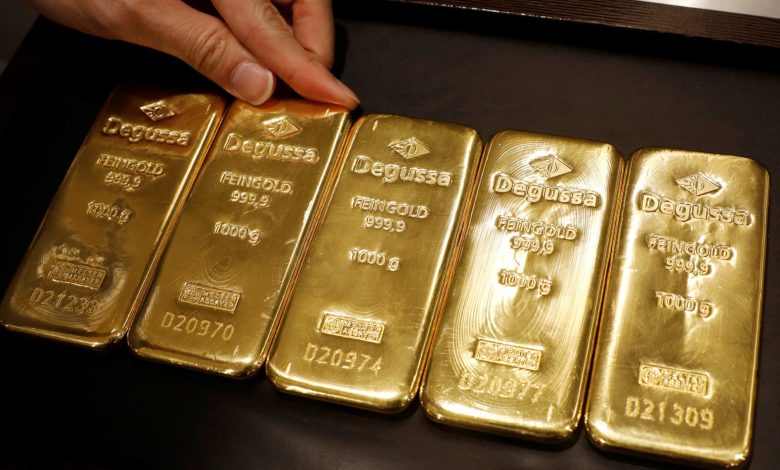
Gold rose on Wednesday as Treasury yields eased, with investors awaiting minutes of the U.S. central bank’s July meeting for fresh clues on the monetary policy outlook.
Edgar Su | Reuters
Gold rose on Wednesday as Treasury yields eased, with investors awaiting minutes of the U.S. central bank’s July meeting for fresh clues on the monetary policy outlook.
Spot gold climbed 0.5% to $4,356.55 per ounce by 0327 GMT after falling nearly 2% on Tuesday, while U.S. gold futures slipped 0.2% to $4,410.20.
U.S. yields backed off earlier highs on Tuesday, switching directions amid a global bond selloff that saw long-term borrowing costs in major economies edge toward their highest levels in decades.
Reduced expectations for Federal Reserve interest rate hikes and rising fiscal budget concerns are positive factors for gold, said Kelvin Wong, a senior market analyst at OANDA.
The minutes of the Federal Open Market Committee’s July meeting are scheduled for release at 1800 GMT.
Traders are pricing in a 64% probability of a Fed hold and a 36% chance of a rate hike next month, according to the CME FedWatch Tool. Bets for a hike have declined after a series of soft U.S. economic data.
Lower interest rates reduce the opportunity cost of holding gold.
“A sustained break above $4,390 could open the door (for gold) towards $4,505, while a break below $4,300 could expose $4,200 and $4,150,” said Lukman Otunuga, head of market research at FXTM.
On the geopolitical front, U.S. President Donald Trump said on Tuesday that no talks were taking place with Iran and insisted the Strait of Hormuz was open, contradicting Iran’s assertion that the critical waterway remained shut to shipping.
Oil prices gained for a fourth straight session.
Among other metals, spot silver slid 0.4% to $63.03 per ounce, platinum gained 0.5% to $1,720.10 and palladium held steady at $1,289.45.
TD Securities said silver and platinum group metals were expected to benefit from a supportive macroeconomic backdrop in the second half of 2027, with easing inflation risks, a weaker U.S. dollar and lower carry costs likely to drive a stronger price response than gold.