Governors Promote ‘Dignity in Politics’
This article is part of Governing’s Inside Politics newsletter. Sign up to subscribe. Also in this issue of Inside Politics: A County Government Fiasco in Kansas City.
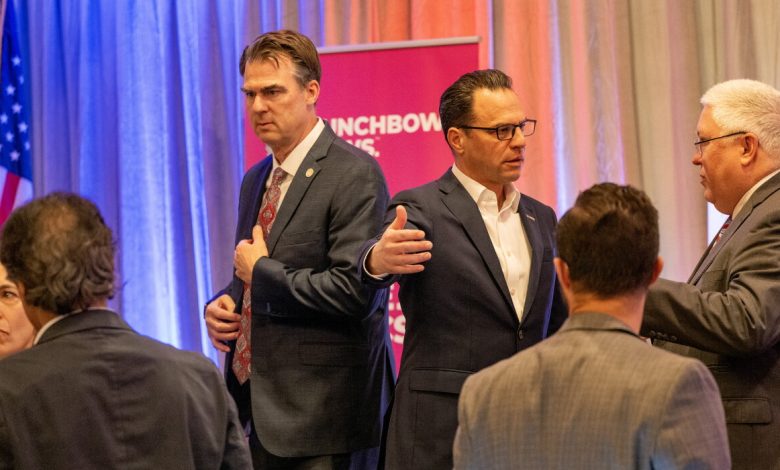
The National Governors Association (NGA) prides itself on being a collegial institution. It brings together governors from different parties to discuss common goals and challenges among the states, highlighting their bipartisan cooperation as a kind of antidote to the bitterness of national politics. But the going isn’t always smooth.
Last year, a handful of Democratic governors skipped the NGA’s summer meeting and threatened to defect from the organization altogether, citing the association’s quiescence in the face of the Trump administration politicizing federal grants and deploying National Guard troops across state lines in support of its immigration crackdown. Early this year, Trump publicly disinvited two Democratic governors from the annual White House dinner. The NGA scrambled to patch things up, coordinating a separate White House meeting to which all governors were invited. But the rifts were on display.
The NGA is always chaired by a state governor, switching between Republicans and Democrats each year. But the organization itself is led by an executive director, who manages the day-to-day operations and promotes the work of governors around the country. Last fall, as tensions between state leaders were rising, the NGA announced the retirement of Bill McBride, who’d led the organization since 2019. It replaced him with Brandon Tatum, a former leader of the Regional University System of Oklahoma and a former chief of staff for Oklahoma Gov. Kevin Stitt, a Republican.
Tatum recently spoke with Governing about the role of the NGA in the current political environment. The interview has been edited for length and clarity.
Governing: You just finished the Summer Meeting in Oklahoma City. What were the big themes that stuck out to you from that, either in terms of policy issues or the relationships among the governors?
Brandon Tatum: It was a great summer meeting. We had an excellent turnout. We had our first national governors’ town hall, with NBC News, moderated by Kristen Welker of Meet the Press. We had four of those town halls. Each one had a Republican governor and a Democratic governor tackling different issues. Things like permitting reform. We’re seeing a lot of agreement across party lines on the fact that we need to build stuff faster, we need to move quicker, we need to deal with some of the bureaucracy and get things done. We talked about education, really focusing on literacy. We talked about online safety for kids. We talked about federalism and the role of states’ rights and the federal government.
We launched the Center for Dignity in Politics, which is going to focus on helping governors’ offices think through how they can strategically use communications to bring people together. We want to continue to show people that Democratic governors and Republican governors can come together and solve problems. And that there are appropriate ways to disagree, that disagreement is not bad. It’s part of the system. We also want to highlight research on the fact that you can campaign and show your opponents dignity at the same time and still win elections. Those were the big highlights.
Around the time you took over last year, there was a lot of tension among the governors around the Trump administration’s immigration enforcement. How have those tensions affected the NGA as an organization and the level of engagement you get from the governors?
We live in a political system right now where tension exists. That tension has always existed. That’s not new to America’s politics. We’re never surprised when we’re faced with tension, no matter who the president is and no matter who our governors are. That’s going to always be part of the system that we operate in. And we think, actually, that is a good part of democracy. The tension is good. Our system was built for tension, so we never shy away from that. We expect it.
I’m very fortunate to get to work with governors every day, because I find governors to be extremely pragmatic. I view them less as politicians and more as CEOs of their states. They’re running multibillion-dollar budgets and having to get stuff done. They have to pass budgets. They have to educate kids. They have to make sure roads are done. They have to make sure people are getting healthcare. Because of that, even when we are at max disagreement, I’m not experiencing disagreement among politicians, I’m experiencing disagreement amongst high-functioning, mature CEOs that are willing to have hard conversations and are very good at working through and being transparent in their feelings. That makes my job really easy. One because we’re expecting the conflict, and two because we’re working with high-functioning folks.
How important is the sense of community among governors? When you had the White House dinner situation, some of the Republicans did sort of come to the defense of some of the Democrats. I don’t know if it was quite that explicit, but there was a response to say, we’re here together.
President [Donald] Trump, just to give him a lot of credit, did end up inviting the Democrats to the Friday morning meeting. And that meeting with the president was a great meeting. They talked about real issues. Kudos to President Trump and our governors. There’s a phrase that some of our governors use that I like, and it’s this idea that you can’t hate somebody that you know. I think that’s some of our secret sauce at NGA. There’s probably not another environment that would bring a Democratic governor and a Republican governor together. There’s not often a lot of reason for that to happen. Because we do that, they actually get to know each other, and they get to know each other’s spouses, and each other’s kids. Governors could bring their kids or their grandkids to our summer meeting and we had activities for the kids. A Democratic governor’s kids and a Republican governor’s kids got to go hang out together for the day. It is really important that they get to know each other. When you have to walk through hard times, it makes it a lot easier to know each other.
It’s a big year for gubernatorial elections. What are some of the issues or trends you’re seeing in these elections and to what extent do they map onto the broader political environment of the midterms?
We have 39 governors elections happening right now, with 18 incumbent governors running for re-election and 21 open governors races, so we’ll at least have 21 new governors coming into the fold. We’ve hired a director of governor transitions at NGA that will help onboard new governors as they come in. We have a new governors leadership forum in November, where we’ll invite all of the Republican and Democratic new governors to come together and talk about the issues that we’ll be facing like having to run a budget and those kinds of things.
Affordability is one of the major topics that you’re seeing in elections right now. People are feeling that on both sides, so there’s a lot of conversations around what that looks like. I think that’s the leading topic right now.
Are there big differences in the way Democratic and Republican governors approach that issue?
I’m seeing quite a bit of commonalities. Sometimes we might blame different sources for the reason that we need to talk about affordability. But in regards to the solutions, how to create more affordability for citizens, there’s quite a bit of alignment among governors right now. You’re seeing governors come together on housing affordability. We’ve had a lot of work at NGA on what to do around housing. We’ve brought together governors around permitting, because we do believe permitting increases costs because of the amount of time it takes to get stuff done. There’s a lot of agreements on solutions.
In some of the past decades, the NGA has been a fairly influential lobbying group in D.C. The governors have gotten together on policy issues. What do you see as the general role of the NGA in the broader political environment now and in the coming years?
We have the ability to communicate broadly what governors are seeing and thinking and wanting. We are elevating our comms staff here at NGA to continue creating national communications strategies to get governors’ voices heard on many topics. We’ve had governors come together on housing, and we’ve just had major housing reform come through Congress. There’s huge connection points there to conversations we’re having at the state level.
Right now we’re still hearing that there’s still traction to get something done on permitting. We’re still having those conversations. At the summer meeting we had that conversation to continue to apply pressure and let people in D.C. know that this is something that we want and is something that is very bipartisan. I do think we’re in an environment where it does help when you can get both sides of the aisle agreeing on something. We can signal to Congress that we both like these things. I think that helps a lot and I think we can provide a communication arm for that.
There’s not a lot of times when Republican governors and Democratic governors need to come together, but when they do need to come together, it’s usually on really important issues. We’re seeing that right now with 13 governors in the Northeastern states, with energy concerns that are crossing state lines.
You mentioned the energy concerns. Did data centers come up a lot in the summer meeting? I think that’s become an issue in the last year that’s put a lot of pressure on state and local governments.
Nationally, we’re not seeing data centers polling at the highest levels, but locally in certain areas, it is the thing, the No. 1 thing. But yes, governors are talking about it. They’re aware of it. They’re thinking through things. One of the practical things I’m seeing is this idea of trying to protect energy rates for the consumers when data centers are coming in. There’s some pretty interesting solutions around that, one of them being that data centers have to provide their own energy, apart from the grid. Governors are really starting to think strategically around, one, do we want these in our state? And if we do, how do we bring them into our state in a way that doesn’t affect affordability for citizens? Because affordability is ranking really high on polling right now.
What else do you want to say?
I am really excited about the Center for Dignity in Politics. It’s a national center. Tim Shriver is the founding chair of the center. I do think Americans would like to know that Republican and Democratic governors can disagree in a really healthy format. There’s an obvious reason we have two different parties, and it’s because we have people that view the world and view how we solve problems differently. That’s really, really good. But we’ve got to bring down the temperature. We’ve got to bring down political violence across the country. We need to start highlighting, yes, we can disagree, in fact we probably should disagree, but we’ve got to learn to disagree in a way that doesn’t dehumanize the other side. That began with Utah Gov. Spencer Cox’s “Disagree Better” initiative, and we’ve continued that effort.
Credit: Source link