Most Tech Stocks Are More Correlated Than You Think. Don’t Let That Wreck Your Trading Plan.

Technical analysis with magnifying glass by Peshkov via iStock
Try not to look at the tickers of these two securities. Quick, tell me which one you’d prefer to invest in. Or, which one is clearly better.
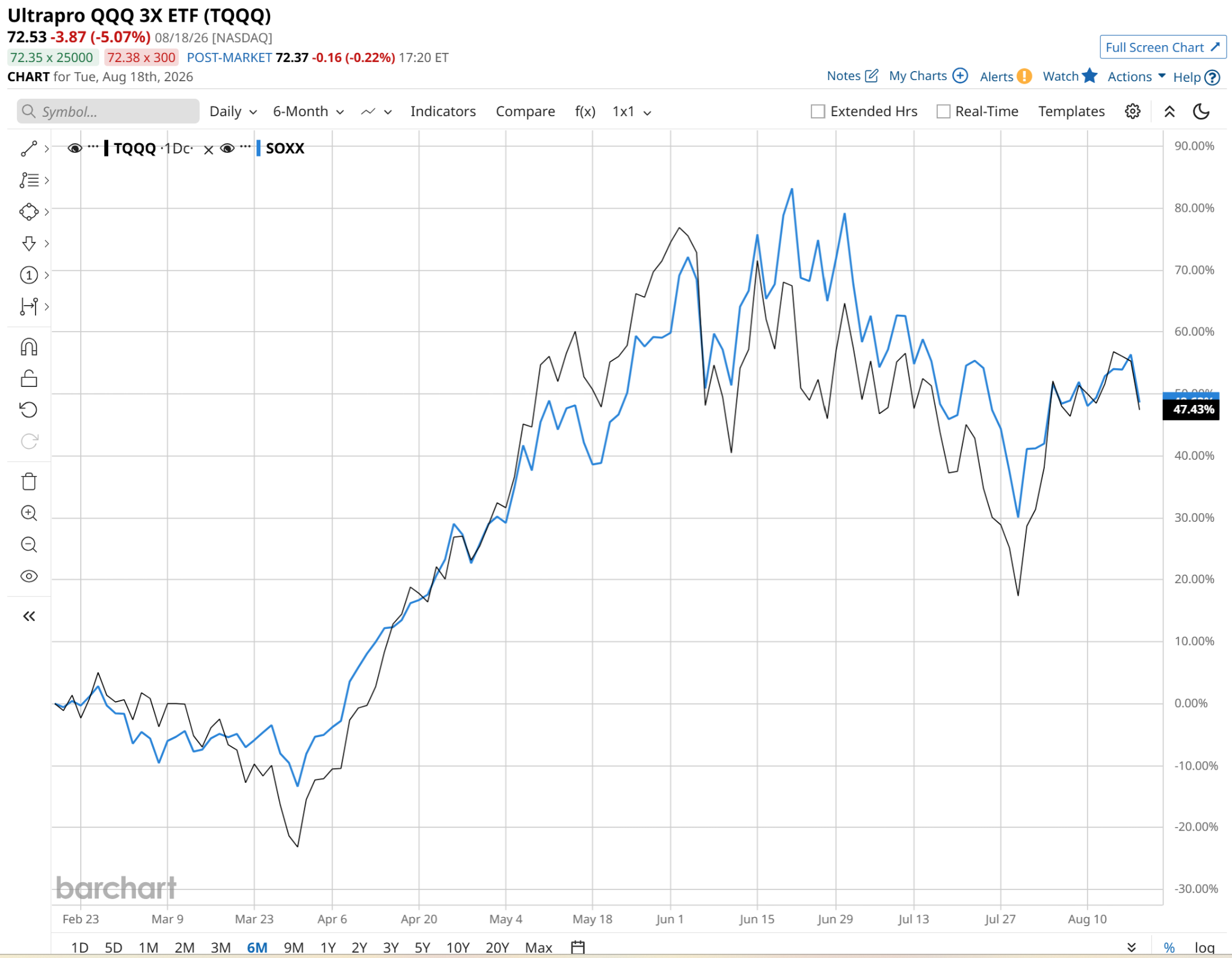
You probably can’t. And that’s my point.
The chart above shows the iShares Semiconductor ETF (SOXX), the celebrated semiconductor ETF, alongside the ProShares Ultrapro QQQ ETF (TQQQ). TQQQ is the same as the Invesco QQQ Trust (QQQ), but with 3x daily leverage.
Why are these two ETFs moving so closely in sync?
Welcome to Correlation Nation. Get comfortable. You’re going to be here for a while. Maybe forever.
As markets head into the fall, the artificial intelligence narrative has completely sucked the air out of the room, forcing equity indexes into a high-volatility holding pattern. The euphoria surrounding AI mirrors the dot-com bubble. While the technology holds practical utility as a productivity assistant, corporate spending and equity valuations have reached levels that are structurally unsustainable.
That’s the fundamental narrative. My concern as an investor, and especially as a risk manager, is not fooling myself into thinking I own different return and risk tradeoffs, when in fact I don’t. That’s the downfall of many investors and traders.
Because as we see above, you can lever up QQQ by a factor of three, and get a return pattern that is nearly identical to that of SOXX, an unleveraged ETF that has a lot of volatile stocks in it.
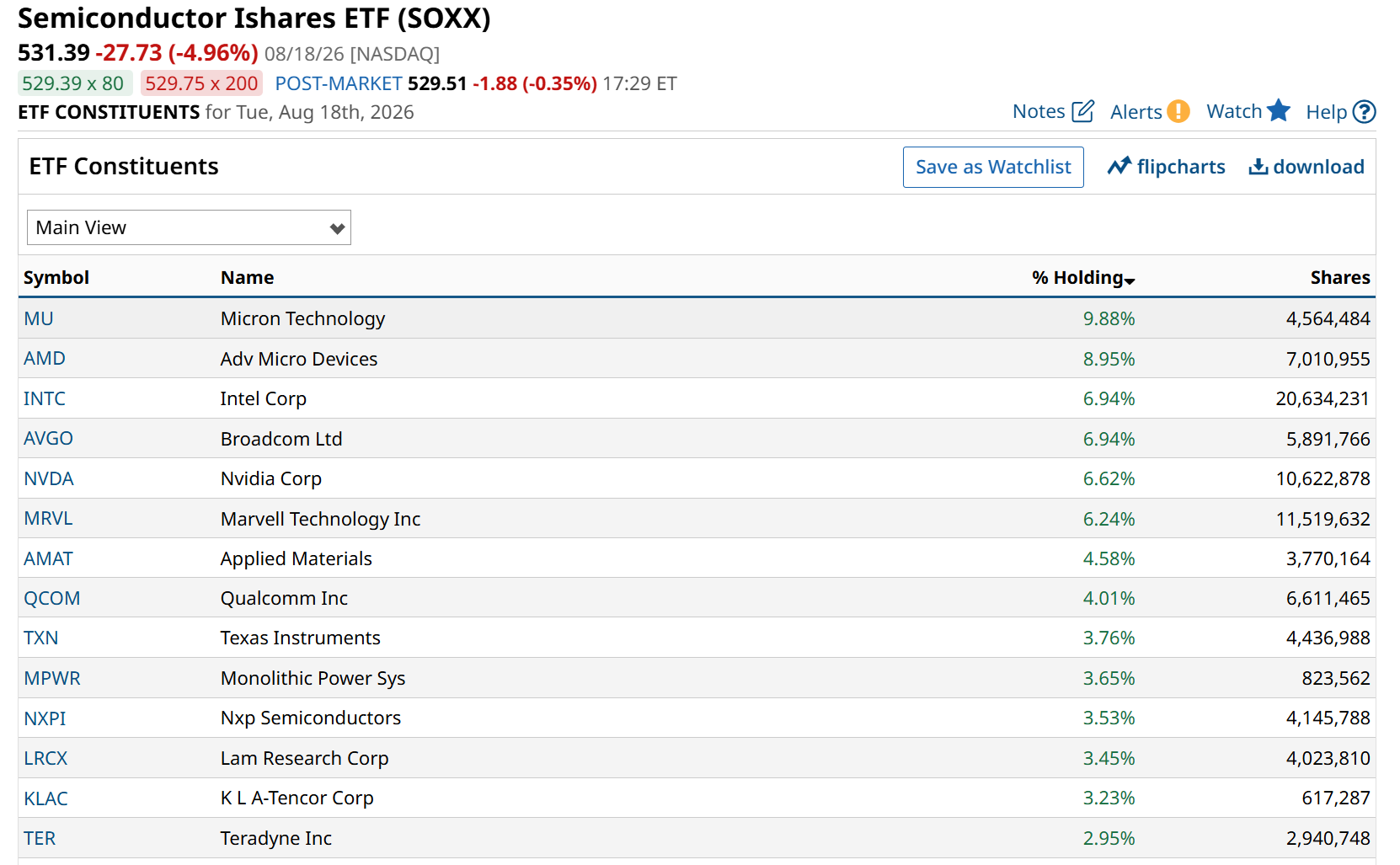
SOXX and QQQ overlap, but only by about one-third. QQQ has 100 stocks and SOXX has 35. 17 of them are owned in both ETFs. So there’s plenty to separate them.
That helps account for why SOXX is more volatile than QQQ. But to replicate SOXX’s up and down, chaotic movement, all we need to do is take QQQ and triple its own price moves. For the past six months, there has been little daylight between them.
If this were the only such situation here in Correlation Nation, I wouldn’t be so worried. But it is far from an isolated incident. I have compared a wide range of currently “sexy” market segments and themes, from quantum computing to space exploration and others. My conclusion is that if thrills are what you want in 2026, you’re not going to get much added value beyond QQQ.
The real decision for traders is how much leverage do you want in your QQQ investing? While the math is not consistent over different time frames due to the quirks of leveraged ETFs (where a loss takes a much bigger subsequent gain to offset), the nature of today’s U.S. stock market is that you can get all the “beta” you want. But realize that in more cases than you’d expect, that’s all you are getting.
Just look at how cleanly this has worked over the past three years. TQQQ’s return is about 300%, QLD’s is 200%, and QQQ is “only” a double (100% gain). All’s well that ends well.
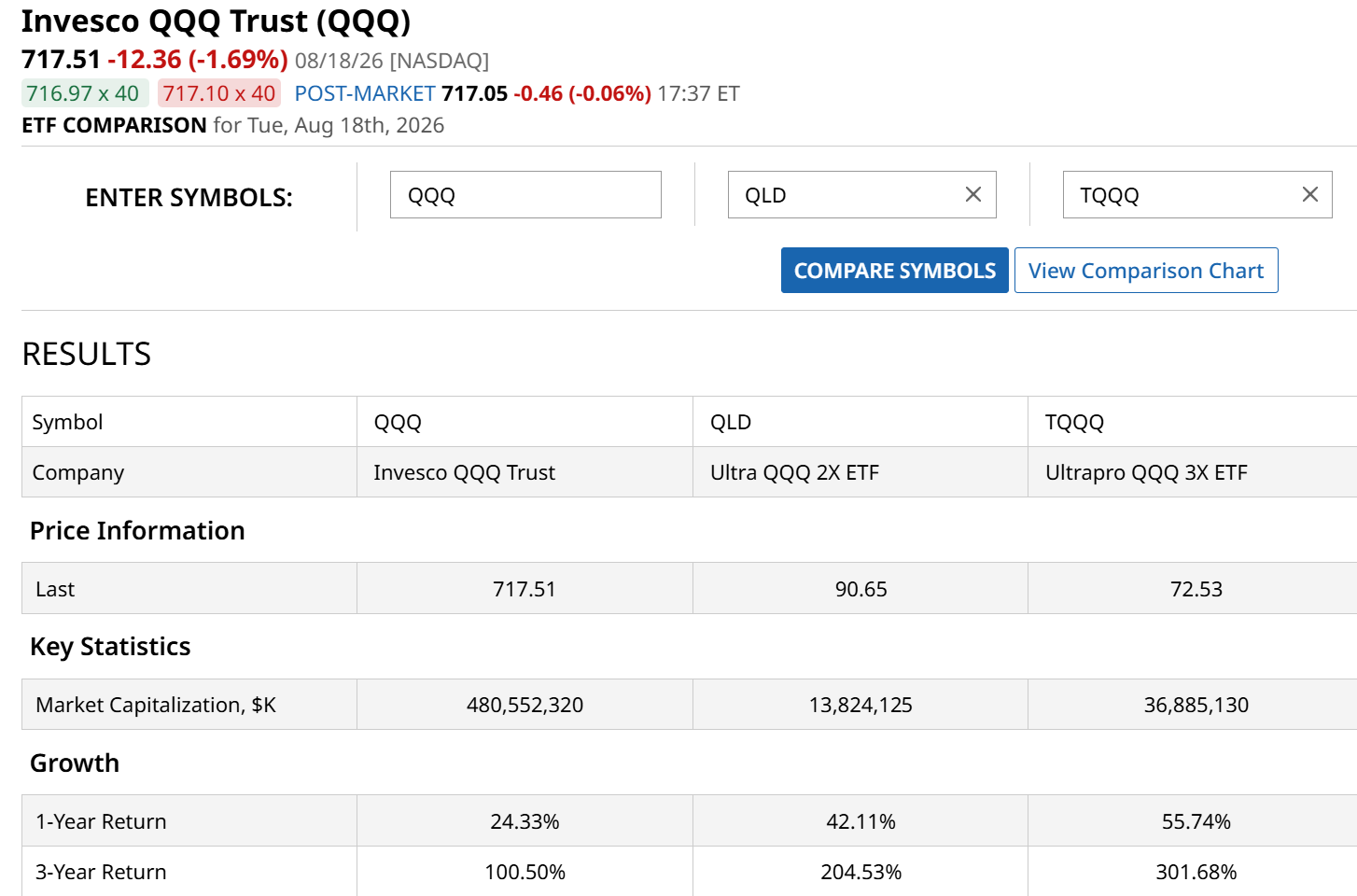
Until the cycle turns, at least. That’s when a lot of investors are bound to look at their portfolios, filled with seemingly different ETFs, and realize that their “allocation” was really a “correlation.” Sort of like saying “I’d like three different scoops of ice cream, please.” And you get three of the same. That’s great for dessert. But if you thought you were getting some variety, you haven’t.
That other way to think of this is just when you expect diversification to be that “free lunch of investing” we hear about, something else happens. You end up paying for everyone’s lunch in the whole restaurant. And the one next door too.
This is not about the companies or stocks themselves. They are all different entities. But we live in an era where algorithms and index funds roam the earth. That means that traditional differences between stocks and even industries get painted over by the “risk on vs. risk off” trade obsession.
That’s where we are. And to me, it makes me much more focused on how much QQQ exposure I have at any point in time, instead of how many different flavors of up and down moves I care to fill my portfolio with.
This is not something I figured out a long time ago. As I’ve written here before, I have seen a rise in correlation between stocks and sectors for a few years. But this summer, it has reached a fever pitch. That’s why I’m heading into autumn with a vow to myself to consolidate where I take risks.
Most tech stocks and AI-related themes are caught in the same web. That’s not bad news. The insight could save a lot of financial headaches as the stock market bull run gradually fades.
Rob Isbitts is a semi-retired CIO, former fiduciary investment advisor, and Barchart columnist. Check out his other work at ETFYourself.com (featuring the Fresh Charts weekly trading post), and ROAR.PiTrade.com, helping investors to better-manage their own portfolios.
On the date of publication, Rob Isbitts did not have (either directly or indirectly) positions in any of the securities mentioned in this article. All information and data in this article is solely for informational purposes. For more information please view the Barchart Disclosure Policy here.