Commencement Speakers’ Politics Vary by Institution Type
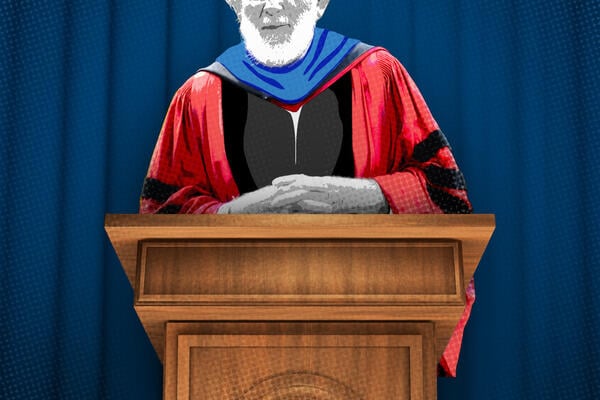
The proportion of liberal commencement speakers has increased since 2011, the researchers found.
Photo illustration by Justin Morrison/Inside Higher Ed | grandeduc/iStock/Getty Images | aimintang/iStock/Getty Images
David Johnson’s interest in the political leanings of commencement speakers was sparked in 2020, when a podcaster he was listening to asserted that conservatives “aren’t welcome” on college campuses.
“I thought, that doesn’t resonate with me. At minimum, it sounds not terribly nuanced,” recalled Johnson, a sociologist and associate professor of higher education in the Department of Educational Policy Studies at Georgia State University.
To understand whether conservatives are, in fact, welcome onto college campus, he decided to analyze the one occasion when nearly every college or university invites a speaker onto campus each year: graduation.
“There are all sorts of different speech events that happen across the system of higher education, like invited speakers and colloquia and universitywide speaker series,” but those events can vary a lot from institution to institution, he said. “Commencement, however, is universal.”
His research builds upon the debate over whether liberal ideology is overrepresented on college campuses, including evidence that faculty members and college administrators skew to the left. But while that research investigates how the people who work in higher education lean politically, Johnson was interested in understanding whom colleges choose to bring to campus to represent the institution at commencement, one of the most important days of the academic year.
In a paper published this month in the American Educational Research Journal, Johnson and his co-author, Liang Zhang, a professor of higher education at New York University, found that commencement speakers tend to lean liberal. But that picture is complicated by factors like the location and size of the institution and whether it’s a private or public university.
Graduation has been a flashpoint for universities in recent years; the Class of 2026 protested or pushed their institutions to disinvite speakers over their stances on Israel, artificial intelligence, the late conservative commentator Charlie Kirk and more. Students have also used commencement as a time to protest their own institutions; in 2024, amid widespread protests over Israel’s bombardment of Gaza, some graduating students interrupted ceremonies to call for their institutions to divest from companies with ties to Israel.
Commencement speakers are often the most prominent and high-stakes guests an institution invites each year. Whom they choose, then, can serve as an indication of what an institution values and how they want to be perceived, the researchers argued.
Using a database of 35 years of speakers at 52 institutions, cross-referenced with public information about those speakers’ political donations, Johnson and Zhang found that public colleges were more likely than private ones to invite speakers who supported conservative candidates, as were colleges that focused more on occupational and professional programs. Meanwhile, institutions that enrolled more students of color and those with larger endowments were more likely to select liberal-leaning speakers. Unsurprisingly, the state’s political leanings also had an impact; institutions in blue states tended to invite more left-wing speakers, and the same was true for conservative speakers in red states.
“What this tells me is that universities are strategic and they’re trying to maintain legitimacy in the eyes of a diverse public and a diverse set of internal stakeholders: students, faculty, boards, the public and governments,” Johnson said. “Universities are trying to navigate this era of polarization and look legitimate in the eyes of everybody.”
The report, which examined speakers through 2024, also found a statistically significant increase in liberal speakers over time, particularly after 2011.
“This shift coincides with a rise in left-initiated disinvitation campaigns,” the authors noted in the report, as well as “growing partisan polarization, and an intensifying national debate over the role of higher education in American political life.”
The researchers also found that disinvitation campaigns, in which students or other stakeholders call on the university to revoke their invitation to a graduation speaker, are effective over the long term, if not immediately. Although only two of 34 campaigns were actually successful in having the speaker disinvited, the researchers found that in the years following such a campaign, colleges throughout the state proved more likely to choose speakers that align with the campaigners’ ideology over several years. In other words, if students tried to have a speech by a conservative speaker canceled, future graduation speakers within that state were more likely to be liberal.
Free speech organizations like the Foundation for Individual Rights and Expression have criticized colleges for disinviting commencement speakers, arguing that doing so teaches students the wrong lesson about how to handle being confronted with difficult or controversial ideas. The organization has documented 382 commencement speaker disinvitation campaigns since 1998.
Johnson doesn’t think institutions select speakers based on their actual political donations, of course. But they probably seek out speakers who are as uncontroversial as possible.
“I think that they are trying to select somebody who reflects well on the university, makes them look prestigious or who happens to uphold something amazing to their students,” he said, “but also do that in a way that avoids political controversy.”
Credit: Source link