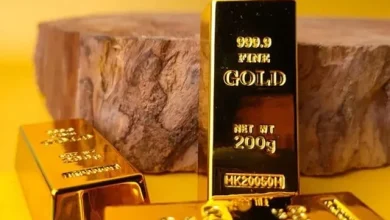
Gold retreats from peak, supply remains constrained.
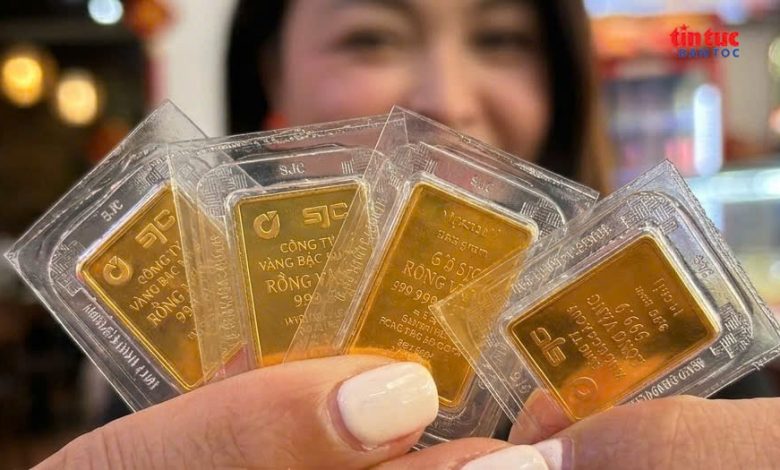
Global gold prices fall sharply, domestic prices react slowly.
The gold market last week experienced a rapid increase in the early sessions, fluctuated in the middle of the week, and then fell sharply in the final session. Opening on Monday morning, August 24th, SJC gold bars were commonly listed at 146-149 million VND/ounce, an increase of 1.4 million VND compared to the end of the previous week; SJC gold rings traded around 145.5-148.5 million VND/ounce.
On August 25th, SJC gold bars increased by 600,000 VND, reaching 147.6 – 150.6 million VND/ounce. SJC gold rings reached 147.1 – 150.1 million VND/ounce. This was the highest price for SJC gold this week and was maintained into the morning of August 26th. Some gold ring products from other businesses were sold at 153 – 154 million VND/ounce, showing a clear differentiation between brands.
On August 26th, world gold prices rose faster than domestic prices, narrowing the gap between the selling price of SJC gold and the converted international price to around 600,000 VND/ounce at times, excluding taxes and fees. However, this narrowing was mainly due to the rapid rise in world gold prices, not because domestic supply had improved. When the international market reversed, this gap quickly widened again.
From August 27th, the market cooled down. SJC gold bars retreated to 147-150 million VND/ounce, then fell to 146.7-149.7 million VND/ounce on the morning of August 28th. By August 29th and 30th, gold bars were at 145.7-148.7 million VND/ounce; SJC gold rings were at 145.2-148.2 million VND/ounce. Therefore, the selling price of gold bars differed by 1.9 million VND between the peak on Tuesday and Wednesday and the low at the end of the week.

If we only compare the beginning and end of the week, the selling price of gold bars decreased by 300,000 VND/ounce, from 149 million VND to 148.7 million VND/ounce. However, the actual loss for buyers is much greater because they have to buy at the selling price and sell at the buying price. A buyer who bought one ounce of SJC gold at the peak of 150.6 million VND/ounce on August 25th or 26th, and sold it on August 29th at 145.7 million VND/ounce, would have lost 4.9 million VND, equivalent to about 3.25% of the transaction value.
Those who bought gold at the beginning of the week at 149 million VND/ounce did not make a profit when the market peaked, because the highest purchase price on August 25-26 was only about 147.6 million VND/ounce; if they held until the end of the week, the loss would be 3.3 million VND. For gold rings, buying at the peak of 150.1 million VND/ounce and selling at 145.2 million VND/ounce also resulted in a loss of 4.9 million VND/ounce. The above calculations show that the buy-sell spread of 3-4.5 million VND represents a significant cost for short-term transactions; the ability to recover capital depends on the brand and buyback policy.
According to financial experts, the reversal in domestic gold prices stems from the international market. At the beginning of the week, global gold prices were supported by a weakening US dollar, falling bond yields, and safe-haven demand. The spot price reached $4,696.18 per ounce on August 25th, the highest level in over three months. However, higher-than-expected US personal consumption expenditure (PCP) data suggests that inflationary pressures have not eased quickly enough, weakening expectations of an early Fed easing of monetary policy.
During the August 26th trading session in New York, gold briefly fell below $4,600 per ounce. Expert Gary Wagner warned that the “evening star” candlestick pattern could signal a reversal. By the end of the week, Fed Chairman Kevin Warsh’s speech at Jackson Hole confirmed this pressure. He stated that the Fed still has work to do if core inflation doesn’t return to its 2% target quickly enough. The probability of a September interest rate hike rose from 36% to 58%; the US dollar and US bond yields both increased, raising the opportunity cost of holding gold.
Global gold prices briefly retreated to the $4,446-$4,454/ounce range during the final trading session of the week. The spot price subsequently recovered to $4,567.23/ounce, while the December futures contract closed at $4,529.90/ounce. Overall for the week, gold fell by approximately 2.9%. Expert Tai Wong commented that the Fed’s message forced the market to reassess interest rate prospects, leading to significant selling pressure.
Domestically, the price of SJC gold decreased more slowly than the global price. From the morning of August 24th to the afternoon of August 29th, the selling price fell by about 0.2%, while international gold prices lost nearly 3%. This lag reflects the cost of goods sold, inventory levels, and listing strategies; businesses lowered their buying prices and maintained trading margins to limit risks.
Supply and trading margins remain obstacles.
Domestic transactions were not very active last week. On August 27th, coinciding with the Mid-Autumn Festival, some shops in Ho Chi Minh City had few customers; buyers mainly chose small quantities of gold rings. According to expert Tran Duy Phuong, the 6th and 7th months of the lunar calendar are usually low season periods; transactions may gradually pick up from the Mid-Autumn Festival onwards.
Weak purchasing power is causing businesses to be cautious about raising their buying prices. When demand is slow, maintaining selling prices and lowering purchasing prices helps protect cost of goods sold, explaining why domestic prices tend to “stick” when falling and why the buy-sell spread is difficult to narrow.
The exchange rate did not cause a significant shock, with the selling price of USD at banks used for conversion fluctuating around 26,260 – 26,330 VND/USD. Deposit interest rates remained competitive with gold but did not create a clear shift in capital flows.

The week of August 24-29 did not see any new policies specifically regarding gold market management. Domestic developments continued to reflect the implementation of Decree 232/2025/ND-CP. This decree abolished the state’s monopoly on the production of gold bars, the export of raw gold, and the import of raw gold for gold bar production; allowing businesses and commercial banks meeting the conditions to be licensed to participate. However, supply remains subject to licensing and quotas.
The current obstacle lies in the speed of policy implementation. If licensing, import quota allocation, and production organization do not generate sufficient quantities, the market will remain dependent on gold already in circulation. Mr. Huynh Trung Khanh, Vice Chairman of the Vietnam Gold Business Association, believes that the price difference is unlikely to decrease sustainably if the raw material supply issue remains unresolved.
Associate Professor Dr. Dinh Trong Thinh, Senior Lecturer at the Academy of Finance, believes that expanding the supply will help domestic prices gradually approach world prices, but the effect will only be clear when the market actually has more products, businesses, and gold sources.
Another obstacle is the lack of a unified reference price, as the current selling prices of the same product group vary by 4-4.5 million VND/ounce between businesses. Therefore, a gold exchange is needed to help centralize data, but it must be accompanied by product standardization, physical collateral, delivery and monitoring mechanisms to avoid increasing speculation.
The regulation requiring gold transactions of 20 million VND or more per day to be settled through bank accounts helps to ensure transparency of cash flow but does not create additional supply. Policies should focus on bringing legitimate gold to the market, publicly disclosing production, import, and transaction data, increasing competition, and balancing these factors with exchange rates and foreign exchange reserves.
Regarding the outlook, Giovanni Staunovo of UBS believes that gold continues to be supported by downward trends dependent on the USD, ETF inflows, and central bank demand; UBS forecasts that the price could reach $5,400/ounce in the next 12 months. David Morrison of Trade Nation sees the $4,400/ounce level as a key support; if this level is breached, selling pressure could expand.
Associate Professor and Doctor Nguyen Huu Huan commented that gold still has long-term prospects due to macroeconomic and geopolitical instability, but the rate of increase is unlikely to be as explosive as before, therefore it is not suitable for short-term trading.
Other experts also suggest that while gold is a defensive asset, it shouldn’t constitute the entirety of one’s capital; long-term investors can allocate funds gradually, while those holding a very large proportion should consider shifting some of it to cash-generating assets.
Compared to gold, bank deposits offer the advantage of guaranteed returns and are suitable for those needing to preserve capital in the short term. Stocks have higher growth potential but require careful selection of companies and acceptance of volatility.
According to experts, given the current volatility of gold prices, investment decisions should not be based on the price of a few trading sessions. Gold is suitable for protecting a portion of long-term assets; deposits meet liquidity needs; and stocks are geared towards growth. The allocation to each channel should be based on holding time and risk tolerance, rather than chasing the fear of missing out.
Source: https://baotintuc.vn/thi-truong-tien-te/thi-truong-vang-tu-24-308-vang-roi-dinh-nguon-cung-van-nghen-20260829181358507.htm