US Stocks: How to Navigate the “Infamous September Market”? …
September is known as a month when U.S. stocks are prone to weakening.Will this decline remain within the range of seasonal adjustments, or will it lead to a correction of the overheated AI market sentiment? The market is now focusing on employment data, crude oil prices, and the Fed’s policy stance.

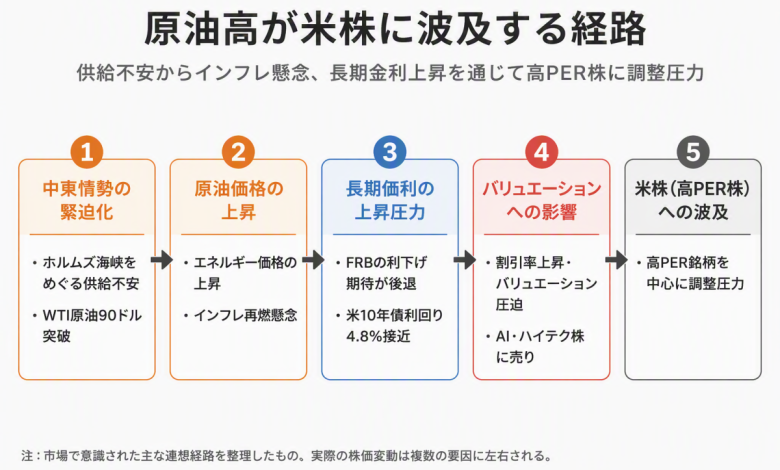
Rising crude oil prices burden the stock market through both corporate earnings and interest rates. In sectors such as airlines, logistics, and chemicals, higher fuel and raw material costs are squeezing profitability. Furthermore, persistently high energy prices hinder the disinflation process and dampen expectations for Fed rate cuts.
The Fed’s policy stance is also capping upside potential in the market. Chair Powell left room for further rate hikes in his speech at the Jackson Hole symposium on August 28. Boston Fed President Collins also indicated that additional tightening would be appropriate if inflation does not slow sufficiently.
Although the policy rate remains unchanged, the market is increasingly aware of the prospect of prolonged high interest rates. If high oil prices persist, inflation concerns may linger, potentially pushing back expectations for the start of rate cuts.
Seasonal factors are also weighing on the market. September is historically known as the month with the weakest performance for US stocks. Data since 1928 shows thatthe average return for the S&P 500 in September is approximately -1.1% to -1.2%. The percentage of years with declines reaches about 56%.
This trend has been confirmed in recent years as well. In September 2022, the index fell by approximately 9.3%, and in September 2023, it dropped by about 4.9%. On the other hand, there are cases where the market bottoms out after strong selling in September and recovers toward the end of the year starting in October. For investors who view corrections as buying opportunities, this is also a phase to look for entry points.
![On September 1, selling pressure dominated the US stock market from the start of the month. $S&P 500 Index (.SPX.US)$ fell 0.71% from the previous day, $Nasdaq Composite Index (.IXIC.US)$ closed down 1.03%. $Dow Inc (DOW.US)$ also dropped $419, or 0.79%,with all three major indices closing lowerdid so. The selling was driven by rising crude oil prices amid escalating tensions in the Middle East. Renewed concerns over supply disruptions in the Strait of Hormuz resurfaced, $Crude Oil Futures (OCT6) (CLmain.US)$pushing crude oil above $90 per barrel. Amid fears of reigniting inflation, selling spread to US Treasury bonds,The yield on the US 10-year Treasury note rose to around 4.79%.Rising interest rates weighed heavily on AI and tech stocks, many of which trade at high P/E ratios. September is known as a month when US stocks tend to weaken.The market is now focused on assessing employment data, crude oil prices, and the Fed's policy stance to determine whether this decline is merely a seasonal adjustment or a correction of overheating in the AI rally. Higher oil prices and rising interest rates are weighing on stock prices.[Angry] Higher oil prices impact both corporate earnings and interest rates...](https://sgsnsimg.moomoo.com/sns_client_feed/181250687/20260902/web-1788339194944-3nlHMZvyJE.png/big?area=105&is_public=true&imageMogr2/ignore-error/1/format/webp)
Amidst this, capital is flowing into large-cap stocks with stable cash flows. Apple rose 2.6%, bucking the trend, driven by speculation about John Ternus as a candidate for the next CEO and anticipation for the new iPhone launch. In a high-interest-rate environment, not only growth potential but also earnings stability is being valued.
For the time being, the focus will be on employment statistics, crude oil prices, and the sustainability of AI investment.
Attention is focused on whether the strength of the labor market will be confirmed in the August US employment report scheduled for release on the 4th. Robust employment figures would support expectations for a soft landing of the US economy, while a significant downside surprise would likely heighten concerns about an economic slowdown.
Regarding crude oil prices, the key focus is whether WTI can maintain levels in the $90s. If prices remain in this high range, inflation concerns will persist, and expectations for Fed rate cuts are likely to recede further. Conversely, if prices stabilize in the high $80s, there is room for an improvement in market sentiment.
In terms of AI investment, attention is on the capital expenditure policies of major cloud providers. During the earnings season from late September to October, the focus will be on whether companies like Amazon, Microsoft, and Alphabet can demonstrate a commitment to continuing or expanding their data center investments. If signs of slowing AI investment intensify, adjustment pressure will remain on semiconductor and tech stocks.
The decline in US stocks on the first day of September was driven by risk-aversion amid escalating tensions in the Middle East, WTI crude breaking above $90, and US long-term interest rates approaching 4.8%. While funds flowed into energy stocks and stable large-cap stocks, profit-taking emerged in AI and semiconductor stocks, which were perceived as overvalued.
Although September is historically considered a weak month for US stocks, there are precedents for the market recovering from October onward. Whether this recent decline remains a temporary correction or adjustment pressure spreads across the AI-led bull market will depend on employment data, crude oil prices, the FOMC meeting, and the AI investment stance of major tech companies.
Source: moomoo, public market filings
This article uses machine translation in part