From High Tech to Politics: Mati Gill Bets on Bennett To Rebuild Israel
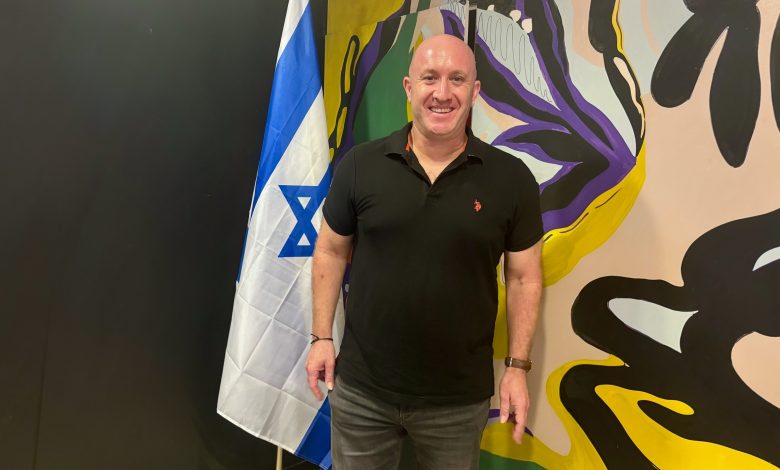
The B’Yachad candidate calls for a new generation of public servants, a stronger technology sector, and a national inquiry into the October 7 failures
Mati Gill grew up looking at photographs of his 90-year-old grandmother standing on the streets of Cleveland, Ohio, holding a sign and protesting to protect local schools from gun violence.
“I have pictures of her standing up there with a sign,” he told The Media Line this week during an interview at the Tel Aviv headquarters of HoneyBook, an artificial intelligence-powered client relationship platform. Sitting in a conference room overlooking the city, he stressed, “I’ve been instilled with civic responsibility.”
His father, Alan Gill, executive vice president emeritus of the American Jewish Joint Distribution Committee, instilled in him the belief that a career should have meaning. Although Gill spent most of the past 15 years in the private sector, including more than a decade at Teva, he said he always viewed himself as being “on loan” to it. He later helped spearhead what he described as Israel’s first public-private venture studio using artificial intelligence for drug development, in collaboration with Teva, Merck, Pfizer, AstraZeneca, and other pharmaceutical leaders.
“At some point, you’ve got to jump in,” he said.
Bennett recently tapped Gill, a former chief of staff to Avi Dichter, to run on his list and head the high-tech portfolio of B’Yachad (Together), the party led by the former prime minister, who is seeking to return to office.
It is not his first experience in politics, although it is his first time running on a party list. He served as Dichter’s chief of staff when Dichter was public security minister from 2006 to 2009. During that period, he was shot by a Palestinian sniper while delivering a briefing near the Gaza border.
The shooting left him injured and, in his words, “lucky I am still here and even luckier I have fertility capabilities based on the location of the explosion and the permanent damage.”
In his hospital bed in Ashkelon, still under the age of 30, he began thinking about his life. He said he lived then, and still lives today, according to three pillars: Israel, family, and working with a mission, or what he called “shlichut.”
Reflecting on those priorities, he realized he had made aliyah, fulfilling his commitment to Israel, and was certainly working with a sense of mission. Yet he had not built a family. He decided to leave his government job and move into the private sector. A few years later, he married and began building his family in Israel.
But, as for so many Israelis, everything changed after October 7.
“I think that loan is no longer possible,” he told The Media Line.
He said Israel was not prepared to deal with the October 7 massacre. Instead, “civil society saved Israel.” He watched a younger generation of Israelis step forward to serve and volunteer, giving back to the country in ways he said were unimaginable.
One reason the country struggled to function, he believes, was that many of Israel’s most talented people had chosen careers in the private sector, particularly high tech, rather than public service.
The best people that this country has to offer are in the high-tech industry
“The best people that this country has to offer are in the high-tech industry,” he said. “They are in industry, they’re in the private sector, and we’ve outsourced governance and politics to whoever is willing to be there.”
Looking at the current government and those that preceded it, he concluded that too many of Israel’s leaders either represented agendas with which he disagreed or, in his view, did not represent the best talent the country had to offer.
We don’t have the privilege anymore of continuing to do it that way
“We don’t have the privilege anymore of continuing to do it that way,” he said.
So he reached out to Bennett.
He knew Bennett from his earlier years in politics, including Bennett’s time as education minister and economy minister. Gill worked at Teva during Bennett’s tenure at the Education Ministry and recalled him as “an excellent minister.”
At Teva, he took part in Bennett’s effort to double the number of students studying advanced-level mathematics within five years, including by increasing participation among students in Israel’s periphery. The initiative ultimately met its goal.
“Bennett came and set out a very broad vision, and a goal that was aggressive yet achievable,” he said. “He also came with a very clear vision not just of what he wanted to achieve but why he wanted to achieve it.”
He continued, “I know Bennett, and I know that if he’s going to do something, and he says he’s going to do something, he’s going to do it, and he does it with these types of visions.”
Rather than seeing Bennett as a conventional politician, he described him as a “capable” and “experienced” person, as well as a “dreamer and an achiever” who is “willing to do bold things.”
“Our country, at this time, needs bold leadership,” he said.
When he approached Bennett after October 7, he told the former prime minister that if he decided to return to politics, he would do whatever it took to help him. He did not ask for anything in return and had no aspirations of joining Bennett’s list. When Bennett ultimately told him that he was needed, he decided to keep his promise.
Since then, he has led the party’s plans for Israel’s high-tech sector. He said that despite its successes, including in the aftermath of the war, the industry needs a jump-start.
“Over the last few years, we have fewer startups being built in Israel, fewer startups being registered in Israel, and fewer employees in the high-tech industry,” he explained. “We’ve seen a decline for the first time in decades. We’ve seen more and more Israelis leave Israel over the last four years. It started before October 7, and it obviously accelerated afterward. And these are some of the best that Israel has to offer: scientists, high-tech entrepreneurs, high-tech executives, high-tech future employees that are still junior but will be the next generation. We need to reverse them. We need to bring them back.”
The Israel Innovation Authority reported in May that the share of employees at privately held Israeli tech companies based in Israel fell to 62% in 2026, from 69% in 2019. The number of new startups established annually also declined, from around 1,400 in 2014 to 775 in 2025.
“We need to build this country to be the beacon of hope that my family made aliyah to 35 years ago because we wanted to live in the best country in the world,” he said. “Part of that is being leaders in science, innovation, technology, having an industry here that’s really inspiring for the rest of the world, and we need to rebuild that.”
B’Yachad has developed a broader plan for the high-tech sector, he said, which the party intends to unveil in the coming weeks. The plan will be published on the party’s website alongside proposals on education, national service, and other issues.
He pushed back against the idea that Bennett abandoned his right-wing constituency when he formed a unity government in 2021 and became prime minister. In his view, people should differentiate between Bennett’s campaign promises and his broader vision for Israel. Bennett acts based on what he believes is in Israel’s best interest at a given moment, he said, and that is what he did in 2021.
“After four different elections, where this country was in complete stagnation, didn’t have a budget for years … when the whole country was in stagnation, it took bold leadership to actually come out and say, ‘This is what’s in the best interest of the country,’ and he did it, and he takes responsibility for it.”
For him, that reflects the qualities of the right kind of leader. As the chief executive officer of an organization, he said, he holds quarterly meetings in which his team examines what it learned over the previous quarter, takes lessons from what went wrong, and identifies what worked so it can be repeated.
He expects a future Bennett government to operate in much the same way. The difference this time, he argued, is that Bennett is explicitly running to become prime minister and has spent the past two years developing an agenda that could begin to be implemented from his first day in office if elected.
“He learned from what happened in the past,” he said. “He’s coming with the best potential list to rebuild Israel that’s ever been formed.”
The list includes, according to Gill, people such as Keren Terner, former director-general of both the Transportation and Finance ministries, and Liran Avisar Ben-Horin, former director-general of the Communications Ministry.
Bennett’s own responsibility for the failures that preceded the October 7 massacre is another question.
He noted that Bennett has said he is willing to testify and be investigated, while also pointing out that the former prime minister served for only about a year of the two decades preceding the attack. More importantly, he said, a national commission of inquiry into October 7 should already have been established. If Bennett forms the next government, establishing such a commission would be a priority.
Beyond high tech and investigating the failures surrounding October 7, B’Yachad’s agenda centers on a broader goal: rebuilding Israel and persuading more people to build their futures in the country.
That includes attracting both new immigrants and Israelis who have moved abroad. Israel absorbed roughly 1 million immigrants from the former Soviet Union beginning in the 1990s, and he believes another 1 million people could immigrate to Israel over the next decade.
“Our country should be proactively and actively going out and finding the best people we can bring to Israel, and offering any Jew to come to Israel and make aliyah and help build up the next 80 years of our country,” he said.
Another priority, he said, would be eliminating Hamas, which he argued is rebuilding itself faster than some of the southern Israeli communities it destroyed on October 7 are being rebuilt. He said Bennett would take decisive action and seek to assemble a governing coalition capable of carrying out that agenda.
“We have very robust plans on every issue: cost of living, military service, how we’re going to get this whole country to be able to serve, either in military service or national service in some cases, in accordance with the army’s needs, on really rebuilding Israel,” he noted. “Even if we’re able to do 50% of what they’ve planned over the last two years, we’re looking at a whole different Israel for the better.”
Part of Bennett’s platform, he acknowledged, is that Prime Minister Benjamin Netanyahu should no longer lead the country. He argued that this is where Bennett’s negative agenda begins and ends.
Bennett is not against. He is for.
“Bennett is not against. He is for,” he said, describing a candidate he believes is offering concrete plans and a vision while recruiting the people he thinks can carry them out.
“I’m very humbled to have actually been selected to be part of that team,” he told The Media Line.
He does not expect Israel to change overnight, even if Bennett begins implementing his plans on his first day in office. The longer the country waits to begin making changes, he said, the longer rebuilding will take.
The Media Line returned to the high-tech world from which Gill comes and asked which lessons from that industry could help a Bennett government turn campaign plans into results. He pointed to three.
First is to surround yourself with talented people, hire the best, and then let them do their jobs.
A second is to adapt and grow.
“Learn from what doesn’t work, fix it, continue to grow,” he said. “Also learn from what does work and then accelerate that to a degree and aim high.”
Finally, he said, leaders should not be embarrassed to set bold goals, even when others believe they are impossible.
“When we built AION Labs, people thought that it was impossible to bring four pharma companies to the table. It doesn’t happen, by the way. This never happened anywhere in the world,” he recalled. “Well, and still to this day, we have four pharma companies sitting around the same table with Amazon and investors supported by the Israel Innovation Authority, all sitting around the same table and speaking about the future of the biotech industry. We identified AI before people understood what AI was as critical to the future of drug discovery and development. So we aimed high; we’re trying to do something that people thought was nearly impossible. And now five years in, we’re all signed up to do another five years.”
That experience offers a model for what he believes Israeli politics needs: strong people, the willingness to learn from failure, and the confidence to pursue goals that initially appear out of reach. With roughly two months until the October 27 election, he is betting those principles can translate from high tech to government.
“We have a great campaign, and it’s actually being heard, and it’s being well organized, and we have a great team to pull it off with,” he said. “I’m a very firm believer in two things: Number one is that we will have new leadership right after the elections. And number two is that the best person to be the next prime minister of the State of Israel is Naftali Bennett.”
Credit: Source link