AI Credit Is Sitting in the Eye of the Hurricane. Goldman Says the Next Supply Wave Is Coming

Michael Cembalest at JPMorgan recently estimated that the five major hyperscalers plus Nvidia have issued roughly $320 billion of debt so far in 2026, including special purpose vehicles where the companies ultimately stand behind data centre lease obligations. In ten year equivalent terms, JPMorgan puts the long duration component at roughly $303 billion.
Takeaways by Dark Side of the Boom™
-
AI credit supply gets a temporary breather. Goldman sees roughly $300 billion of AI-related issuance already completed this year, with senior hyperscaler and chip supply slowing sharply into year-end.
-
2027 is the real stress test. Papai’s rough scenario points toward roughly $340 billion of senior hyperscaler and chip issuance, potentially before another large layer of data centre and structured chip financing is added.
-
The buyer base has to keep expanding. Limited hyperscaler maturities mean there is much less natural recycling of investor capital than in sectors such as banks, leaving the market dependent on fresh demand for fresh supply.
-
The AI boom is rebuilding the credit risk transfer machine. CDS volumes are returning, TRS usage is growing and cash bond trading is surging. The deeper message is that AI is becoming large enough to create its own financing and hedging ecosystem.
The AI trade is increasingly becoming a credit story.
That matters because the extraordinary data centre buildout has moved well beyond the point where hyperscalers can fund everything comfortably from internal cash generation. Capex is heading toward levels that would have looked almost absurd a few years ago, free cash flow is being absorbed by infrastructure, chips and power, and the bond market is increasingly being asked to finance the difference.
The numbers are becoming large enough that this is no longer simply a technology sector financing issue. It is beginning to matter for the broader supply and demand balance in long duration credit and potentially even for rates.
Michael Cembalest at JPMorgan recently estimated that the five major hyperscalers plus Nvidia have issued roughly $320 billion of debt so far in 2026, including special purpose vehicles where the companies ultimately stand behind data centre lease obligations. In ten year equivalent terms, JPMorgan puts the long duration component at roughly $303 billion.
That is equivalent to around 68% of new long duration Treasury borrowing this year.
That comparison should get the attention of anyone trading the long end.
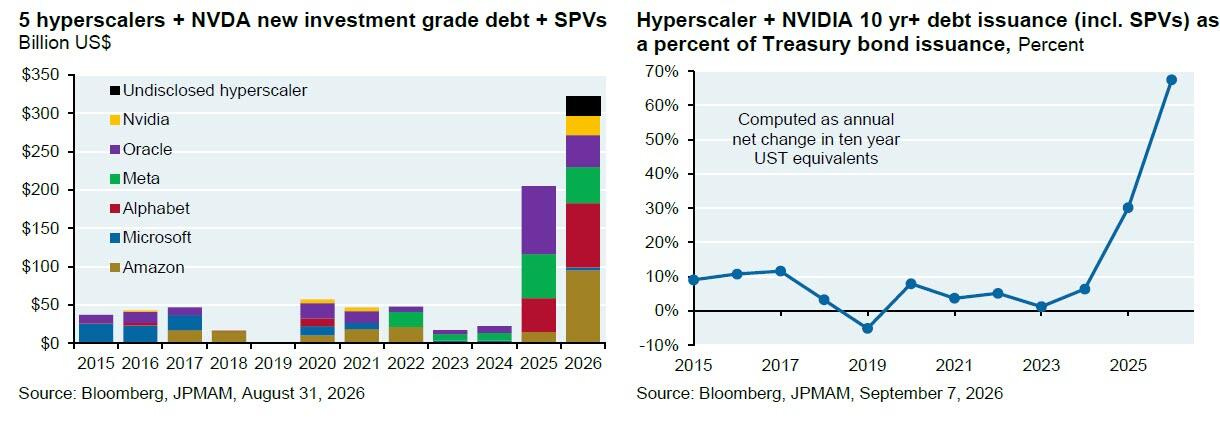
Source: JPMorgan, Michael Cembalest
Goldman Sachs credit trader Jeffrey Papai now takes the argument one step further.