If You Think Inflation and Bond Yields Are High Now, a Potential $5,000 “Trump Dividend” Could Send Both Into the Stratosphere

Election season is heating up, and so are campaign promises ahead of the Nov. 3 midterms. While not every law passed in Washington, D.C., will impact Wall Street, the makeup of Congress can affect fiscal policy, which has a direct impact on corporate America and, therefore, the stock market’s major indexes, the Dow Jones Industrial Average (DJINDICES:^DJI), S&P 500 (SNPINDEX:^GSPC), and Nasdaq Composite (NASDAQINDEX:^IXIC).
Although campaign promises don’t always come to fruition, some stand out more than others. On Sept. 9, President Donald Trump proposed paying a $5,000 “Trump Dividend” to every adult U.S. citizen, contingent on Republicans retaining their majorities in the House of Representatives and Senate.
Missed Nvidia in 2009? This Rare Signal Is Flashing Again. In 2009, a “Double Down” signal flashed for a little-known chipmaker called Nvidia. For the first time in years, that same “Total Conviction” signal is flashing for a company 1/100th the size of Nvidia. Continue »
President Trump’s $5,000 “Dividend” proposal could have dire consequences for the economy and stock market. Image source: Official White House Photo by Daniel Torok.
But there’s a problem: if (big “if”) this payout became a reality, it could light an inferno under an already above-average inflation rate and send long-duration Treasury bond yields into the stratosphere.
President Trump’s $5,000 midterm-contingent “Dividend” comes with more questions than answers
Currently, Republicans hold 53 of 100 seats in the Senate and 218 of 435 seats in the House, with traders on prediction market Polymarket assigning just a 14% chance of Republicans sweeping both houses of Congress. In comparison, 50% of traders expect Democrats to sweep both houses, as of Sept. 10, with 36% projecting Democrats to take the House while the GOP retains the Senate.
To be clear, there’s a laundry list of things we don’t know about Trump’s $5,000 dividend proposal. We don’t know whether it’s legal, if Congress would approve it, how it would officially be funded, or if the president would even follow through with payouts.
As a reminder, promised payouts have come and gone on several occasions under Donald Trump. The president previously promised Americans a DOGE dividend, based on proposed savings from the Department of Government Efficiency (DOGE). He also implied that $2,000 tariff checks would be sent to Americans, supported by his tariff and trade policy. Ultimately, neither promise resulted in payouts.
But the issue isn’t whether the president will follow through with the “Trump Dividend” after the midterm elections. It’s how a payout of this magnitude could adversely impact an economy that’s already contending with persistently high inflation and a visibly worried bond market.
The prevailing inflation rate and Treasury bond yields are already high
Before digging into any projected impacts of the president’s $5,000 payout proposal, it’s important to lay the foundation of why the prevailing inflation rate and long-duration Treasury bond yields have been climbing.
Modest levels of inflation (rising prices) are perfectly normal for a growing economy. When businesses are firing on all cylinders, we’d expect them to possess some degree of pricing power over their goods and services. But when the trailing 12-month (TTM) inflation rate sustains well above the Federal Reserve’s long-term target of 2% for an extended period, it can be detrimental to economic growth and the stock market.
Two of President Trump’s policies are behind the surge in TTM inflation that we’ve witnessed since February.
Firstly, there’s the president’s tariff and trade policy. In July, the Trump administration reinstated sweeping global tariffs on more than 80 countries. Adding duties to unfinished imported goods can increase manufacturing costs, which are then passed along to consumers.
The second policy igniting inflation is the Iran war. Shortly after military operations began against Iran on Feb. 28, the latter shut down the Strait of Hormuz to virtually all maritime traffic. This action effectively halted the flow of a fifth of the world’s petroleum liquids and sent fuel prices soaring at the fastest pace in decades.
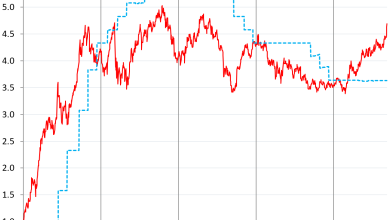
In May, TTM inflation peaked at a three-year high of 4.2%.
Meanwhile, long-duration (10-, 20-, and 30-year) Treasury bond yields have been steadily rising. The 30-year yield reached a 19-year high above 5.3%, while the 10-year is a stone’s throw away from its highest level since the financial crisis.
Bond yields have been precipitously climbing due to a confluence of factors, including:
-
U.S. total debt rising above $40 trillion in August
-
Fed Chair Kevin Warsh removing forward-looking guidance (making the bond market more volatile)

Image source: Getty Images.
A “Trump Dividend” could prove disastrous for inflation and long-duration bond yields
With a better understanding of the mechanics that have pushed inflation and long-duration Treasury yields higher, let’s take a closer look at the as-of-now hypothetical scenario of Trump’s $5,000 “Dividend” becoming a reality.
Based on what history tells us, injecting a serious amount of capital into the economy can stoke the coals of inflation. During the COVID-19 pandemic, several rounds of fiscal stimulus put cash directly into consumers’ hands, which, several quarters thereafter, when combined with historically low lending rates, pushed TTM inflation to a four-decade high above 9%.
Although the federal funds target rate is currently a far cry from the 0% to 0.25% it sat at during the pandemic, injecting well over $1 trillion into the economy via “Trump Dividends” for adult citizens would almost certainly push up prices and afford businesses otherworldly pricing power.
The effects of Trump’s proposed “Dividend” on long-duration bond yields could be even more pronounced.
Put simply, bond investors have made it clear that they want higher yields (i.e., better compensation) for holding longer-duration debt, given that America’s total debt has surpassed $40 trillion. Trump’s election-contingent proposal would add in the neighborhood of $1.2 trillion atop the nation’s already ballooning debt pile.
This “Dividend” would effectively add on to a trend of unsightly federal deficits. Since fiscal year 2020 (the federal government’s fiscal year ends on Sept. 30), federal deficits have clocked in annually between $1.38 trillion and $3.13 trillion. With seemingly no effort being made to reduce annual federal deficits, long-duration bond yields would be expected to rise.
Long-duration bond yields can impact corporate borrowing rates and mortgage rates. If the $5,000 “Trump Dividend” is actually paid, the expectation would be for lending rates and mortgage rates to climb rapidly. While initial payouts would likely fuel economic growth for several quarters, the reaction in the bond market would be akin to slamming on the brakes not long thereafter.
For the stock market, we’d likely witness a pattern similar to 2021-2022, in which the Dow Jones Industrial Average, S&P 500, and Nasdaq Composite initially soared due to stimulus payouts, but cratered during the 2022 bear market as the impacts of those payouts became apparent.
Should you buy stock in S&P 500 Index right now?
Before you buy stock in S&P 500 Index, consider this:
The Motley Fool Stock Advisor analyst team just identified what they believe are the 10 best stocks for investors to buy now… and S&P 500 Index wasn’t one of them. The 10 stocks that made the cut are built for long-term growth and could produce monster returns in the coming years.
Consider when Netflix made this list on December 17, 2004… if you invested $1,000 at the time of our recommendation, you’d have $417,413!* Or when Nvidia made this list on April 15, 2005… if you invested $1,000 at the time of our recommendation, you’d have $1,341,294!*
That performance is why people listen. With a track record of beating the S&P 500 by 4x, Stock Advisor offers a distinct advantage. Don’t miss the latest top 10 list, available with Stock Advisor, and join an investing community built for the long haul.
*Stock Advisor returns as of September 14, 2026.
Sean Williams has no position in any of the stocks mentioned. The Motley Fool has no position in any of the stocks mentioned. The Motley Fool has a disclosure policy.
If You Think Inflation and Bond Yields Are High Now, a Potential $5,000 “Trump Dividend” Could Send Both Into the Stratosphere was originally published by The Motley Fool