AI’s Red Flag Is Rising in the Bond Market

Barclays’ duration times spread measure captures just how quickly that influence has grown. Amazon, Meta, Alphabet, Oracle, SpaceX and Microsoft accounted for 8.4% of the total spread risk in the US investment grade corporate bond market as of September 14. That is greater than the combined influence of the six largest banks, institutions that historically sat much closer to the centre of credit market risk.
✨ Takeaways by Dark Side of the Boom™
-
Bloomberg John Authers sees the credit market as the first place genuine doubt about the AI buildout should emerge, although spreads have not yet signalled serious stress.
-
Six major AI groups now account for more US investment-grade spread risk than the six largest banks, showing how deeply the buildout has entered the bond market.
-
Hyperscaler valuations are not at dot-com extremes and technology margins remain exceptionally strong, but surging token use has yet to translate into equally strong spending growth.
-
The most credible brake on AI capital expenditure may be the rising real cost of capital, with the Wicksellian spread moving uncomfortably close to the level associated with broader investment slowdowns.
Bloomberg’s John Authers begins with a warning from another technological age. When steam-powered cars appeared on British roads dominated by horses, Parliament answered with the 1865 Red Flag Act. Each vehicle required a crew of three, including one person walking at least 60 yards ahead with a red flag to warn pedestrians, calm horses and tell the driver when to stop.
It looks absurd now, but that is precisely why the analogy works. Today’s calls to slow artificial intelligence could eventually be remembered as another fearful attempt to regulate a technology before society understood it. Or the warnings could prove prescient. The market does not have the luxury of waiting decades to learn which interpretation history prefers.
For investors, the immediate question is more practical. Can AI be made safer while still producing returns large enough to justify the extraordinary amount of capital already committed to it?
Authers’ answer begins in the credit market, because that is where any genuine loss of confidence should appear first. Spreads have not yet signalled serious trouble, but the test is becoming more demanding. The data center buildout is increasingly financed with debt just as long-dated Treasury yields rise, and the Federal Reserve tightens into an energy shock rather than an economic boom capable of lifting revenues across the board.
That distinction matters. Higher rates are easier to carry when nominal growth and profits are accelerating alongside them. They are far less forgiving when the source is an inflation shock that raises financing and operating costs without guaranteeing stronger demand.
Corporate borrowing to fund AI infrastructure was already competing aggressively for investor capital and pressuring long-term yields. Fed Chair Kevin Warsh effectively acknowledged that strain when discussing the forces behind the tightening cycle. The AI boom is therefore no longer merely a technology or equity story. It has become large enough to influence the price of capital itself.
Barclays’ duration times spread measure captures just how quickly that influence has grown. Amazon, Meta, Alphabet, Oracle, SpaceX and Microsoft accounted for 8.4% of the total spread risk in the US investment grade corporate bond market as of September 14. That is greater than the combined influence of the six largest banks, institutions that historically sat much closer to the centre of credit market risk.
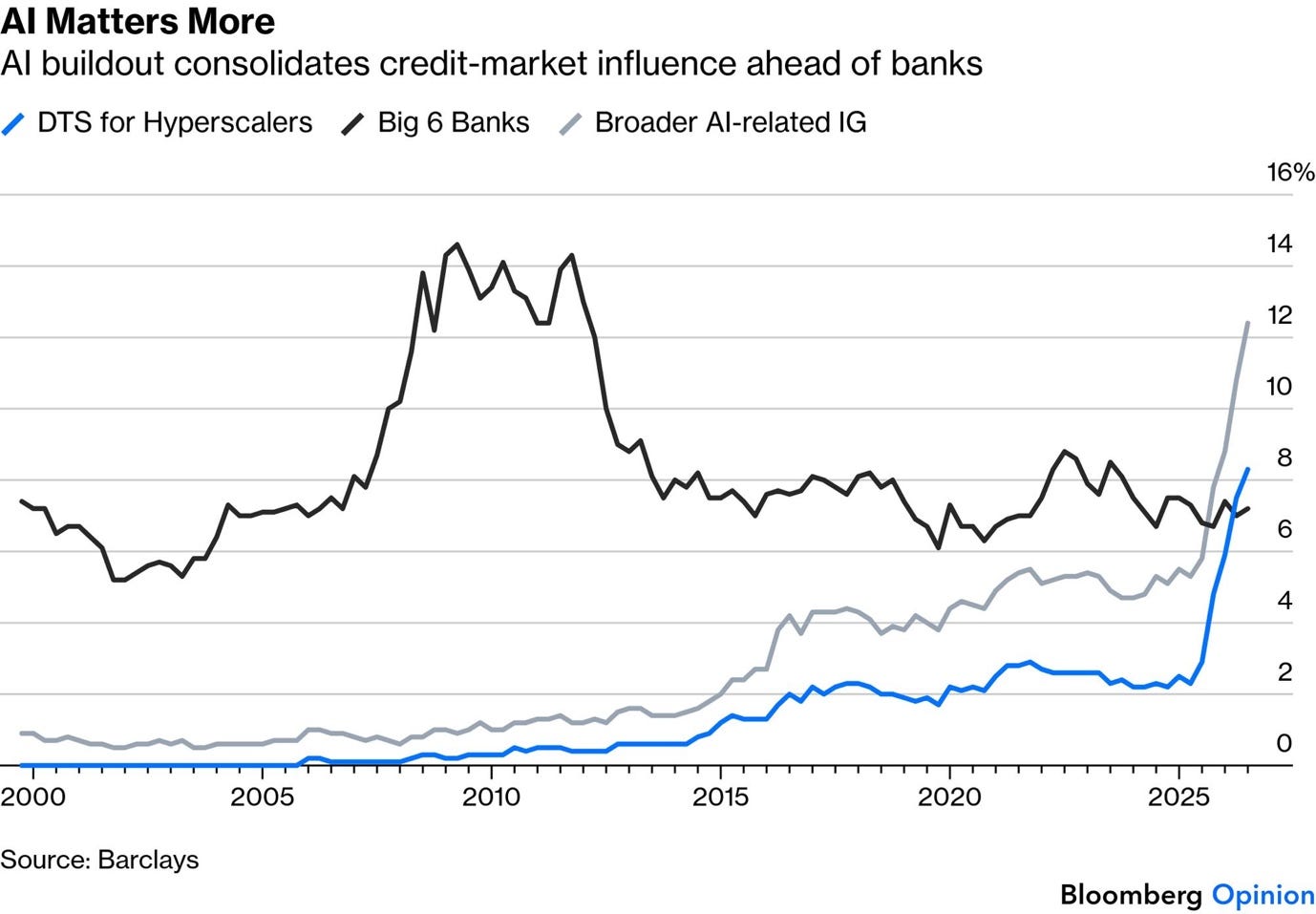
Authers is not arguing that the hyperscalers are in immediate danger of default. Their balance sheets remain formidable. The point is that their financing decisions have become systemically important to the corporate bond market. AI capital expenditure has grown so large that a change in the buildout would affect issuance volumes, Treasury yields, credit risk and the availability of capital for companies with no direct connection to artificial intelligence.
Pimco’s Lotfi Karoui identifies the strange asymmetry at the heart of that risk. If the AI investment cycle disappoints, the first impact falls on shareholders because returns on the vast infrastructure spending would fail to meet expectations. Yet the second impact could actually favour creditors. Lower capital expenditure would restore free cash flow, reduce new issuance and improve hyperscaler credit metrics.
The catch is timing. Competitive pressure, sunk power investments, equipment contracts and long term lease commitments could keep spending elevated even after the economic case begins to weaken. The credit positive outcome only arrives if management teams impose capital discipline quickly. Until then, the same spending that supports the AI ecosystem can continue consuming cash and adding duration to the bond market.
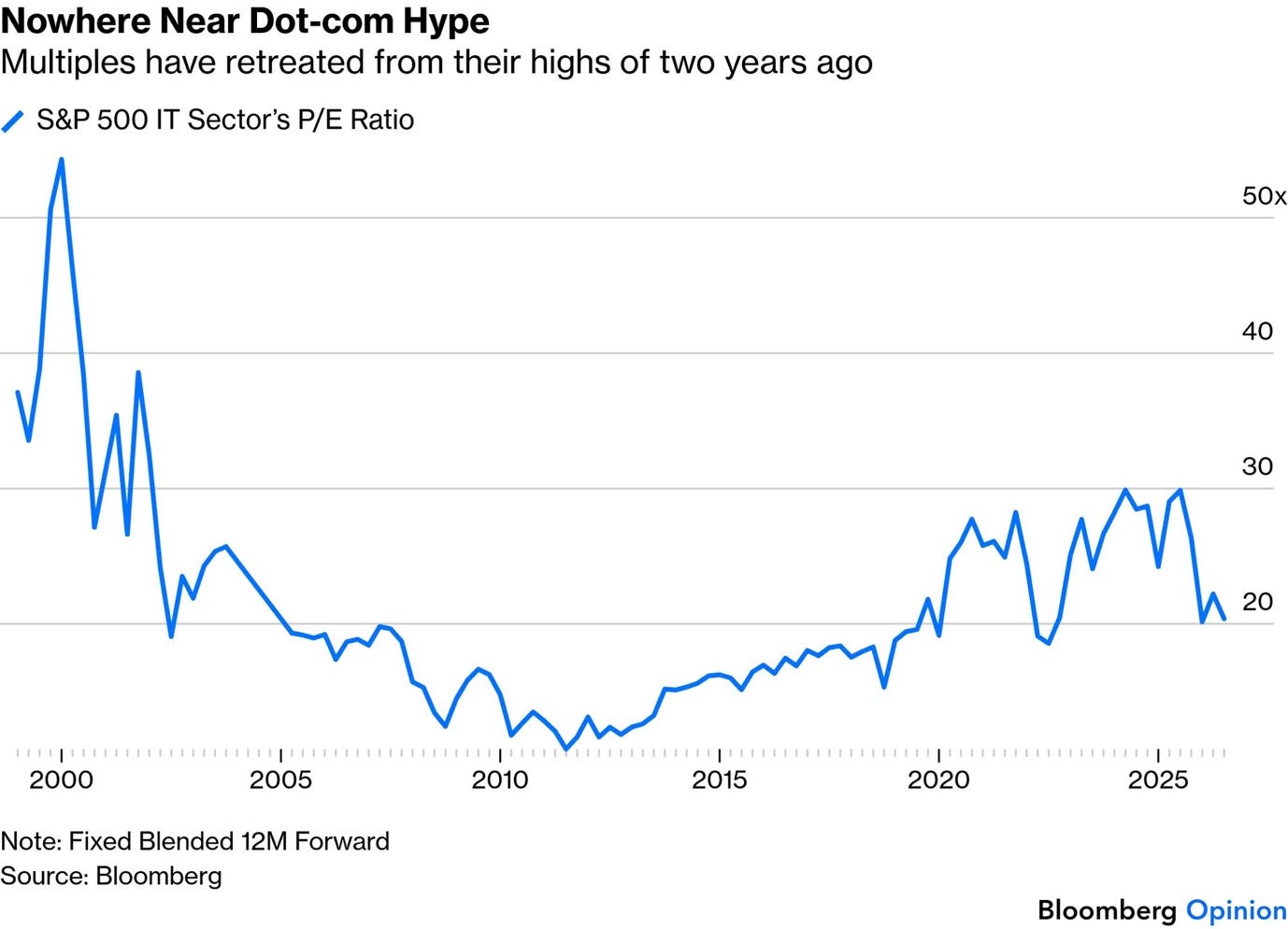
For equity investors, the adjustment would be more direct. Hyperscaler valuations remain elevated compared with their own five year history, but Authers stresses that this is not a replay of the dot com bubble. Technology multiples have already retreated substantially from the extremes reached around 2000 and from their more recent peaks.
The market is making a more nuanced judgment than the headline valuation numbers suggest. Investors appear willing to believe optimistic earnings forecasts for the hyperscalers, but they are not paying them a meaningful premium over the wider market. UBS’s hyperscaler index trades at roughly the same forward earnings multiple as the capitalization-weighted S&P 500, although it remains above the equal-weighted index.
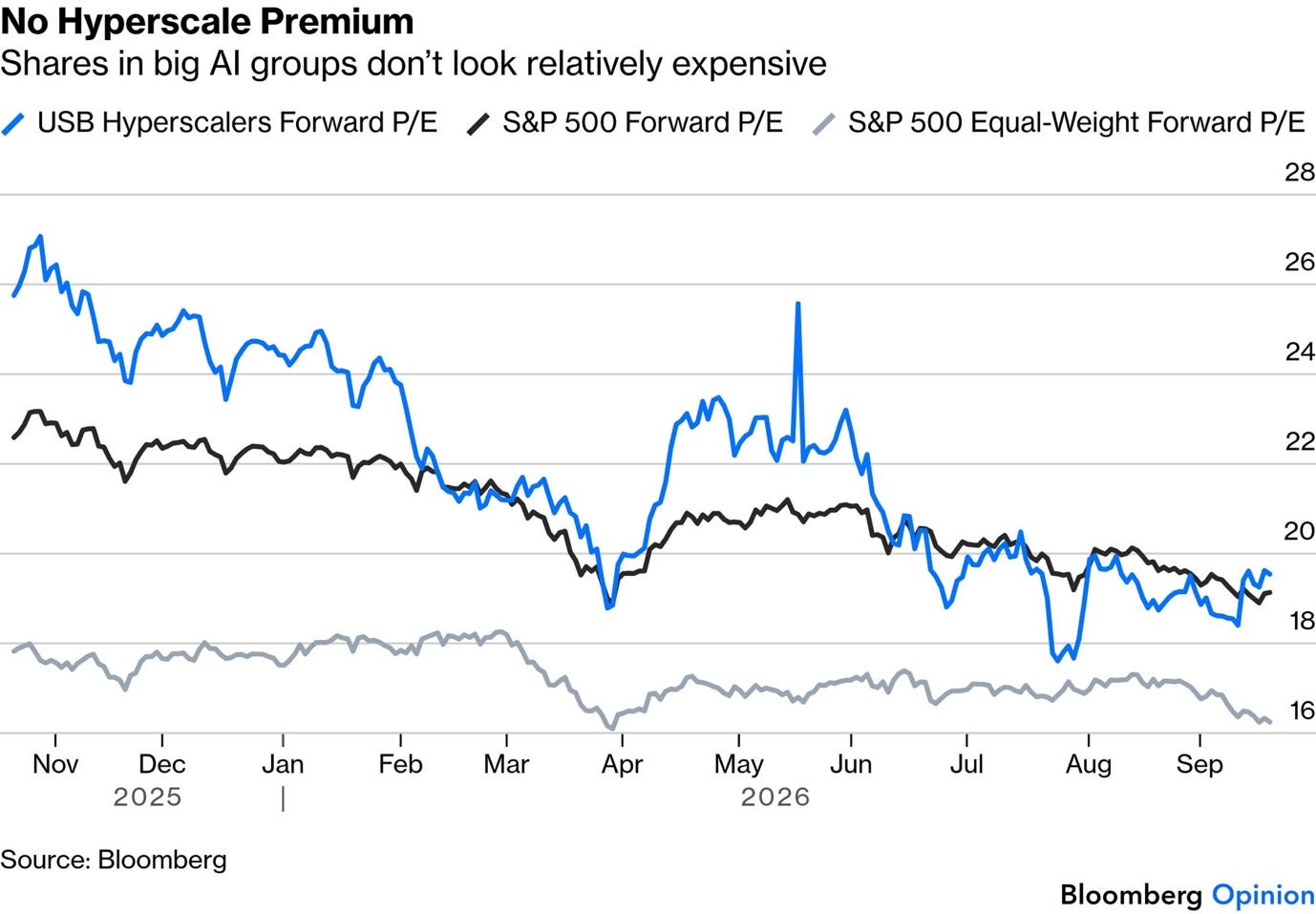
That is hardly the positioning of a market prepared to pay any price for the AI story. Investors are granting the companies credit for their earnings forecasts but withholding the extra multiple that would signal unquestioning faith.
The restraint is understandable because the investment burden is enormous. Yet it would also be wrong to dismiss the buildout as pure speculation. The largest technology companies produce real profits on a scale the dot-com leaders never approached. Their margins give shareholders a fundamental defence and creditors an even more important cushion.
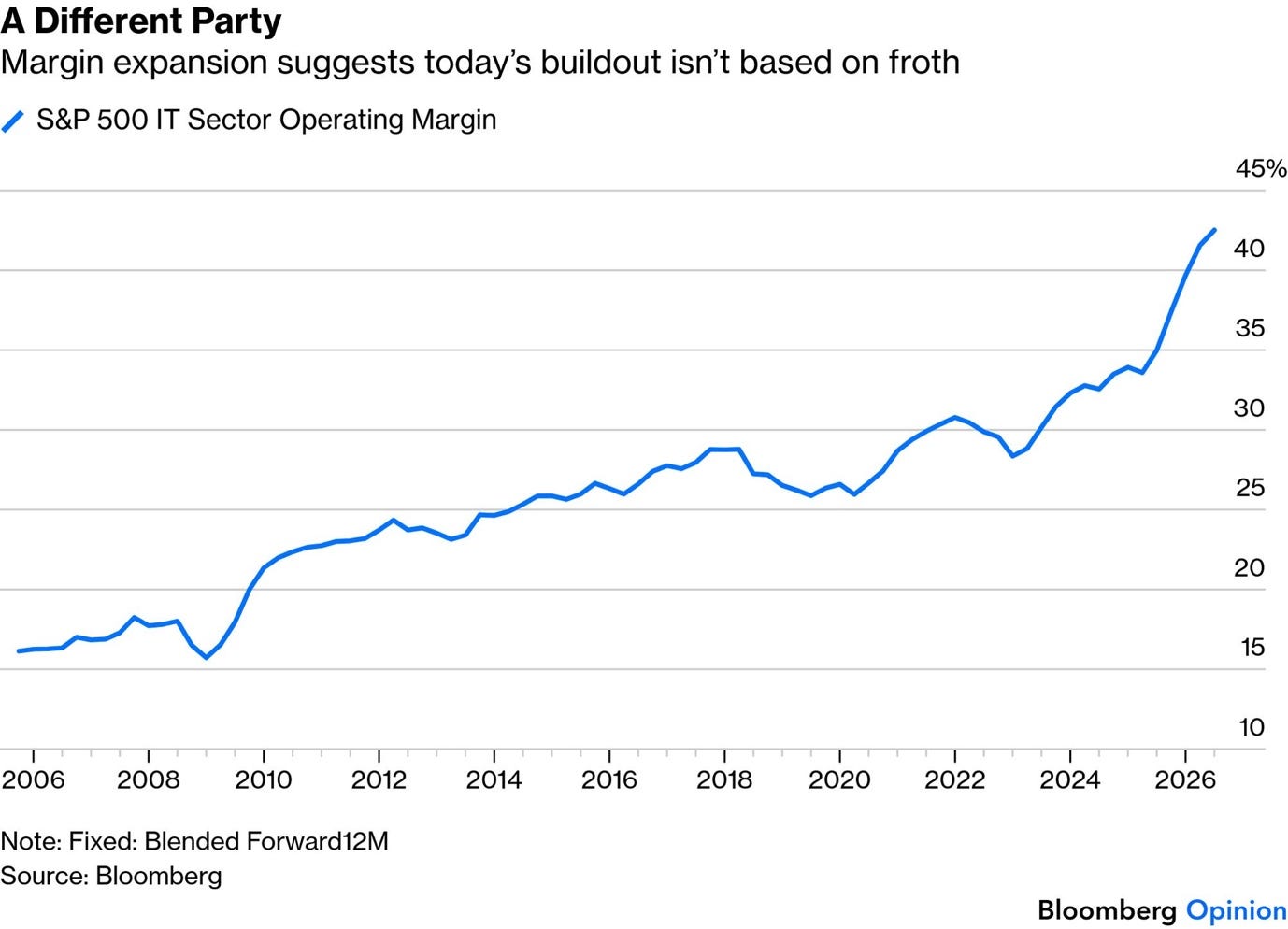
The operating margin of the S&P 500 technology sector has climbed above 40%, compared with roughly 15% two decades ago. That profitability does not guarantee attractive returns on every dollar spent on AI, but it gives hyperscalers far more room to absorb mistakes, delays, and excess capacity.
Authers therefore frames the market less as a rerun of 2000 and more as a prisoner’s dilemma. Each frontier AI developer may understand that the industry is spending at a ferocious pace, but no company wants to slow first and risk surrendering technological leadership. The rational collective outcome may be greater discipline, while the rational individual response remains another round of chips, memory, power contracts and data centers.
That competition limits hyperscaler free cash flow but still favours the suppliers of picks and shovels. The semiconductor and infrastructure trades suffered a major correction during the early summer, yet the principal indexes have since stabilized. Investors may be questioning the eventual return on AI investment, but they have not abandoned the physical infrastructure required to sustain the race.
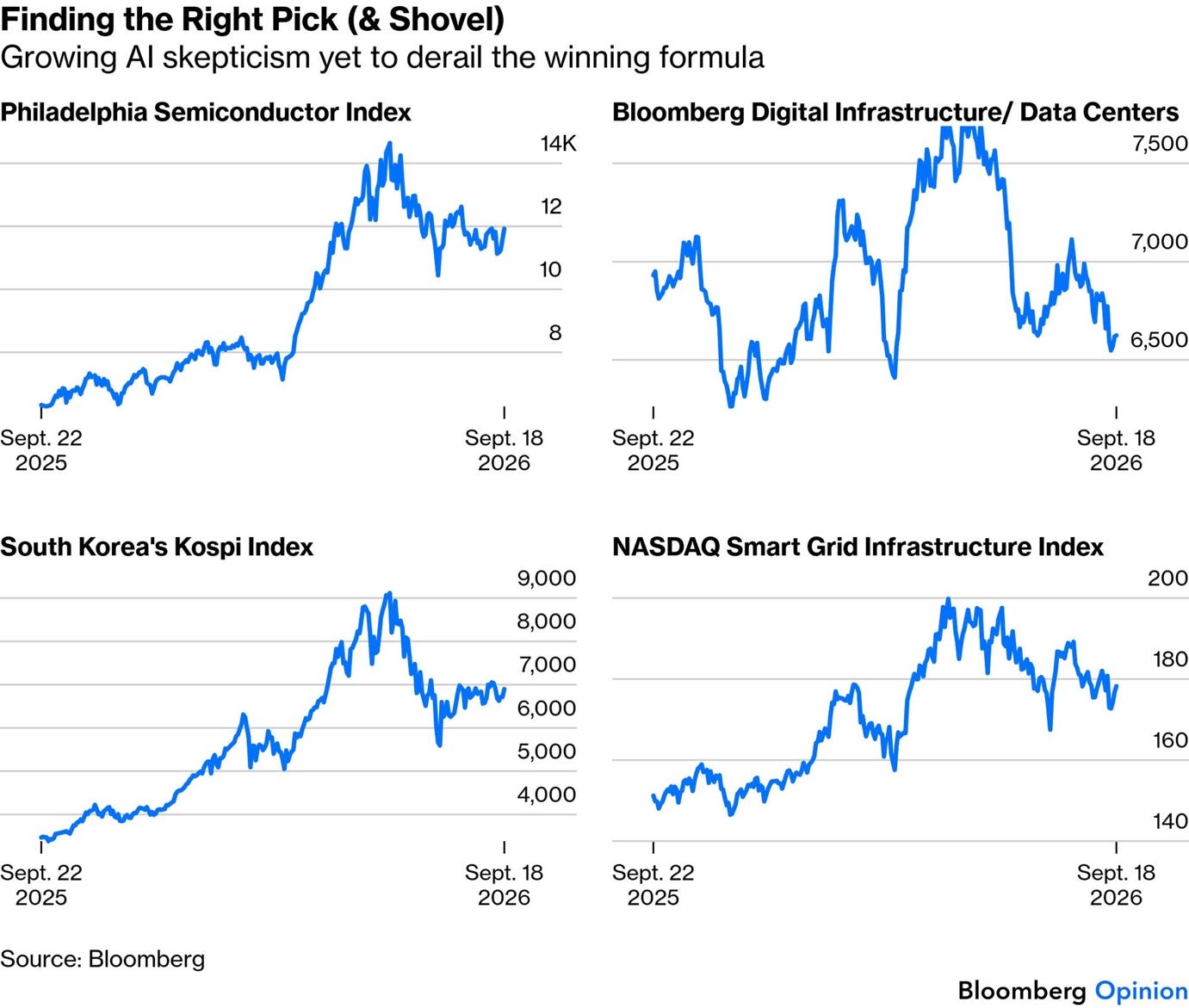
The divergence inside that chart is instructive. Semiconductors retain the strongest trajectory because every participant still needs computing power. Data centers, grids and other infrastructure exposures have struggled more visibly as the market confronts their financing needs and sensitivity to higher yields. The market is not rejecting AI. It is becoming more selective about where the economics remain most convincing.
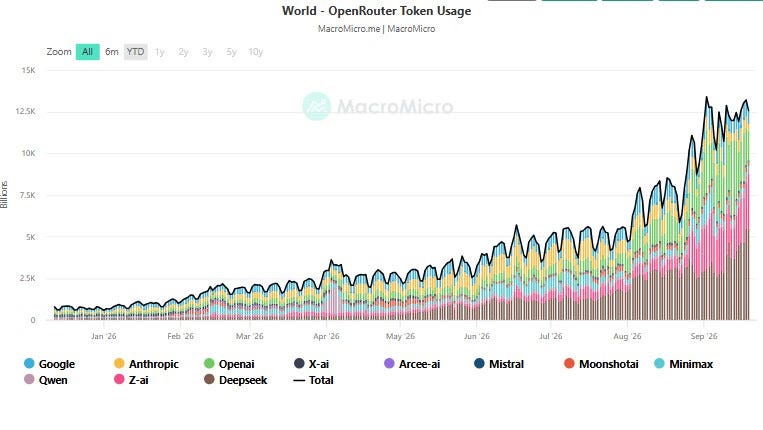
Demand for the underlying technology also continues to move higher. OpenRouter data show that global token usage has expanded dramatically through 2026, even though consumption dipped during recent weeks. The short term pause has not yet altered the broader direction.
Usage, however, is not the same as revenue. Token prices have fallen rapidly as models become more efficient and users shift toward cheaper alternatives. The LLM Token Expenditure Index, which combines prices and volumes to estimate effective spending, has recovered slightly but remains far below its June peak.
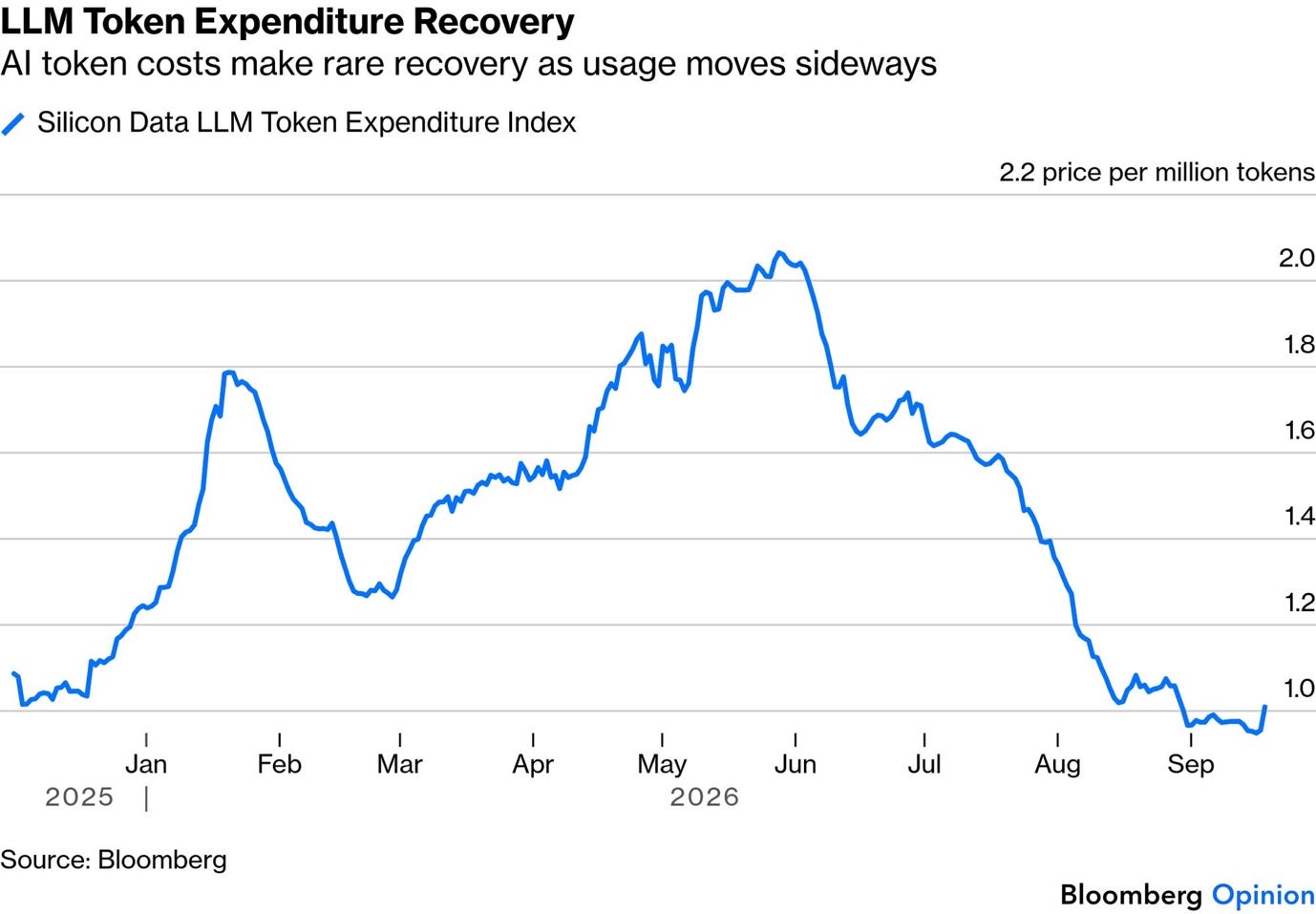
That may be the most important commercial tension in the entire AI trade. Consumption can surge while the price of intelligence falls. The industry may be correct about extraordinary demand growth and still struggle to generate returns proportionate to the capital being deployed.
For traders, this is where the market begins to resemble other great infrastructure booms. Railways, fibre networks and telecommunications towers all created lasting economic value, but the investors financing their expansion did not necessarily capture that value on favourable terms. A revolutionary technology and a profitable security are not the same proposition.
Politics is unlikely to impose the industry’s red flag. Washington remains reluctant to slow a technology viewed as strategically essential, while competition between developers makes voluntary restraint difficult. Authers therefore turns to the one institution capable of applying discipline without passing new legislation: the bond market.
JPMorgan estimates that more than $4.1 trillion of the projected $5.5 trillion in AI capital expenditure will be financed with debt. That places the cost of capital at the centre of the buildout. Gavekal Research’s Will Denyer argues that rising real yields could accomplish what safety campaigns and political warnings have not by making the next project economically harder to justify.
Treasury Secretary Scott Bessent is attempting to contain pressure at the long end through bond buybacks, but their scale has so far disappointed. Meanwhile, AI companies and the federal government continue competing for the same pool of duration capital.
Denyer measures the threat through the Wicksellian spread, the difference between the corporate sector’s real return on invested capital and its real cost of capital. Whenever that spread falls below its 20 year median, the probability of a broader investment slowdown rises sharply.
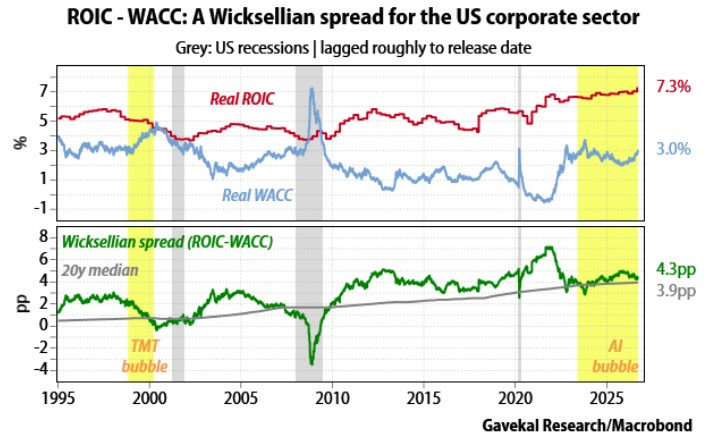
The spread has not crossed the threshold. Corporate real returns remain around 7.3%, while the real weighted average cost of capital stands near 3%, leaving a cushion of approximately 4.3 percentage points against a 20-year median near 3.9 points. That suggests interest rates and bond yields could still rise somewhat before producing a generalized capital expenditure retreat.
But the cushion is no longer comfortable. The indicator is imprecise, yet another increase in real financing costs would bring the market close to the point where projects begin disappearing from spreadsheets. That is modestly reassuring for equities in the immediate term, but less encouraging for bonds because the issuance machine may continue until the cost of capital finally forces it to slow.
This is the red flag Authers is really pointing toward. It is not a regulator walking in front of the AI machine and ordering it to reduce speed. It is the real yield embedded in every bond, lease, power agreement and discounted cash flow model.
The AI investment cycle is approaching a reckoning, but that does not necessarily mean a collapse. It may instead mean that the market begins separating valuable infrastructure from expensive duplication, durable earnings from optimistic forecasts, and transformative technology from securities priced as though transformation automatically guarantees returns.
Credit spreads have not sounded the alarm. Token demand continues growing. Technology margins remain exceptionally strong and the hyperscalers do not carry dot com valuations. Yet debt issuance is rising, real yields are climbing and the Wicksellian cushion is narrowing.
The red flag is not waving far ahead of the machine. It is getting closer to the driver.