Prediction: Berkshire Hathaway’s Operating Earnings Will Top $48 Billion in 2026

You certainly know that Berkshire Hathaway (BRKA -0.47%) (BRKB -0.73%) owns a bunch of individual stocks. You may have even borrowed a few of these picks for your own portfolio.
What’s often easy to forget, however, is that Berkshire is also a conglomerate of several dozen wholly owned enterprises. Unlike the publicly traded stocks that the conglomerate owns, these privately run enterprises’ results are collectively reflected on the organization’s income statement, just as they would be for any individual company.
There’s more of it than you might expect of the $1.1 trillion conglomerate, too. Indeed, Berkshire Hathaway’s operating earnings alone could easily top $48 billion this fiscal year.
Halfway there already
It’s not that you hear nothing about it. It’s just that all the buying and selling of stocks that Berkshire does in any given quarter is given considerably more attention.
Today’s Change
(-0.73%) $-3.70
Current Price
$506.07
Key Data Points
Market Cap
Day’s Range
$504.96 – $510.50
52wk Range
$464.01 – $537.74
Volume
1.6M
Avg Vol
4.5M
Gross Margin
23.52%
It’s there if you’re willing to do a little digging, though. Take last quarter’s official investor update, for instance. During the three months ending in June, the company’s privately owned businesses — like GEICO insurance, Fruit of the Loom, Clayton Homes, and railroad BNSF — collectively generated $12.98 billion in liquid, accessible operating earnings, bringing the year-to-date total to $24.33 billion.
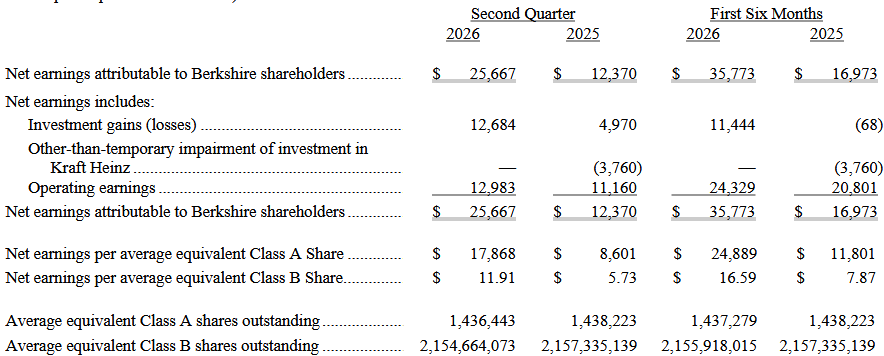
Image source: Berkshire Hathaway’s Q2 2026 investor update.https://www.berkshirehathaway.com/news/aug0826.pdf
Berkshire Hathaway simply needs to do what it did during the first half of 2026 again in the second half to reach — and eclipse — the $48 billion mark. It very likely will, given the nature of these wholly owned companies like Pilot travel centers, Shaw flooring, and the aforementioned Fruit of the Loom. None of these are particularly high-growth enterprises. Most of them are reliable cash cows, however, producing operating profits regardless of the economic backdrop.
A business structure fully capable of adapting as needed
Surprised? Plenty of people are, but that’s OK. It’s easy to forget — or never even realize — that Berkshire Hathaway is so much more than a collection of hand-picked stocks.
That’s been the case for most of its modern-day existence, in fact, when Warren Buffett acquired the majority of the then-struggling textile mill called Berkshire Hathaway back in 1965. This would end up being the entity through which Buffett would slowly, wholly acquire more and more businesses. It simply held stocks when there wasn’t much else to do with its idle cash.

Image source: Getty Images.
That’s something for current and future shareholders to keep in mind, too. The company owns $360 billion worth of individual stocks right now. However, it’s not obligated to own any. Or it could own even more. Management gets to make that call, and then change its mind if and when it sees fit. Owning a stake in Berkshire means trusting its management team to make the optimal use of its assets and opportunities at any given time.
Of course, given the company’s track record and corporate culture, that’s not a bad bet to make.