Stocks rattled by geopolitical tensions as Trump heads to Davos; bonds remain fragile
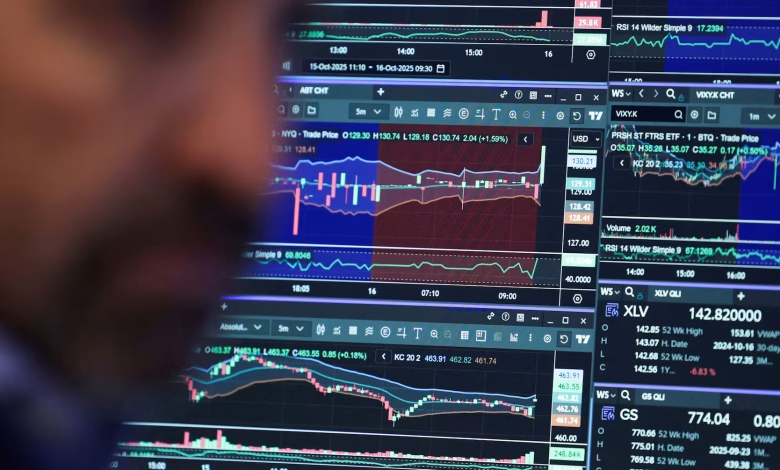
Item 1 of 2 A trader works on the floor at the New York Stock Exchange in New York City, U.S., October 16, 2025. REUTERS/Jeenah Moon/File Photo
SYDNEY/LONDON, Jan 21 (Reuters) – Global shares fell for a fourth day on Wednesday and some measures of market stress remained high after a rout in global bonds and U.S. threats to acquire Greenland kept investors on edge ahead of President Donald Trump’s Davos speech.
Sign up here.
That sent investors into safe-havens like gold , which rose as much as 2.6% to a new record of $4,887 an ounce, and like the Swiss franc .
“The ‘sell America’ trade was the driving force behind major market moves overnight, as investors looked to reduce exposure to the U.S., seen by many as an unreliable partner pursuing self-defeating policies,” said Mantas Vanagas, a senior economist at Westpac.
The European Union will convene an emergency summit in Brussels on Thursday to discuss the matter, with the long-standing U.S.-EU alliance at risk.
All eyes are now on the World Economic Forum in Davos, where Trump is due to deliver a speech later in the day that could either calm or inflame tensions with Europe.
Futures on the S&P 500 were down 0.12%, while those on the Nasdaq 100 were down 0.3%, having reversed course earlier in the day.
“The key question is whether dip buyers step in to support early weakness, or whether traders see developments that justify taking risk down further,” Pepperstone head of research Chris Weston said.
BONDS ATTEMPT RECOVERY
The global bond market was still reeling from a brutal selloff, having been caught up in a perfect storm of worries over exposure to U.S. assets and a surge in Japanese government borrowing costs.
At the epicentre were long-dated Japanese sovereign bonds, which endured their most aggressive selloff in nearly 25 years on Tuesday, as fears grew over increased government spending under Japanese Prime Minister Sanae Takaichi. U.S. 30-year Treasury yields neared the 5% threshold for the first time since September, while German government bond yields also rose sharply .
By Wednesday, Japanese bond prices rallied as buyers returned, almost entirely reversing the previous day’s rise in yields. A similar dynamic played out across U.S. Treasuries, where 30-year bond yields were steady at 4.918%.
In the foreign exchange markets, the dollar index, which tracks the U.S. currency’s performance against that of six others, retreated for a third day, dipping 0.1%.
The euro rose 0.1% to $1.1733, adding to Tuesday’s 0.7% gain, while the Swiss franc firmed, leaving the dollar down 0.1% at 0.7891 francs.
The yen was a touch stronger at 157.77 per dollar ahead of a Bank of Japan policy meeting on Friday. No rate hike is expected this time though policymakers could signal an increase may be coming as soon as April.
Oil prices were steady, as pressure from geopolitical tensions and an expected build-up in U.S. crude inventories was offset by a temporary halt in output at two large fields in Kazakhstan. Brent crude futures were unchanged on the day at $64.91 a barrel.
Additional reporting by Stella Qiu in Sydney; Editing by Shri Navaratnam, Elaine Hardcastle and Chizu Nomiyama
Our Standards: The Thomson Reuters Trust Principles.