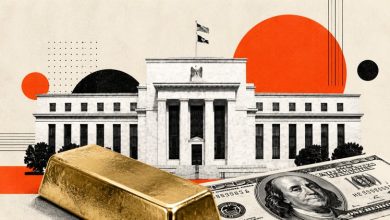
gold plunged overnight. Do you see risk, or a once-in-a-decade opportunity?
From the core logic of trading, the market’s optimistic expectations of a loose U.S. policy directly clashed with the reevaluation of the Federal Reserve leadership triggered by Trump’s nomination of Kevin Warsh, a staunch advocate of tightening policies and former Fed governor, to succeed Powell in May after his term ends. This became the key trigger for the market reversal.
As previously mentioned in earlier articles, this expectation directly countered the trading logic of ‘selling the U.S.,’ bringing back the view of buying the dollar and a strong dollar. The shift in expectations behind this trade was precisely the core bullish argument that had previously supported the unilateral surge in gold and silver prices, which is now gradually unraveling.
Christopher Forbes, head of the Asia-Pacific and Middle East region at Gain Capital Group, explicitly stated that the sharp pullback in gold this time represents a typical technical correction following an extreme one-sided rally, rather than a substantive breakdown of its long-term bullish logic. Essentially, it is a classic case of a sharp decline after an extreme surge.
 Multiple Contributing Factors: Capital Flows, Dollar Strength, and Geopolitical Sentiment Exert Joint Pressure
The sharp short-term decline in gold is the result of multiple bearish factors working together.
Warsh’s nomination has become one of the core drivers of the strengthening dollar. As a staunch supporter of tight monetary policy, he has fueled hawkish expectations about the future direction of the Federal Reserve’s policies. Previously, the market expected Reid, who represented loose policies and tolerance for inflation, to become the Fed chair. This shift created a significant divergence in market expectations.
Meanwhile, the U.S. government shutdown transitioned from an actual closure to a nominal one during this period. Although the government nominally shut down again this time, key agencies received their budgets, ensuring no substantial disruption occurred.
In addition, statements released by Trump regarding a potential agreement with Iran significantly eased geopolitical risk aversion in the market. West Texas Intermediate crude oil futures fell approximately 4% on Monday, weakening gold’s support from safe-haven buying. Multiple factors collectively burst the market bubble of this overcrowded trade.
At the capital flow level, CME Group raised margin requirements for gold and silver futures contracts. The margin for gold futures increased from 6% to 8%, while that for silver futures rose from 11% to 15%. Coupled with the accumulation of substantial profit-taking positions during the earlier one-sided rally, some investors chose to cash out, and concentrated profit-taking directly triggered the price drop.
The U.S. Dollar Index also continued to strengthen, rising approximately 0.8% since Thursday. This reduced the attractiveness of dollar-denominated gold to overseas buyers, directly pressuring gold prices.
Price Resilience: Remarkable Annual Gains, Long-Term Trend Unchanged
Despite a significant short-term pullback, the price performance of the precious metals market continues to demonstrate strong resilience, with the long-term upward trend remaining unaltered by this technical correction.
In terms of year-to-date performance in 2026, silver prices have risen approximately 16%, while gold has gained about 8% during the same period, maintaining positive returns despite short-term corrections.
Reviewing the 2025 market trends, both gold and silver experienced record-breaking one-sided rallies, with annual gains reaching approximately 65% and 145%, respectively. These substantial increases underscore the long-term strength of the precious metals market and lay the groundwork for the 2026 outlook, as short-term technical corrections have not undermined this long-term trajectory.
Core Support: Multiple Underlying Factors Bolster Gold’s Long-Term Upside
The long-term bullish case for gold is underpinned by multiple foundational factors, including geopolitical dynamics, central bank gold purchases, and market capital allocation. Importantly, these core drivers remain fundamentally unchanged.
On the geopolitical front, although tensions in the Middle East have eased somewhat recently, global uncertainties persist. The diplomatic standoff between the U.S. and Europe over Greenland’s status has disrupted the traditional stability among Western allies.
The resurgence of global tariff sanctions has heightened the risk of economic ‘fragmentation,’ injecting a long-term ‘risk premium’ into gold prices. This reaffirms gold’s role as the ultimate safe-haven asset.
In terms of central bank gold purchases, the global de-dollarization wave is unfolding comprehensively, providing the most transformative structural support for the gold market. From 2025 to early 2026, central banks in emerging markets such as China, India, Poland, and Turkey initiated record-breaking gold-buying campaigns, marking the first time in modern financial history that multiple major economies held larger proportions of gold reserves than U.S. Treasuries.
Central banks’ demand for gold exhibits long-term stability, rarely resulting in panic selling. This ‘official sector’ buying behavior establishes a solid floor for gold prices, acting as a stabilizing force within the gold market.
At the level of capital and investor structure, the main participants in the gold market are continuously expanding, with new funds flowing in steadily.
By the end of 2025, physical gold ETFs recorded record inflows exceeding $26 billion. These modern financial instruments allow institutional and retail investors to participate in gold investment as conveniently as stock trading, significantly lowering market entry barriers.
Meanwhile, retail demand has shown remarkable resilience, with physical demand for gold bars and coins in major gold-consuming countries like India remaining at historically high levels; young investors in Western markets are also gradually incorporating gold into diversified digital portfolios, viewing it as an essential hedge against market volatility.
After the price of gold broke through the psychological threshold of $5,000 per ounce, the Fear of Missing Out (FOMO) effect drove trend traders to enter the market en masse, further amplifying the momentum of capital flows in the gold market.
Institutional Forecast: High Volatility Awaits Signals, Long-Term Bullish Logic Remains Unchanged
Regarding the future trading trend of gold, industry institutions have provided clear assessments, with short-term volatility and long-term bullishness becoming the consensus.
Forbes believes that in the short-term trading horizon, gold prices will continue to operate within a high range, but volatility will increase significantly. The core reason is that the market is in a wait-and-see state, anticipating clearer signals regarding Wash’s policy direction, and the policy tone set by the Federal Reserve leadership will serve as a crucial guide for the short-term market.
In the long term, Forbes maintains its bullish outlook on gold over the next 12 months, primarily because the key drivers supporting gold’s rise—geopolitical tensions, global debt pressures, and the weakening of the US dollar’s hegemony—show no signs of abating.
If the US dollar subsequently enters another weakening phase or Wash’s policy stance is confirmed to be dovish, funds seeking to buy on dips will quickly flow back, driving a rebound in gold prices; if the Federal Reserve continues its accommodative monetary policy while economic growth and inflation remain divergent, gold prices could test recent historical highs again.
For modern gold traders, gold has evolved from an ancient store of value to a core risk-hedging instrument in volatile market environments. This short-term technical correction is merely a phased manifestation of market dynamics driven by multiple factors, without altering its fundamental long-term strengthening logic. Subsequent trading around Federal Reserve policies, geopolitical developments, and central bank gold purchases will continue to dominate trends in the gold market.
Summary and Technical Analysis:
The recent plunge in gold prices presents numerous opportunities for bottom-fishing. This is because the main decline has primarily occurred during the Asian trading session. As mentioned in previous articles, gold price increases are mainly concentrated in the European and American trading sessions, where trading volumes are also predominantly focused. Recently, however, during the Asian session, gold has experienced significant declines with low trading volumes. Such a volume-less drop can easily be corrected by capital inflows.
The characteristic of a crash is that the decline happens very quickly, but once the rate of decline slows, the gold price rebounds rapidly. The window of opportunity for each trading move often lasts only a few seconds, as capital can sense the slowing of the downward momentum within seconds.
Although the time window for each rebound in the gold price is short, throughout the day, gold experiences multiple sharp declines, providing several rebound opportunities.
Technically, spot gold has retraced to between the 0.236 and 0.382 Fibonacci levels of this upward wave and is currently stabilizing near the 0.500 level. Note that near the lowest point, it is far from the critical support at the 0.382 level while close to the lower boundary of the channel, indicating a position with a high safety margin. A similar situation occurred on January 30 at the day’s lowest point, which was far from the critical support at the 0.500 level and close to the lower boundary of the channel.
A key price level does not mean that the price will necessarily stop at that position; rather, it is highly likely to become a pivotal price center around which prices tend to fluctuate. If the price moves away from a price center and approaches a key support level, from the perspective of deviation and support/resistance, it is highly probable to attract capital interest, generating short-term trading opportunities while also offering cost-effective positions for medium- to long-term fund allocation.
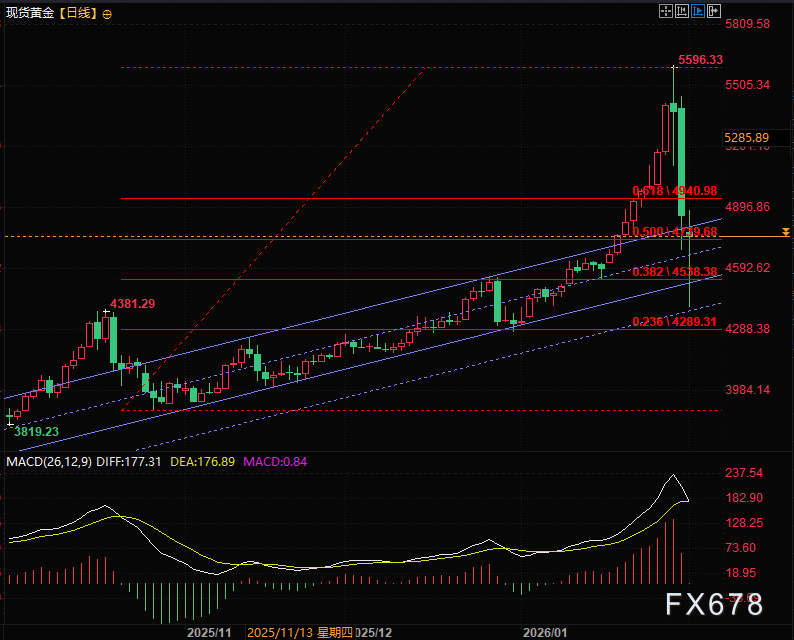
(Daily chart of spot gold, source: Yihui News)
At 20:01 Beijing Time, spot gold is reported at $4,762.64 per ounce.