The Small Cap Industrial ETF That Has Crushed the S&P 500 by 145 Points
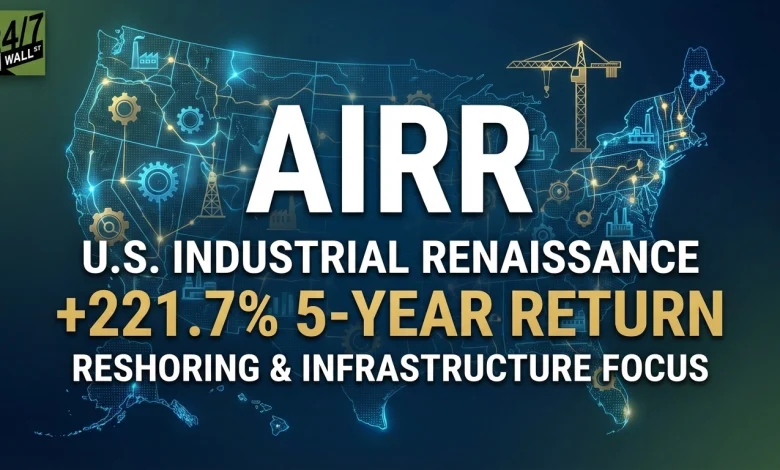
Most industrial ETFs offer broad baskets of large-cap conglomerates and defense primes. First Trust RBA American Industrial Renaissance ETF (NYSEARCA:AIRR) concentrates specifically on small- and mid-cap U.S. companies that build, move, and maintain physical infrastructure — contractors, electrical services firms, regional freight carriers, and specialty manufacturers that benefit most when domestic industrial activity accelerates.
The ETF’s Intended Portfolio Role
AIRR is a thematic, sector-concentrated growth vehicle — not an income tool. With a dividend yield of just 0.17%, income is irrelevant here. The fund targets investors who want exposure to the reshoring and domestic infrastructure buildout narrative, capturing companies that directly benefit from increased U.S. capital spending on physical assets.
The portfolio holds 50 positions, with 91.5% in industrials and 8.4% in financials — regional banks that finance local industrial and construction activity. Top holdings include electrical and mechanical contractors like Comfort Systems USA (NYSE:FIX) and EMCOR Group (NYSE:EME), infrastructure builders like Sterling Infrastructure (NASDAQ:STRL) and MasTec (NYSE:MTZ), and specialty freight carriers like Saia (NASDAQ:SAIA). The top 10 holdings represent roughly 33.6% of the fund, keeping position sizing relatively balanced for a concentrated strategy.
Does It Deliver?
AIRR’s long-term track record stands out sharply against its benchmarks. Over five years, the fund has returned +221.7% — dwarfing both the Russell 2000 and the S&P 500. That gap reflects the concentrated reshoring bet paying off as domestic industrial activity structurally accelerated, rewarding investors who held through the cycle.
The outperformance has continued into 2026. AIRR is up +24% year-to-date while the broader market has barely moved, supported by U.S. manufacturing value added posting its strongest quarterly growth in recent data at 3.2% in Q3 2025 — a sign the industrial renaissance driving AIRR’s holdings is still gaining momentum.
The Tradeoffs
Concentration is the defining risk. With virtually zero exposure outside industrials and regional financials, a slowdown in domestic capital spending — from higher rates, federal budget contraction, or a pullback in private construction — hits AIRR with no cushion. Construction sector growth already slowed to just 0.3% in Q3 2025, a signal worth monitoring.
Active management carries a cost. At 0.69% annually with 60% portfolio turnover, AIRR is meaningfully more expensive than broad index alternatives, and high turnover creates tax drag in taxable accounts.
The thesis is cyclical. AIRR’s outperformance is tied to the durability of U.S. reshoring and infrastructure investment. If fiscal priorities shift or private industrial capex contracts, the concentrated portfolio has limited defensive characteristics to fall back on.
Investors researching thematic industrial exposure may want to examine how AIRR’s concentration profile, cost structure, and cyclical characteristics align with their broader portfolio goals before making any decisions.