Modi visit to Israel: why India switched sides on Israel-Palestine
This past week, we got a vision of what the future of world politics might look like. And it wasn’t pretty.
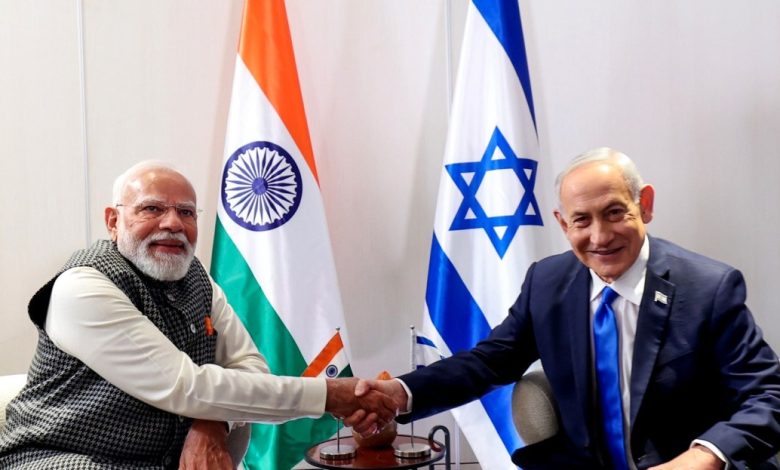
The glimpse came during Indian Prime Minister Narendra Modi’s visit to Israel, in which he signed an expansive defense cooperation agreement and gave a speech to Israel’s parliament (called the Knesset). This kind of thing may seem like the routine stuff of international politics, but it’s actually highly unusual: Historically, India has kept its distance from Israel and has often acted as a prominent international supporter of the Palestinian cause.
Such a country should, in theory, be moving away from Israel, given the past several years of brutality in Gaza. Prime Minister Benjamin Netanyahu has also been aggressively attacking the foundations of Israeli democracy, which you’d think would be a problem for the leader of a country frequently described as the world’s largest democracy.
But the opposite is true. It is quite likely that Israel’s assault on Gaza and ongoing democratic backsliding are, for India’s current leadership, not vices but virtues.
India under Modi is strikingly similar to Israel under Netanyahu. Modi, a deep believer in the chauvinist Hindutva ideology, has worked to undermine the basic idea of the Indian state — replacing its historic secular democracy with a state by and for the Hindu majority, particularly targeting the Muslim minority for exclusion. In order to accomplish this agenda, Modi has worked to consolidate power in his own hands — and undermine the fairness of the Indian electoral system in the process.
Growing security cooperation between India and Israel doesn’t just make sense on a material level: It’s also because these countries, with these particular governments, feel a genuine ideological affinity.
And in a post-Trump world, where old rules about human rights and international law continue to weaken, these kinds of ties between human rights-abusing authoritarians may become an increasingly important part of the global landscape — even in countries that claim, on the surface, to be democracies.
The India-Israel ideological alignment, explained
India and Israel, both formerly British possessions, became independent within a year of each other (August 1947 and May 1948, respectively). And at first, the two countries appeared to be traveling in opposite directions.
The early Indian state was defined by its partition with Pakistan. While India aimed to be a secular liberal democracy for all of its citizens, Pakistan’s leaders believed that its citizens could only be secure in a Muslim-majority state. The process of splitting the two states was violent and massively disruptive, causing one of the largest episodes of human migration in recorded history as Hindus and Muslims uprooted their lives to fit the new national boundaries.
For India’s early leaders, the bloodiness of partition — and enduring hostilities with Pakistan — proved the folly of ethno-nationalism.
Israel, by contrast, was more like a Middle Eastern Pakistan. Believing that the Jews of Palestine could only be safe in an avowedly Jewish state, the Zionist movement pushed for post-colonial political separation from surrounding Arab states — and fought its first war to enforce it.
Thus, the Indian political elite long viewed Israel and Zionism suspiciously, its sympathies aligning with the Palestinian refugees displaced in the Nakba. This approach was, as leading India expert Christophe Jaffrelot recently wrote in The Wire, a driving force in India’s Middle East policy.
“India has long been a leader in the Palestinian cause,” he writes. “Historically, it opposed the creation of the State of Israel, with [first prime minister Jawaharlal] Nehru advocating for the creation of a secular state where the Jewish minority would enjoy protections.”
This changed, in Jaffrelot’s telling, because of Modi. Since becoming prime minister in 2014, he has gradually worked to strengthen ties between New Delhi and Jerusalem — focusing, in particular, on their shared interests and experience in combating jihadist terrorism.
The decisive break came after October 7, 2023. “India tried hard not to take sides in Israel’s war on Gaza, but by abstaining [in UN votes] as civilian casualties — and international outrage — continued to mount, it effectively sided with Israel,” Jaffrelot writes, adding that Israel also sent weapons to Israel and deepened economic ties as the Gaza war grew more vicious.
Today, there’s little doubt where India lies.
Not only does New Delhi explicitly cite Israel as a source of inspiration for its counterterrorism policies, but it has begun paying into them — making up roughly half (46 percent) of all foreign purchases of Israeli arms.
Modi’s trip this past week was, on top of any tangible agreements, an all-but-official confirmation that India has switched sides in the Israel-Palestine conflict. Modi’s speech to the Knesset spent a lot of time lavishing praise on Israel — and confined its discussion of the Palestinians to a thin, barely noticeable aside.
Why the Israel-India alignment matters
Modi sees Israel differently from his predecessors because his worldview is fundamentally opposed to theirs.
Unlike secularists like Nehru, Hindutva devotees see a spiritual twin in the hardline versions of Zionism embraced by Netanyahu and his allies on the Israeli right.
Both Modi and Netanyahu see the nation in ethno-national terms: There is only one people who has a legitimate claim on belonging and ownership. Both share a special antipathy for Muslims living on land they see as rightfully theirs, seeing them as interlopers at best and invaders at worst.
“After October 7, 2023, leaders of the Hindutva movement — including ministers and members of parliament — expressed their unreserved solidarity with Israel, denouncing not only terrorists but Muslims in general,” Jaffrelot writes. “This pro-Israel bias was so widespread that the judiciary once again echoed it by banning demonstrations in support of the Palestinians.”
Growing India-Israel partnership is not just the result of strategic interests: It reflects a new development in the rise of the so-called nationalist international. This is, in essence, the concept that far-right movements are increasingly sharing knowledge and coordinating their activities to advance a shared struggle against the existing liberal order.
Originating from Western politics, in reference to things like the ties between the Republican party and Hungary’s ruling Fidesz group, the term “nationalist international” is often deployed semi-ironically — in the sense that nationalist movements are, by their nature, unlikely to be able to be stable partners with each other for very long.
But unlike, say, Eastern European nationalist movements, the Israeli and Indian far-right nationalisms have few points of geographical or historical conflict. Separated by geography and history, they are free to prioritize their shared ideological interests — and are, increasingly, doing so.
This is a glimpse into a possible future for global politics: one in which the “might makes right” ethos championed by the current US administration wins the day.
In this future, countries will no longer feel burdened by the need to even pay lip service to human rights concerns.
Leaders of ascendant powers like Modi, who might once have at least had political reservations about being too closely linked to an Israeli prime minister under ICC indictment, will act on their unrestrained impulses. A network of far-right movements, united in large part by shared hostility to Muslims, will unite a group of governments ranging from Western Europe to South Asia — maybe even North America.
This is not an inevitable future. But it is an increasingly possible one — enabled both by the Biden administration’s fecklessness in the face of Israeli atrocities in Gaza and the Trump administration’s bulldozing of the current international order.
Credit: Source link