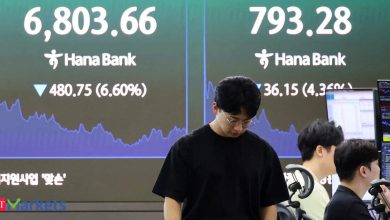
War hits global shares as Asia enters ‘sell everything’ phase

‘Panic more than a structural crisis’
Prakit Siriwattanaket, managing director at Mersion Partner Asset Management, said the Thai market’s plunge — severe enough to trigger the circuit breaker — reflected panic rather than a structural crisis in Thailand’s economy.
He said part of the selling came from investors sitting on sizable gains, who chose to take profits when negative signals emerged, causing the index to fall quickly and sharply. However, he said such a steep drop suggested downside risk was starting to become limited. He added that the index had closed a technical “gap” around the level seen during the post-election results period, which, by technical analysis, could allow a rebound if there were no further severe developments.
On external factors, particularly oil prices, he said conditions had not yet entered a crisis phase. If the situation were truly deteriorating, oil prices should quickly break above $100 a barrel. Instead, prices were still moving gradually, suggesting the Thai market’s fall may have exceeded what fundamentals could justify.
Watan Jitsomnuek, director of strategy analysis at Pi Securities, said part of the Thai decline reflected a delayed reaction to earlier falls in Asian markets. But the main factor undermining investor confidence was the Iran–Israel–US conflict, whose endpoint remained unclear.
He also pointed to risks around the Strait of Hormuz, a route that carries about 20% of the world’s oil. If the situation escalated to the point of affecting that corridor, oil prices could spike immediately, feeding into inflation, interest-rate policy and further pressure on the global economy.
Asia hit by heavy selling
Asian markets saw intense “panic selling” on Wednesday, March 4, 2026, extending the US-led sell-off from the prior session, as the Middle East conflict between Iran and the United States and Israel worsened.
South Korea saw the heaviest selling. The KOSPI closed down 12.06%, or 698.37 points, at 5,093.54 — its worst one-day fall on record, breaking the previous record set during the September 11, 2001 shock. Trading was briefly halted earlier in the day by a circuit breaker, but the market continued to fall after trading resumed. Over the past two days, the tech-heavy market has lost more than 18%, while the won weakened to its lowest level in 17 years.
Japan’s Nikkei closed down 4%, falling more than 2,251 points to 54,023.63, its lowest level in a month, while the Topix slid 4.33% to 3,608.54, as investors rushed to sell semiconductor shares. Hong Kong’s Hang Seng closed down 518.60 points, or 2.01%, at 25,249.48. Indonesia’s JKSE fell 391.86 points, or 4.94%, to 7,547.90.
Matt King, founder of financial markets research firm Satori Insights, wrote in a note that markets investors had previously used for diversification suddenly appeared the most vulnerable after the attacks on Iran.
Charu Chanana, chief investment strategist at Saxo in Singapore, said markets were entering a phase of “selling everything that can be sold”, with Asia’s sell-off becoming disorderly as markets no longer treated the situation as merely a “one-week headline shock”.