Bigger schools, better futures – The Hindu
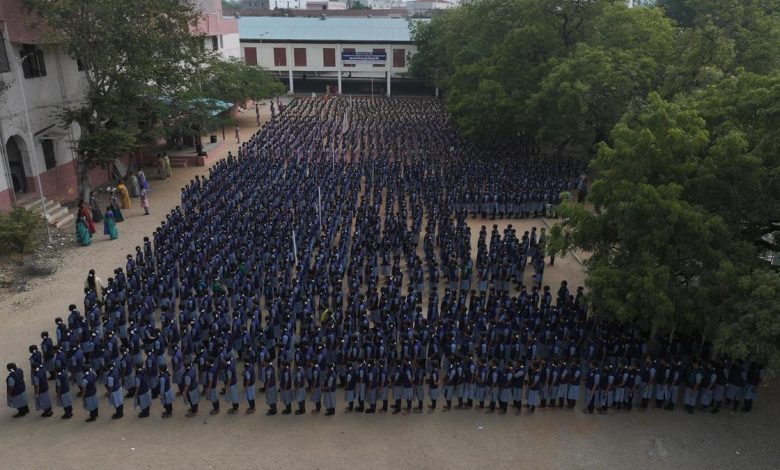
By 2035, India is projected to have nearly 8 crore students in Classes 9-12. This scale creates the possibility of large, well-resourced secondary schools. Representational file image.
| Photo Credit: B. Jothi Ramalingam
A recent visit to China offered a striking view of what scale and holistic school design can achieve. A Class 1-9 school there serves around 1,200 students, with K-12 schools averaging 2,800 students. This is in stark contrast with India, where an average government K-8 school has around 150 students. Although three times the size of India, China has only one-third the number of schools. While India has succeeded in ensuring access at the elementary level, China has used scale to strengthen quality. Its schools have specialised subject teachers, support staff, viable vocational laboratories, and counselling, sports, Information and Communication Technology (ICT) labs, and co-curriculars — the kind of holistic learning environment that the National Education Policy, 2020, envisions.
India has made enormous strides in enrolment and infrastructure, but the school network remains fragmented. There are about 5.6 lakh schools nationally, which enrol less than 50 students each. Over 1 lakh single-teacher schools cover 33 lakh students, making multi-grade teaching a necessity (UDISE 24-25). At secondary levels, the need for subject expertise and lab infrastructure becomes even more critical. Around 40% of government secondary schools have fewer than 100 students enrolled (across Classes 9-12), making such provision difficult. Today, only 19% of schools have functional ICT labs, 51% have integrated science labs; about 10% offer higher secondary classes; and just 6% provide vocational education (UDISE 24-25).

Experiments with schools
These gaps highlight the next phase of India’s education reform: building school systems that address not only access, but also the quality of education. Several States have already experimented with different models of this. Rajasthan has established one upgraded, well-resourced government school in every Gram Panchayat, called Adarsh Schools. Over the past decade, the State has upgraded thousands of schools in a phased manner — improving infrastructure, staff deployment, and secondary-grade offerings. In Uttar Pradesh, Model Composite Schools (Class 1-12) have been approved in every district; these will have tech-based learning, including smart classrooms and WiFi. Madhya Pradesh has consolidated 36,000 under-enrolled schools under the NITI Aayog’s SATH-E programme to create larger campuses with better facilities. In 2023, the Chief Minister announced the rollout of one ‘CM RISE’ school (now Maharishi Sandipani Schools) for every 25-30 villages to improve learning. Odisha, Jharkhand, West Bengal, Tamil Nadu, Telangana and Gujarat are also moving in this direction.
Composite and consolidated schools are not about efficiency alone; their core purpose is to create real learning environments, with one teacher per class and adequate subject specialists to support every child. Equity must remain paramount. This is enabled through decentralised decision-making, and supported by transport facilities so that no child loses access. Equally essential is thoughtful change management: engaging teachers, parents, and communities early to build consensus and ensure smooth, trusted transitions towards larger, integrated schools.

Drawing on these lessons, two clear directional goals can guide India’s progress towards universal, high-quality school education by 2035. The first is to have one K-8 school in every Gram Panchayat. By 2035, India should transition towards K-8 integrated schools (elementary and middle) as the default elementary school model. If each K-8 school serves around 300 students, these campuses could collectively educate close to 8.1 crore children. This shift could allow each school to reach the minimum enrolment threshold required for one teacher per class, and better facilities, leading to a better learning environment. Second, only 87% of students transition from middle to secondary school, and this falls to around 75% from secondary to higher secondary. Too often, secondary education is delivered through fragmented, under-resourced campuses with limited subject teachers, weak lab infrastructure, and few pathways beyond board examinations. What India needs at scale are composite secondary schools.
By 2035, India is projected to have nearly 8 crore students in Classes 9-12. This scale creates the possibility of large, well-resourced secondary schools with the capacity to offer real-world, application-based learning, career guidance, subject specialist teachers and multiple academic and vocational pathways. Supported by transport facilities, such schools ensure that distance does not become a barrier to continuing education and allow secondary schooling to move beyond exam preparation.

Achieving these goals
India needs State-specific road maps that lay out how each State will move towards larger, well-resourced schools, grounded in local realities of population density, geography and existing school networks. States can consider the following levers while designing these road maps. The first is thoughtful teacher deployment so that there is one teacher per class and subject specialists. The second is localised planning and decentralised decision making. The third is coming up with transport solutions for students. States will need a mix of transport models to ensure that students can reach these schools. The fourth is providing funding for composite schools. Samagra Shiksha, supported by State funds and coordinated with other schemes, can finance these upgrades.
Published – January 26, 2026 12:12 am IST