Bill Gates Issues Warning on AI Investment Hype, Urges Caution
Key Takeaways
- Bill Gates on Wednesday warned the AI industry will be “hypercompetitive,” and that “a reasonable percentage” of today’s pricey tech stocks will lose a lot of their value.
- Big Tech’s huge data center investments fueled concerns about an AI bubble and weighed on tech stocks in November.
Bill Gates has again warned AI investors that not everyone will be a winner, and the workforce disruption is coming faster than governments realize.
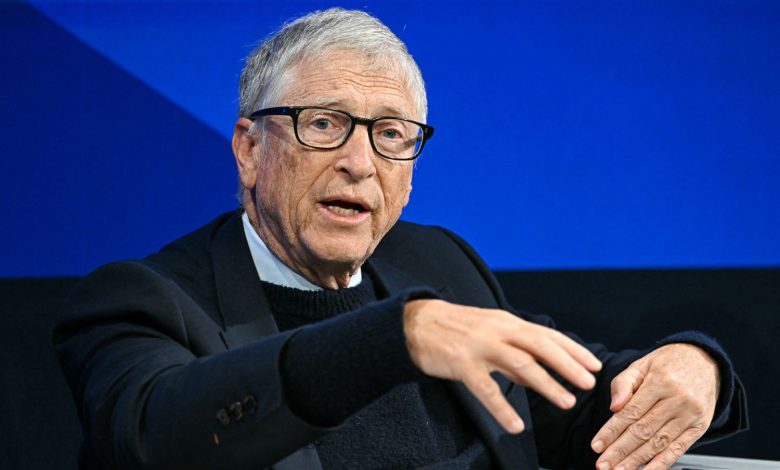
Speaking at the World Economic Forum in Davos this week, the Microsoft (MSFT) cofounder warned that AI’s impact on employment will be widespread within four to five years.
“Over the next four to five years, the impact of AI will become clearly visible not only on white-collar jobs but also on blue-collar jobs,” Gates said Tuesday. He added that governments aren’t prepared and must take “serious steps” to address growing inequality.
Last month, Gates cautioned that “a reasonable percentage” of today’s pricey AI stocks can’t justify their valuations. “Not all of these valuations will end up going up. Some of them will go down,” Gates told CNBC. “It’s going to be hyper-competitive.”
Gates’ concerns come as the so-called hyperscalers—Microsoft, Alphabet (GOOG), Amazon (AMZN), Meta Platforms (META), and Oracle (ORCL)—spent $400 billion on infrastructure in 2025 and are set to spend a third more in 2026.
Why This Is Important
The AI boom has been the driving force behind the stock market rally for much of the past three years. But the rally has faltered in recent months due to lofty valuations and concerns that tech giants are overspending on AI. Meanwhile, worries about the potential for widespread job losses from AI have grown.
Some investors worry the sheer size of those figures has encouraged speculation on Wall Street, causing some AI stocks to trade at eye-watering valuations.
Software firm Palantir (PLTR) has a price-to-earnings ratio of more than 400, one of the highest in the S&P 500. Shares of chip designers Broadcom (AVGO) and Advanced Micro Devices (AMD) have soared this year on hopes they can take market share from AI chip leader Nvidia (NVDA); those gains have nudged their PE ratios above 100, more than three times that of the S&P 500 as a whole.
Then there’s the cohort of unprofitable startups commanding lofty valuations in private markets. OpenAI, the company behind ChatGPT, isn’t expected to turn a profit before the end of the decade. Yet the startup was valued at $500 billion in October, which would make it the 16th largest public company in America.
The AI buildout has turbocharged the sales and profits of some companies, leaving their valuations relatively steady despite big stock gains. AI demand has accelerated growth in the cloud computing businesses of Alphabet, Microsoft, and Amazon, all three of which have PE ratios hovering around 30. Booming demand for Nvidia’s chips made it a $4.5 trillion company, but shares trade at a relatively modest 45 times earnings.
Bubble jitters have hit tech stocks several times since ChatGPT sparked the AI craze on Wall Street. In November, the Magnificent Seven nearly entered a technical correction. Less established competitors like Oracle (ORCL) and CoreWeave (CRWV) have performed even worse.
As with past pullbacks, investors shook off valuation concerns and bought the dip, lifting tech stocks out of their November slump, leading to new highs in the new year.
Stock valuations aside, Gate said he’s confident in AI’s potential to transform society and power advancements in health, education, and agriculture. AI, he said, “is a technology that’s deeply profound, that will reshape the world. There’s not the slightest doubt about that.”
At Davos, he announced a $50 million partnership between the Gates Foundation and OpenAI to deploy AI healthcare tools across 1,000 clinics in Africa by 2028.