Bond Market Alarm Bells Sounding

Blain’s Morning Porridge Feb 10th, 2026 – Bond Market Alarm Bells Sounding
“Feche le vache..”
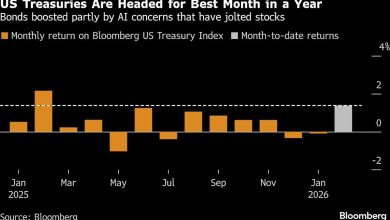
Did someone say Century Bond? What’s not to like about the bond market? Rates are going to fall! Everyone wants to buy credit (at historically tight spreads) and the biggest most successful firms on the planet are paying 70 cents over Treasuries for your money! What could possibly go wrong?
100-year Sterling bonds from Google? Wow. That’s…. interesting. (Ding, Ding, Ding…. Bond market alarms going off very loudly in my head.) Top of the market time?
What do the buyers of that Century bond know that we don’t? There are so many reasons not to buy a corporate Century bond – but clearly there is demand for them. I’ll come back to 100-year bonds below, but the succession of massive public (and private) AI Hyperscale debt deals to fund the datacentre build out has had my bond spidey-senses on edge for some time now.
Google’s century bonds y’day sent them into overdrive.
The sheer volume of debt being raised for AI is off the historical scale. There are estimates of $700-900 bln of funding to be raised by the Hyperscalers this year. Google raised $20 bln of its announced $185 bln 2026 funding ask yesterday. Oracle attracted a $130 bln order book for a recent $25 bln deal – despite many market analysts fearful of its weak financials, over-stretched debt profile, and reliance on OpenAI being able to pay the leases on its compute. Amazon and Microsoft are in the market funding as much as they can.
Some say $3 trillion will be raised over 5 years. It’s extraordinary, but apparently, it’s not a problem because these are some of America’s largest and most successful companies – what can possibly go wrong? (Why did Enron, WorldCom, WaMu and the big 3 Autos just flash through my memory?)
Recently I’ve written about the potential of a Corporate Bond Burp – not necessarily a complete credit meltdown, but a market that’s got ahead of itself that’s about to suffer chronic indigestion. The “Burp” is the warning it’s all about to happen – that the underlying assumptions behind a trade or a wider rally were mis-founded.
Reasons for suspecting a Bond-Burp is imminent include the circularity arguments around AI firms funding and backing each other through datacentre leases and compute, the historically tight credit spreads in the corporate markets, and multiple questions about what is supporting what in the complex debt ecosystem.
Should I be worried?
Corporate bond buyers are not daft. They are not equity stock pickers given to flights of financial fancy inspired by the rosy narrative’s CEOs like to spin. Fixed income analysts are intensely analytical and want to know exactly how they will be repaid interest and principal. They want dull, boring and predictable cash flows to back up their analysis. They don’t like whoosh or surprises. Every detail of how funds will flow to the debt provider will be intensely scrutinised on bespoke private credit deals – especially on the kind of complex data-centre leasing deals that are occurring off-balance sheet where the analysts will drill down through each tenant’s risk.
Certainty is the objective. (If you want to have fun at a party, avoid the bond guys, go make merry with the equity salesmen… they are a hoot.)
But…. when very, very clever people in the bond markets start to get excitable… that when you should get very worried indeed.
For all their care and caution, historically, bond buyers get it wrong. I’ve seen that repeatedly through my career, starting with the Great Perp Bond crash in 1986 right through to the CDO and RMBS tremblors that set off the Global Financial Crisis that began in 2007 – the consequences of which are still with us today! There are parallels between 2006 and today. The risks may be different, but what’s driving the exuberant excitement is the same.
There are all kinds of risk swirling round the current AI bubble – and some of them are in such plain sight they might be getting missed. When analysts are so focused on the fine detail of deals – it’s easy for them to miss the Elephant in Fridge.
The datacentre build-out and the associated energy infrastructure that will be required makes all kinds of assumptions like steady growth in demand, yet the technology will remain pretty much the same, and that cheaper, better, less energy intensive ways of getting to the same place won’t occur. Yet AI is intensely competitive – spurring new tech. While the USA is chasing LLMs, China is down the cheaper SLM open-weight AI route.
How many is too many datacentres? If AI starts closing down software companies, then how does that impact total demand? How vulnerable could the current leases on datacentres be to a cascading series of renegotiations? (Ever come across We-Work?)
The credit market is a complex beast. In recent days the SAS market has taken a massive tumble on fears Anthropic’s’ latest products will replace software firms. As a result, these firms’ bonds have been marked down, and debt deals in the pipeline have stalled. Suddenly these firms are reigning back commitments, including their own compute spending, which credit investors will be looking to hedge the rising risks of credit losses on these names. The result is a shift in risk appetite.
Do you invest more in AI as the future. Or…. is that the problem.
You need to make sure you are looking at the right thing. It reminds me of the story of the B-17 Flying Fortress Bomber in World War 2. The Germans were shooting lots of them down. American engineers looked at the battle damage on the ones that struggled home and analysed the bullet holes. They concluded the planes needed more armour where the holes were most concentrated.
One young chap said no! Look at where there is no damage – the ones coming home show where the damage is not critical. They re-examined the planes and spotted few planes came back with holes around the cockpit, the engines and the rear fuselage. They strengthened these areas, and the number of lost aircraft dropped. The tails stopped being shot off and putting a new chin-turret on the nose reduced head on attacks which killed the cockpit crew.
So…. what do we need to be looking at in the current bond market?
- We know there is plenty of liquidity feeding bonds in the expectation Donald Trump will get his way and interest rates will fall.
- We know that Scotty Bessent wants bond yields to fall so he can reduce the amount of money the US treasury is paying in interest on its Bonds and Bills.
- We know that although new Fed Chair designate Kevin Warsh was anti QE, the only way to get yields lower will be through “yield curve control”, which is QE by another name, to pull down rates.
When that happened in 2010 it triggered a massive rally in all financial assets, including credit bonds. Back then there was no inflationary spark in the markets. Now there is – if all the above happens, then the likely outcome will be inflation – the bond markets worst nightmare. Who wants to hold debt when inflation is eating into it?
Sidebar: 100-year bonds.
There is a buyer base for ultra-long bonds from insurance and pension funds, but it’s a small market. Buyers like duration – how sensitive bonds are to changes in rates, which is magnified in longer bonds. (Just take a look at the performance of the Austria Century Bonds to illustrate the risks.) As a credit play there are multiple reasons not to buy 100-year corporate bonds. Even AAA borrowers’ default, and the cumulative risk of default rises over time. The risk is lower for sovereign issuers – they are less prone to hostile acquisitions, their products being superseded and they own the printing presses. Few corporates survive 100 years in good shape. They rise and fall, and as they do the chance of a default increases exponentially! (Moody’s publish very good tables showing cumulative default rates.)
Out of time and back to the day job… anyone want to fund a datacenter?
Bill Blain
Author of the Morning Porridge
Advisor – Spitfire Strategic Capital