BRICS nations control 50% of the global gold reserves. What does it mean for the US Dollar?
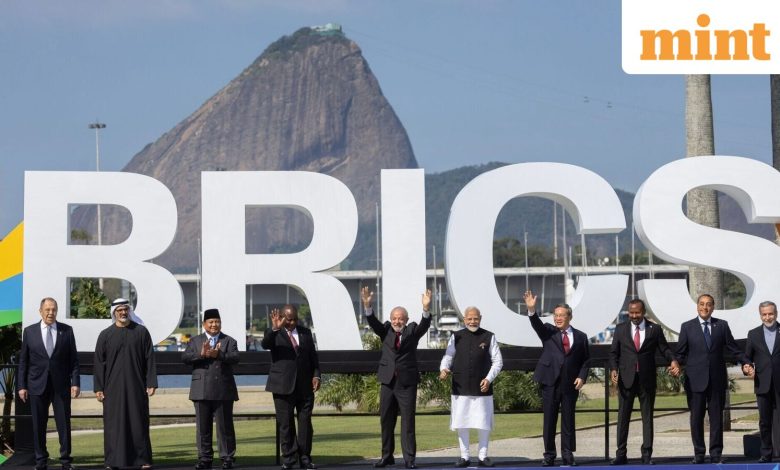
BRICS — a significant economic bloc of emerging nations comprising Brazil, Russia, India, China, and South Africa — is fast shifting its reliance on the US Dollar to gold through the accumulation of the precious metal. Although officially BRICS nations hold around 20% of the global gold reserves, they, along with their strategically allied states (who are not BRICS members but have strong ties with BRICS member countries), now collectively hold around 50% of the global gold production.
BRICS gold reserve
Russia and China are leading from the front in this strategy. In 2024, China produced 380 tonnes of gold, while Russia contributed 340 tonnes. Following this strategy, in September 2025, Brazil purchased 16 tonnes of gold, marking its first gold purchase since 2021.
Explaining the dual strategy of BRICS member countries, Anuj Gupta, Director at Ya Wealth, said, “BRICS member countries are both producing more gold and selling less. At the same time, they are also purchasing gold from the international market. According to existing data, between 2020 and 2024, the Central Banks of the respective BRICS nations purchased more than 50% of the global gold, information that US President Donald Trump may not like to hear.”
What lies behind this BRICS dual strategy?
Decoding this BRICS dual strategy on gold, Sachin Jasuja, Head of Equities and Founding Partner, Centricity WealthTech, said, “The increasing control of gold reserves and gold purchases by BRICS nations is emerging as a meaningful signal of stress within the US Dollar-dominated global financial order. While the US Dollar remains the world’s primary reserve currency, recent developments suggest that its uncontested supremacy is being gradually questioned rather than abruptly challenged.”
Today, BRICS economies account for nearly 30% of global trade, giving their collective monetary choices global relevance. A long-standing objective of the bloc has been to reduce its reliance on Western financial infrastructure, particularly the US dollar, for trade settlement and reserve purposes.
Trigger for this shift
Highlighting the developments that led to the germination of this shift in BRICS member nations’ thinking, Jasuja added, “The decisive shift in thinking followed the Russia–Ukraine war, when Western governments froze a substantial portion of Russia’s foreign exchange reserves. This episode fundamentally altered how sovereign nations perceive reserve safety. It demonstrated that reserves held in dollar-denominated assets or foreign jurisdictions are exposed to geopolitical risk if political alignment breaks down. Since then, reserve management has increasingly prioritised assets that are politically neutral, physically held, and immune to external control.”
Sachin Jasuja said that BRICS central banks have been among the most aggressive buyers, with China, Russia, and India now ranking among the world’s largest official gold holders. As a result, gold’s share in BRICS foreign exchange reserves has steadily increased, while exposure to dollar assets has moderated at the margin. This reserve shift has coincided with a sharp and sustained rally in gold prices, reflecting not only inflation hedging but also strong official demand. The price action suggests markets are increasingly recognising gold’s renewed role as the ultimate reserve asset in a fragmented financial system—one where trust in reserve currencies is no longer unconditional.
BRICS reducing dependence on the US Dollar
“BRICS nations have been actively reducing dollar dependence in trade. Over the past decade, the share of intra-BRICS trade settled in local currencies has risen steadily, with roughly one-third of such trade now bypassing the dollar. Bilateral arrangements—such as India–Russia and China–Brazil trade in local currencies—illustrate a pragmatic shift aimed at lowering transaction costs, reducing exposure to sanctions, and limiting dependence on dollar liquidity cycles,” said Jasuja.
How will this strategy work?
Asked about the outcome of this dual strategy on gold adopted by BRICS members and their allied states, Ponmudi R, CEO at Enrich Money, said, “BRICS influence is clearly rising in annual gold production, with member and aligned countries accounting for close to half of the new global supply. This distinction matters because control over future supply enhances strategic flexibility without implying immediate dominance over the global monetary system. The recent acceleration in gold purchases by BRICS central banks should be seen primarily as a risk-management and diversification strategy. Gold is a neutral, sanction-resistant asset, and recent geopolitical developments have led many emerging economies to reassess reserve concentration risks.”
Challenge for BRICS gold-backed currency?
The Enrich Money expert stated that the recent acceleration in gold purchases by BRICS central banks should be viewed primarily as a risk-management and diversification strategy. Gold is a neutral, sanction-resistant asset, and recent geopolitical developments have led many emerging economies to reassess the risks associated with holding their reserves in this asset.
“Real structural contest is not gold alone, it is the petrodollar system, trade realignments, and rising import tariffs. China’s strategic push toward electric vehicles, renewable energy, and reduced dependence on fossil fuels is part of a broader effort to rewrite global trade and energy rules, reducing long-term exposure to dollar-linked commodity pricing,” Ponmudi R said.
“BRICS’ growing gold accumulation does not signal the end of the dollar’s role, but it does mark a credible structural shift toward a more diversified and multipolar global financial system—one in which gold is quietly reclaiming its role as the ultimate anchor of monetary trust,” Sachin Jasuja concluded.
Disclaimer: This story is for educational purposes only. The views and recommendations above are those of individual analysts or broking companies, not Mint. We advise investors to check with certified experts before making any investment decisions.